Is Distance Education Degree Valid in India?
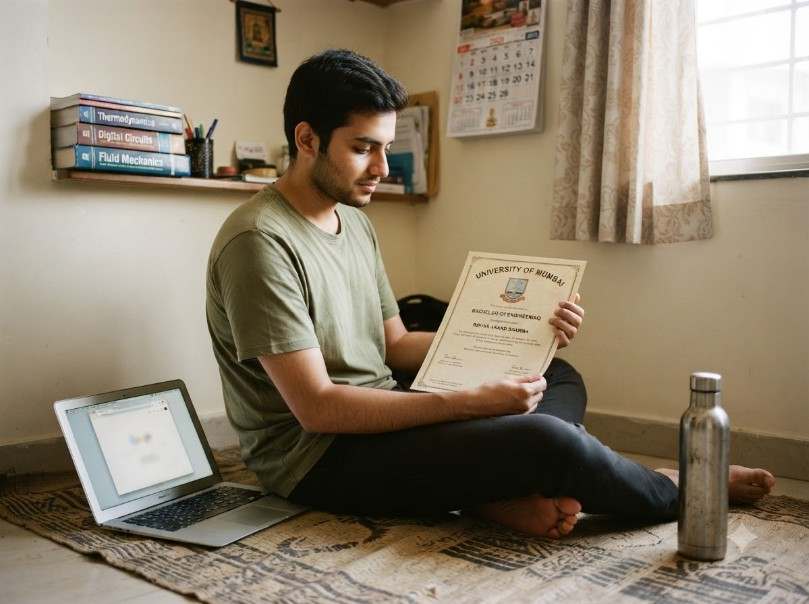
Yes, if your university is UGC-DEB approved for that exact course and session — here's exactly how to check before you pay a single rupee.
Key Takeaways
- Yes, a distance education degree is valid in India — but only if the university is UGC-DEB approved for that specific course and that specific academic session.
- A DEB ID is now compulsory. Since the 2025-26 session, you must create an APAAR (ABC) ID first, then a DEB ID, before your admission counts as valid — no exceptions except foreign students.
- The claim that the Supreme Court fully approved distance degrees is oversimplified — courts have ruled both ways depending on the job and the course.
- Some courses are permanently banned from distance mode — engineering, medicine, nursing, law, and pharmacy top that list, no matter which university offers them.
- Verification takes two minutes on deb.ugc.ac.in, and skipping it is the single biggest mistake students make.
This question comes up almost every week from someone in Kota, a Tier-2 town, or a working professional in Delhi trying to finish a degree while holding down a job. The honest answer isn't a flat yes or no — it depends on three things that most articles skip over entirely.
Those three things are which university you pick, whether that exact course is on the approved list for your admission year, and whether you actually complete the DEB ID registration before you pay your fees. Miss any one of these, and a 'valid' degree can turn into a rejected application at the worst possible moment — during a government job interview.
Dozens of students have been walked through this exact verification process — this article shows precisely how to do it, plus the court rulings that most articles get wrong.
Is a Distance Education Degree Valid in India?
A distance education degree is valid in India if it's awarded by a university that holds UGC-DEB (Distance Education Bureau) approval for that specific course during your admission year. The UGC's 2020 Open and Distance Learning Regulations state that degrees from DEB-entitled institutions carry the same value as regular degrees for employment and higher education.
In plain terms: it's not the university's overall reputation that matters, it's whether your specific course — say, BA in Political Science or MBA in Finance — appears on the DEB's approved list for the year you enrolled. Universities can lose or gain approval for individual courses year to year, so a friend's 2022 MBA being valid doesn't guarantee a 2026 MBA from the same university is automatically fine too.
Is Distance Education Degree Valid for Government Jobs?
Yes, a UGC-DEB approved distance education degree is valid for government jobs in India, including central and state government recruitment. Government job notifications requiring a bachelor's or master's degree accept distance and open-learning degrees as long as the awarding university held DEB entitlement for that course in the admission year.
Practically, if a government job lists 'Bachelor's degree from a recognised university' as the eligibility criteria, a distance BA, BCom, or BSc from a DEB-approved university satisfies that requirement. Students have cleared document verification rounds for state government clerk posts using exactly this kind of degree, with zero pushback once their DEB approval printout was in hand.
The catch: some specific government departments and specialized posts — police sub-inspector physical roles, certain teaching cadre posts, and a few technical departments — set their own additional eligibility rules beyond 'any recognised degree.' Always read the specific job notification's eligibility section line by line, not just the general degree requirement.
Is Distance Education Degree Valid for UPSC?
Yes, a distance education degree from a UGC-recognised university is valid for UPSC exams, including the Civil Services Examination. UPSC's eligibility criteria require a degree from a university 'incorporated by an Act of the Central or State Legislature' or one 'recognised as an equivalent by the Government' — and UGC-DEB approved distance degrees fall squarely within that definition.
Many working professionals prefer this route specifically because it lets them prepare for UPSC prelims and mains while completing their graduation part-time — for example, finishing an IGNOU BA while working a day job and studying for UPSC in the evenings.
A genuinely useful tip: if you're eyeing UPSC, pick a subject for your distance BA that overlaps with a potential optional subject (History, Political Science, Sociology, Public Administration), so the degree coursework doubles as exam preparation instead of being a separate, disconnected task.
Is Distance Education Degree Valid for Assistant Professor Posts?
This is where it gets genuinely complicated. A distance education master's degree can make you eligible for Assistant Professor posts if it meets UGC's specific qualification norms for teaching positions, but many universities and recruiting bodies additionally require NET/SET/SLET qualification regardless of how the master's degree was earned.
Eligibility for teaching roles is determined by a combination of three things: the master's degree being from a DEB-approved program, a NET or equivalent qualifying exam score, and — the part people miss — some university-level teaching recruitment boards have historically been stricter about distance-mode master's degrees for teaching posts specifically, even when the degree is otherwise valid everywhere else. It depends heavily on the specific university's own recruitment rules, so a distance master's alone should never be assumed to clear the bar — verify with the specific institution's recruitment cell before enrolling with that goal in mind.
Is Distance Education Degree Valid for SSC CGL?
Yes, a UGC-DEB approved distance education degree is valid for SSC CGL and other Staff Selection Commission exams. SSC's eligibility criteria for graduate-level posts accept degrees 'from a recognised University or equivalent,' and this includes distance and open-learning degrees from DEB-entitled institutions.
For students preparing for SSC CGL while working or living in areas without easy college access, an ODL degree from a state open university or IGNOU is often the most practical route — low fees, minimal campus attendance requirements, and full SSC eligibility once completed. Just make sure the specific course was DEB-approved during the enrollment year, because SSC document verification teams do check this against the official list.
Is Distance Education Degree Valid for Bank Jobs?
Yes, a UGC-DEB approved distance education degree is valid for bank jobs, including IBPS PO, IBPS Clerk, SBI PO, and other banking recruitment exams. Banking exam eligibility criteria generally require 'a degree from a recognised university,' and distance degrees from DEB-approved institutions satisfy this requirement in the same way a regular degree does.
Is a Distance Education Degree Valid Outside India? (UAE, Saudi Arabia, Kuwait, UK)
A UGC-DEB approved Indian distance education degree's validity outside India depends entirely on the destination country's own credential evaluation process — it is not automatically recognised the way it is domestically. Gulf countries like the UAE, Saudi Arabia, and Kuwait typically require degree attestation through the Ministry of External Affairs (MEA), followed by embassy attestation, and some employers there specifically prefer full-time regular degrees over distance ones for visa and labor ministry approval purposes.
For private-sector jobs in the Gulf, many employers do accept a DEB-approved Indian distance degree as long as it clears the standard attestation chain (HRD/MEA attestation, then embassy attestation, then sometimes an additional equivalency check by that country's Ministry of Education). But for UK higher education admissions or professional licensing, universities and professional bodies often run the degree through a separate credential evaluation service like UK ENIC (formerly NARIC), and distance degrees sometimes get evaluated more cautiously than campus-based ones, depending on the specific university's classification.
If planning to work or study abroad after a distance degree, don't assume — contact the specific country's education ministry or the employer's HR department directly and ask what attestation and evaluation process they require for the exact university and course, well before finishing the program.
The Court Cases Nobody Explains Properly
Almost every article on this topic states that 'the Supreme Court in 2022 ruled that distance degrees are equal to regular degrees' and leaves it there. That's not accurate — here's the real picture, case by case.
- In 2022, the Delhi High Court ruled in favor of nursing officers who held IGNOU distance-mode BSc degrees, when AIIMS tried to disqualify them from an MSc Nursing admission purely because of their mode of learning. The court said AIIMS couldn't invent its own stricter rule when the Indian Nursing Council had already recognised those distance degrees as valid.
- In 2021, in Devender Bhaskar vs State of Haryana, the Supreme Court ruled the opposite way for a different case — it held that a diploma earned through distance mode could not automatically be treated as equal to one from regular classroom study, and said equivalence is a policy decision for the recruiting authority, not something courts should assume.
- In 2023, the Supreme Court reaffirmed that same position in a case involving an 18-month distance-mode teaching diploma, again ruling it wasn't automatically equal to a 2-year regular diploma for a specific teaching post.
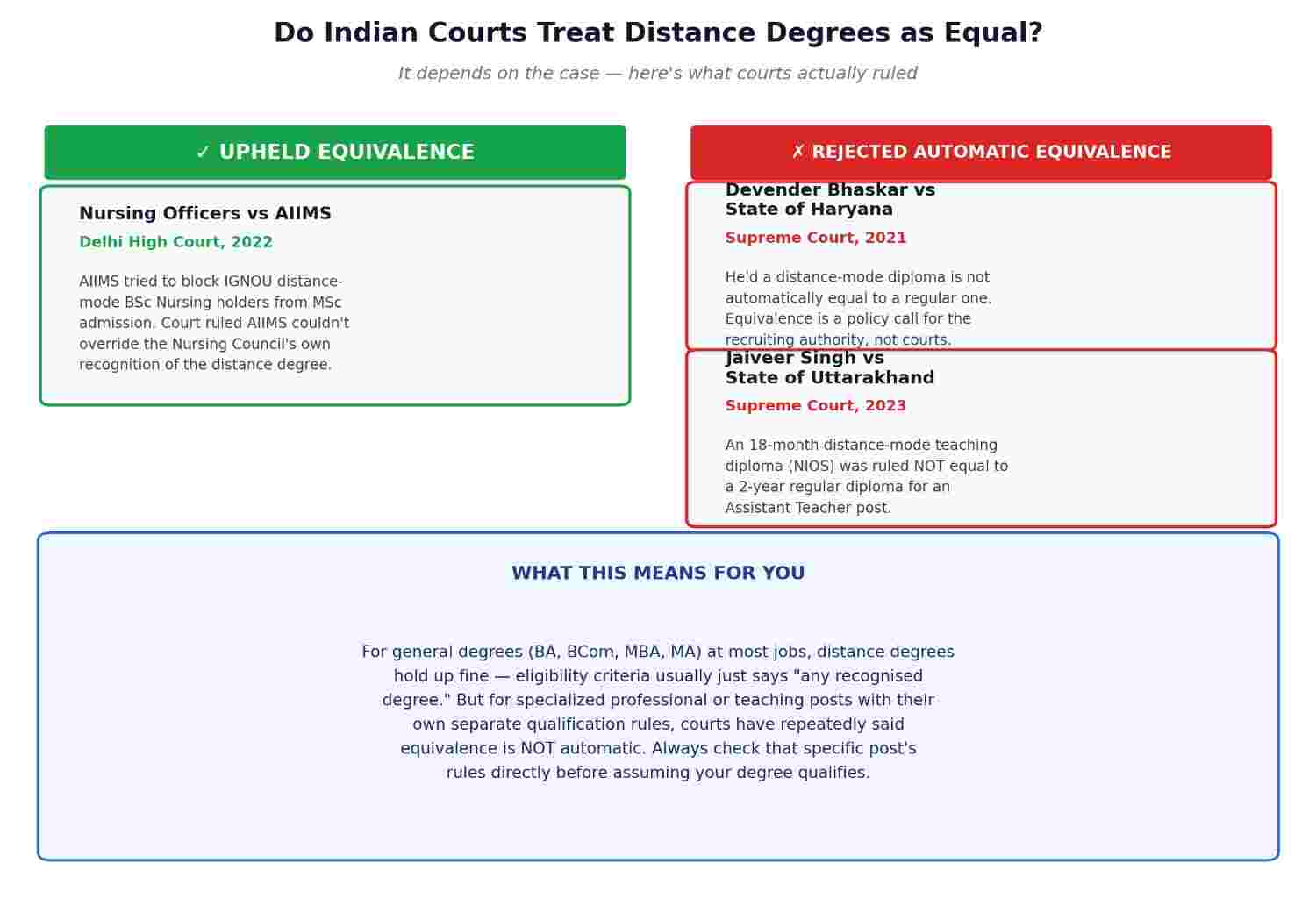
Courts don't apply one blanket rule to every distance degree everywhere. They look at what the recruiting authority's own rules say, what the specific regulatory body (like the Nursing Council or a State Education Department) has already approved, and whether the distance version genuinely covers the same practical training as the regular version.
For general degree requirements (BA, BCom, MBA, MA) at most jobs, distance degrees hold up fine because the eligibility criteria just says 'any recognised degree.' But for specialized professional or teaching posts with their own separate qualification rules, don't assume equivalence — check that specific post's rules directly.
How to Check If Your University Is UGC-DEB Approved (Step by Step)
Here is the exact process to follow before paying a single rupee to any distance education program.
- Go to the official DEB portal at deb.ugc.ac.in — never trust a university's own claim of 'UGC approved' without checking here directly.
- Click on 'Entitled Institutions' for the current academic session (2025-26 or 2026-27, depending on when you're enrolling).
- Search for your exact university name and confirm it appears on the list for that specific year.
- Check that your specific program is listed — a university being approved for BA doesn't automatically mean its MBA or BCA is also approved.
- Create your APAAR ID (ABC ID) at abc.gov.in using your Aadhaar and registered mobile number, if you don't already have one.
- Generate your DEB ID on the DEB portal using your APAAR ID — this step is now compulsory for every ODL and online learner starting the 2025-26 session, except foreign students.
Courses You Can NEVER Do Through Distance Mode
Certain professional courses are permanently barred from distance and online delivery in India because they legally require hands-on practical or clinical training that can't be replicated remotely. This rule applies no matter how reputable the university claims to be.
| Course Category | Examples | Why It's Banned |
|---|---|---|
| Engineering (undergraduate) | B.Tech, B.E. | Requires lab work and AICTE-mandated practical training |
| Medical & Allied Health | MBBS, BDS, BAMS, BUMS, BHMS | Requires clinical rotations and patient contact |
| Nursing (undergraduate) | B.Sc Nursing (regular entry) | Requires supervised clinical practicum hours |
| Law | LLB, integrated law degrees | Requires moot court and practical training components |
| Pharmacy | B.Pharm, D.Pharm | Requires laboratory and dispensing practical work |
If any university offers these specific courses through pure distance or online mode with no campus component, that's an immediate red flag — such degrees will not be recognised for licensing, government jobs, or further studies in that field, regardless of what the marketing material claims.
Distance Education Coaching Centres: What They Actually Do
In cities like Kota, Delhi, and other education hubs, local coaching and counselling centres have built a whole business around helping students navigate distance education admissions. These centres typically partner with a handful of DEB-approved universities (state and private alike), help students shortlist a course, handle admission paperwork, and sometimes provide local exam centers or study support closer to home.
If you're comfortable navigating the DEB portal, comparing university fee structures, and handling your own admission form, you can do all of this yourself at zero extra cost. A local centre genuinely helps students who need physical exam centers closer to their town, or who want someone to double-check university choice and paperwork rather than doing it solo — just make sure any centre you go through can show you the DEB-approved status of the specific university and course they're recommending, not just tell you it's 'valid.'
Real Examples of People Who Used Distance Degrees
A working professional's promotion path: several bank employees have completed a distance MBA specifically to become eligible for internal promotion to officer-level cadre — their banks accepted the DEB-approved distance MBA exactly the same as a regular one for internal eligibility criteria.
A government job aspirant from a Tier-3 town: one student completed her BA through a state open university while simultaneously preparing for state-level government exams, since her town had no regular college offering her preferred subject combination. She has since cleared a state government clerical exam, with her distance degree accepted without a single question during document verification.
The nursing officers who fought and won: the 2022 AIIMS case wasn't abstract — it involved real in-service nursing officers who had already been working in the field for years, using their IGNOU distance BSc to try to advance into an MSc Nursing program, only to be blocked by an eligibility rule AIIMS invented on its own. Their win at the Delhi High Court is a useful precedent for anyone in a similar regulated profession facing an institution's arbitrary mode-of-study bias.
About the Author
Kush Verma is a Software Engineer, Teacher & Principal Editor, and Researcher at UKTU, with a background in Computer Science Engineering and full-stack development. He writes about software engineering, educational frameworks for readers seeking practical, fact-checked guides, drawing on a strict four-stage editorial process of primary research, technical validation, editorial refinement, and continuous auditing.
Frequently Asked Questions
Is distance education degree valid for UPSC exams?+
Yes, a UGC-recognised distance education degree meets UPSC's eligibility criteria, which requires a degree from a university incorporated by legislature or recognised as equivalent by the government. Many working professionals specifically choose distance BA programs to prepare for UPSC while continuing their job.
Is a distance education MBA valid for jobs in the private sector?+
Yes, private companies across IT, finance, FMCG, and management roles generally accept UGC-DEB approved distance MBAs, though the hiring company's own policy and the reputation of the specific university can influence how it's weighed against candidates with regular MBAs. It's most useful for working professionals seeking internal promotions or career pivots rather than fresh campus placements.
Can I do an assistant professor job with a distance master's degree?+
It depends on the specific recruiting university's rules — some accept a DEB-approved distance master's alongside a valid NET/SET score, while others prefer regular master's degrees for teaching posts specifically. Always confirm directly with that university's recruitment cell before assuming eligibility.
Is IGNOU degree valid for government jobs in India?+
Yes, IGNOU is a central university established by an Act of Parliament, and its UGC-DEB approved degrees are valid for central and state government job eligibility across India. It's one of the most widely accepted distance education providers precisely because of this parliamentary backing.
What is a DEB ID and do I really need one?+
A DEB ID is a mandatory unique identification number every distance and online learner must generate on the UGC-DEB portal before their admission is considered valid, effective from the 2025-26 academic session onward. Skipping this step, even if your university is DEB-approved, can leave your specific admission unverified in official records.
Is a distance education degree valid in Saudi Arabia or the UAE for a job?+
It depends on proper document attestation (MEA and embassy attestation) and the specific employer's own hiring policy, since Gulf countries don't automatically extend India's domestic UGC-DEB recognition. Private-sector employers are generally more flexible than government-linked roles or professional licensing bodies in these countries.
Which courses are not allowed through distance education in India?+
Engineering, medicine and allied health sciences, nursing (undergraduate entry-level), law, and pharmacy cannot be offered through distance or online mode because they require mandatory hands-on clinical or practical training. Any university claiming to offer these fully online should be treated as a red flag.