LLB Course in Distance Education: What Every Student Must Know

LLB in distance mode is not recognised by the Bar Council of India for law practice — here's what actually works instead, explained simply.
Key Takeaways
- A distance or online LLB degree cannot make you an advocate in India — the Bar Council of India (BCI) does not recognise it, full stop.
- IGNOU, the biggest distance university in India, does not even offer an LLB — it only has diplomas and certificate courses in law.
- Some private institutes still sell 'distance LLB' programmes for ₹75,000 to ₹2.5 lakh. Legally, this paper is close to worthless for court practice.
- If you want to practice law, you must join a regular, on-campus LLB — either 3 years (after graduation) or 5 years (after Class 12).
- If you just want legal knowledge for a job (HR, compliance, contracts), a UGC-approved diploma or certificate in law is the honest, useful distance option.
I recall a student named Ankit who messaged me one Sunday night, panicking. Ankit had already paid ₹40,000 to an institute for a 'distance LLB', only to later find out it wouldn't let him become a lawyer. This article works through the topic slowly, in plain language, to prevent that from happening to others.
What Is an LLB Course in Distance Education?
LLB stands for Legum Baccalaureus, Latin for Bachelor of Laws — the basic degree needed before someone can call themselves a lawyer in India.
Distance education means not attending daily classes on campus. Instead, students study from home, receive material by post or online, and appear for exams at set centres — the same way IGNOU teaches a B.A. or B.Com.
So a 'distance LLB' is a law degree studied mostly at home without a physical classroom every day. That sounds convenient — no travel, no fixed timetable, self-paced study. But the law regulator in India does not accept this mode of study for practicing law, and that single fact changes everything about whether it's worth pursuing.
Is LLB Through Distance Education Even Legal in India?
The short answer: you can enrol in a distance LLB programme (some private colleges still sell it), but the degree you get will not let you practice law in Indian courts.
The body that decides this is the Bar Council of India (BCI), set up under the Advocates Act, 1961. The BCI acts as the gatekeeper — it decides who is allowed to call themselves an advocate and argue cases in court. Its position on distance legal education is unambiguous and unchanged: the BCI does not recognise LLB degrees earned through distance, correspondence, online, part-time, or evening study for the purpose of enrolling as an advocate.
This is the single most important fact in this entire topic, which is why it's repeated in different words throughout this article.
Why Did the BCI Ban Distance LLB?
Law isn't a subject that can be learned only from a textbook, which is the core reasoning behind the ban.
- Moot courts: Students practice mock trials, arguing both sides of a case in front of judges (usually senior faculty) — this can't be faked over a video call.
- Court visits and internships: A good LLB program sends students to real courtrooms to watch live proceedings, which is how courtroom behaviour is actually learned, not from a PDF.
- Mandatory attendance: The BCI requires a minimum of 70% attendance for all law students in BCI-approved institutions — a number that's almost impossible to track or enforce in a purely distance format.
This is also why law is treated more like medicine or engineering than like a B.A. or B.Com — it's a practice-based professional degree, not a purely theoretical one. The BCI has decided hands-on training is non-negotiable.
Is LLB From Distance Possible?
You can find institutes willing to enrol you in a distance LLB. What you cannot get from it is BCI recognition.
A distance, correspondence, or online LLB lacks recognition from the Bar Council of India, which means holding this degree does not grant eligibility to practice law in India or to take the mandatory All India Bar Exam (AIBE) — the exam every fresh law graduate must clear before they can practice.
So it's technically 'possible' — you can enrol and get a certificate — but practically not useful if the goal is to stand up in court one day. That gap between 'possible' and 'useful' is where most confusion, and most wasted money, comes from.
Is There Any 1-Year LLB Course?
No. An LLB — whether the 3-year version (after a bachelor's degree) or the 5-year integrated version (straight after Class 12) — cannot legally be compressed into one year.
Any ad for a '1-year LLB' or 'LLB in 6 months' should be treated as a red flag, not a shortcut. What might genuinely exist in 1 year is a postgraduate diploma or certificate course related to law — useful for knowledge, but not an LLB degree, and not a path to becoming an advocate.
Can I Do LLB Without Going to College?
No — not if the degree needs to count for legal practice. The BCI's 70% attendance requirement in BCI-approved institutions exists specifically to stop LLB from becoming a 'study from your bedroom' degree.
A common mistake is assuming that because other degrees (B.A., B.Com, even some MBAs) can now be done fully online, law must have caught up too. It hasn't, and the regulator has been consistent about this for years — this isn't a temporary Covid-era rule that eventually got relaxed.
Can We Do a 3-Year LLB Online?
No legitimate, BCI-recognised university offers a fully online 3-year LLB in India. Even online programs offered by otherwise reputed universities do not meet the BCI's requirement for physical attendance, moot courts, and clinical legal education.
A website advertising a '3-year online LLB, no attendance needed' should be treated with suspicion — it's either a diploma marketed misleadingly as an LLB, or a private 'university' with no real BCI standing.
Who Actually Offers "Distance LLB" and What Are You Really Buying?
IGNOU — the country's biggest open university — does not offer an LLB at all. IGNOU doesn't provide an LLB course, as LLB courses can't be done in distance mode education according to BCI rules. What IGNOU does offer is a set of law-related diplomas and certificates — such as a Post Graduate Diploma in Intellectual Property Rights, or a Certificate in Cyber Law — genuinely useful, just not an LLB.
So who is selling 'Distance LLB'? Mostly private institutes and some private universities operating through their distance-education wing. Since a Distance LLB degree is not recognised by the BCI, no government institutions provide the programme — but some private entities still offer it, with fees typically ranging from around ₹75,000 to ₹1.8 lakh, going up toward ₹2.5 lakh once 'placement assistance' and study kits are added.
The honest picture of what you get for that money: a printed degree certificate, some study material, and in most cases zero pathway to the courtroom.
What You CAN Legally Study in Distance Mode Instead
If the real goal isn't 'become a courtroom lawyer' but 'understand law well enough to build a career', distance education still has real value — with the right product.
- Certificate and diploma programs in law: IGNOU offers programs such as PGDIPR (Intellectual Property Rights), PGDCJ (Criminal Justice), DIPP (Paralegal Practice), and PG Certificate in Cyber Law, all through flexible distance learning, with fees around ₹8,000 to ₹10,800.
- Compliance and paralegal training: builds exactly the knowledge companies actually hire for — labour law, contract law, IP basics — without pretending to replace a law degree.
- UPSC and state PSC legal-knowledge prep: a law diploma genuinely helps here, since several government exams test legal awareness without requiring a practicing advocate.
This route is arguably undersold. A well-chosen diploma, done alongside a regular job, can open doors in HR, compliance, and legal-process-outsourcing roles that many 'LLB but not enrolled with the Bar' graduates never manage to unlock, simply because the diploma is honest about what it is.

Distance LLB vs Regular LLB vs Legal Diploma: Full Comparison
The comparison below is judged on four things: BCI recognition, real cost, time, and what job or right it unlocks at the end.
| Feature | Distance/Online LLB | Regular (On-Campus) LLB | UGC Law Diploma/Certificate |
|---|---|---|---|
| BCI recognised? | No | Yes | Not applicable (not a law-practice degree) |
| Can you become an advocate? | No | Yes, after clearing AIBE | No |
| Duration | 3 years (unofficial) | 3 years (after grad) or 5 years (after Class 12) | 6 months to 2 years |
| Typical fees | ₹75,000 – ₹1.8 lakh | ₹20,000 – ₹40,000 per year (govt colleges) to much higher in private ones | ₹8,000 – ₹10,800 |
| Attendance required | Rarely enforced | Minimum 70% mandatory | Flexible |
| Best suited for | Honestly, almost no one | Anyone who wants to practice law or join the judiciary | Working professionals wanting legal knowledge for their current job |
The row worth staring at longest is 'Can you become an advocate?' — everything else in the table is secondary to that single answer.
My Honest Take: Who Should (and Shouldn't) Consider This
If your dream is to fight cases, become a judge one day, or join a law firm as a practicing lawyer, a distance LLB is close to a dead end. The author would not recommend it to his own younger cousin, and has said exactly that to more than one student who called after already enrolling.
If you're a working professional in HR, compliance, banking, or a government job, and you just want to understand law better without switching careers, a distance diploma is genuinely worth it. It depends heavily on the actual goal — that's the honest, non-symmetric truth of this topic.
The advice to push back hardest on is 'do the distance LLB now, upgrade to regular later.' In the author's experience, that 'later' rarely comes, and the fees paid upfront rarely get refunded.
How to Actually Become a Lawyer in India — Step by Step
If practicing law is genuinely the goal, here is the real, working path.
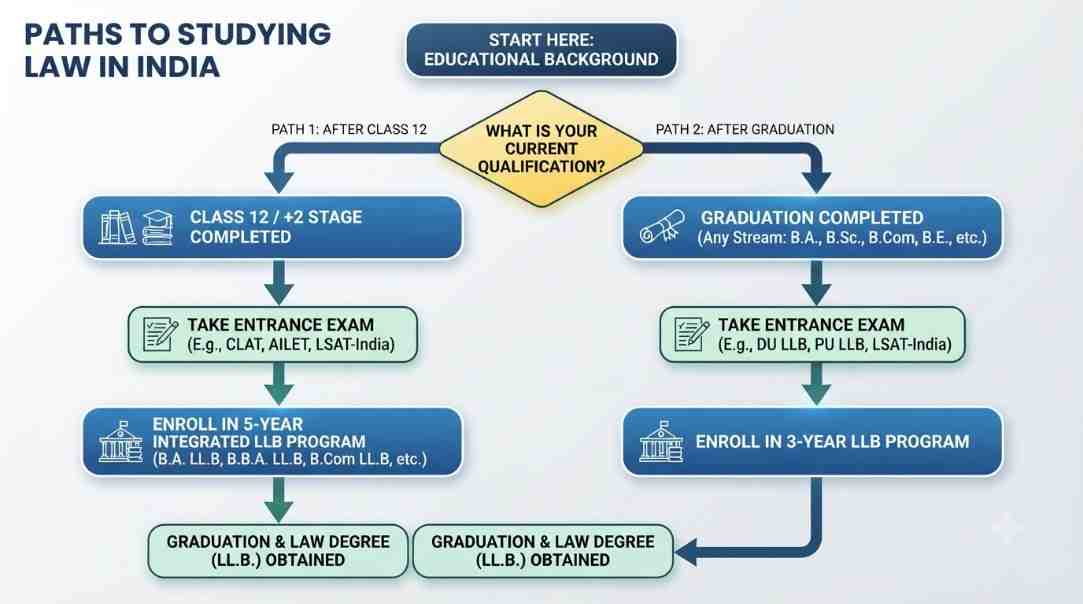
- Choose your entry point. After Class 12, go for a 5-year integrated course like BA LLB, BBA LLB, or BCom LLB. After graduation in any stream, go for the 3-year LLB.
- Clear an entrance exam. Top national-level options include CLAT, LSAT India, and AILET, plus university-specific ones like DU LLB or state exams such as MH CET Law and TS LAWCET.
- Confirm the college is BCI-approved before you pay any fee.
- Attend regularly and take moot courts seriously — the 70% attendance rule isn't a formality; miss it and you can be barred from sitting your exams.
- Do internships every summer. Courts, law firms, or NGOs — real experience matters more here than in almost any other undergraduate degree.
- Graduate and register with your State Bar Council.
- Clear the AIBE (All India Bar Exam) — the final gate before you can legally practice.
Real Stories: Three People, Three Different Paths
Priya, a bank employee in her early 30s, wanted to move into her bank's compliance department. She enrolled in a one-year PG Diploma in law through distance mode, kept her job, and got the compliance role within eight months of finishing. She never once needed Bar Council enrolment — the diploma was exactly the right tool for her actual goal.
Ankit, the student mentioned at the start of this article, enrolled in a private 'distance LLB' advertised heavily on social media, paid ₹40,000 upfront, and only discovered the BCI recognition problem when he tried to register as a law intern at a local court. He eventually had to start over with a regular 3-year LLB, effectively losing a year and the money.
Meera, a Class 12 student, came to the author confused between a 5-year integrated BA LLB and 'waiting and doing distance LLB after graduation to save money.' Once she understood the recognition issue, she chose the 5-year regular route straight after school — it's now saving her a full year compared to the graduate-then-LLB path, and she's doing her second moot court this semester.
Three very different people, three very different needs — and in every case, the right choice came down to being honest about what they actually wanted at the end.
Frequently Asked Questions
Is LLB from distance possible?+
You can technically enrol in a distance LLB through some private institutes, but it won't be recognised by the Bar Council of India. This means you can hold the certificate but still won't be able to practice law or take the AIBE.
Is there any 1-year LLB course?+
No. Regular LLB is either 3 years (after a bachelor's degree) or 5 years (after Class 12) — it cannot legally be shortened to one year. Any 1-year 'LLB' offer is most likely a diploma being marketed misleadingly.
Can I do LLB without going to college?+
No, not for a BCI-recognised degree. The Bar Council requires a minimum 70% classroom attendance, along with moot courts and practical training that can't be done from home.
Can we do a 3-year LLB online?+
No BCI-approved university currently offers a fully online 3-year LLB in India. Even reputed universities' online law offerings don't meet the BCI's attendance and clinical-training requirements.
Does IGNOU offer an LLB course?+
No. IGNOU offers only diploma and certificate courses in law (like Cyber Law or Paralegal Practice), not a full LLB degree, because BCI rules don't allow LLB in distance mode.
Is B.L. (Bachelor of Legislative Law) the same as LLB and can it be done via distance?+
B.L. is essentially another name for LLB used by a few universities, and it carries the exact same BCI recognition rules — so it faces the identical distance-education restriction.
Can I use a distance LLB degree for a government job that isn't in law practice?+
Sometimes, for roles that need general legal awareness rather than Bar enrolment, but many recruiters still specifically ask for a regular, BCI-recognised degree, so always check the exact eligibility notice before applying.
Final Word
The key thing to remember is the difference between a degree that sounds like law and one that actually works like law. A distance LLB gives you the first; only a regular, BCI-approved LLB gives you the second.
The honest recommendation: if courtroom practice is the goal, save yourself the detour and go straight for a regular LLB, even if it means a slightly longer wait to start. If you just need legal knowledge for the career you already have, a proper distance diploma will serve you far better than a distance LLB ever could — for a fraction of the cost too.
Whatever you choose, don't sign up for anything before checking the institute's BCI status yourself. That one habit alone can save you the kind of stress Ankit went through.
About the Author
Kush Verma is a Engineer, Teacher & Principal Editor, and Researcher at UKTU, with a background in Computer Science Engineering and full-stack development. He writes about software engineering, educational frameworks for readers seeking practical, fact-checked guides, drawing on a strict four-stage editorial process of primary research, technical validation, editorial refinement, and continuous auditing.