Science Training Programme: The Complete 2026 Guide to Types, Benefits, and How to Choose One
Science Training Programme: The Complete 2026 Guide to Types, Benefits, and How to Choose One
'Science training programme' sounds like it should mean one specific thing, but it doesn't. Search for it and you'll find a school science fair pipeline, a government agency's internal scientific upskilling plan, a university's clinical research fellowship, a teacher leadership placement, and a five-day university immersion course for high schoolers — all legitimately calling themselves a science training programme. That's not a flaw in the term. It reflects how broad and fragmented the actual landscape of structured scientific training has become, which is exactly why most people who could benefit from one never find the right fit.
The stakes for getting this right are larger than they look. The U.S. Chamber of Commerce estimates that 3.5 million STEM jobs will go unfilled due to skills gaps, concentrated in cybersecurity, data science, and advanced manufacturing, while roughly 1.9 million STEM job openings are posted every month. That gap isn't primarily a shortage of interest — it's a shortage of structured pathways that take someone from curiosity or a raw degree into applied, job-ready scientific capability. A well-matched training programme is one of the most direct ways to close that gap for yourself, whether you're a student, a career switcher, a teacher, or a working scientist trying to move into a new specialty.
This guide covers the six main categories of science training programmes, what each one is actually designed to do, how they're funded, how to evaluate whether a specific programme is worth your time, and how to convert a completed programme into a real career or research outcome rather than just a line on a CV.
What a Science Training Programme Actually Is
At its core, a science training programme is any structured, time-bound programme designed to build specific scientific skills, knowledge, or research capability that isn't fully covered by a standard degree or on-the-job learning alone. What separates a training programme from a standalone course is structure: a defined cohort or intake, a sequence of modules or placements, a mentor or supervising body, and — in most credible programmes — some form of assessment, certification, or output at the end (a case study, a research poster, a portfolio, or a placement report).
They exist because formal science education has a structural gap: undergraduate and graduate degrees teach theory and methods, but the applied, hands-on, real-world version of those skills — running an actual clinical trial, coordinating a national science policy initiative, mentoring 15-year-olds through an independent research project, or translating a research finding into an industrial process — is rarely taught directly. Training programmes exist specifically to fill that gap.
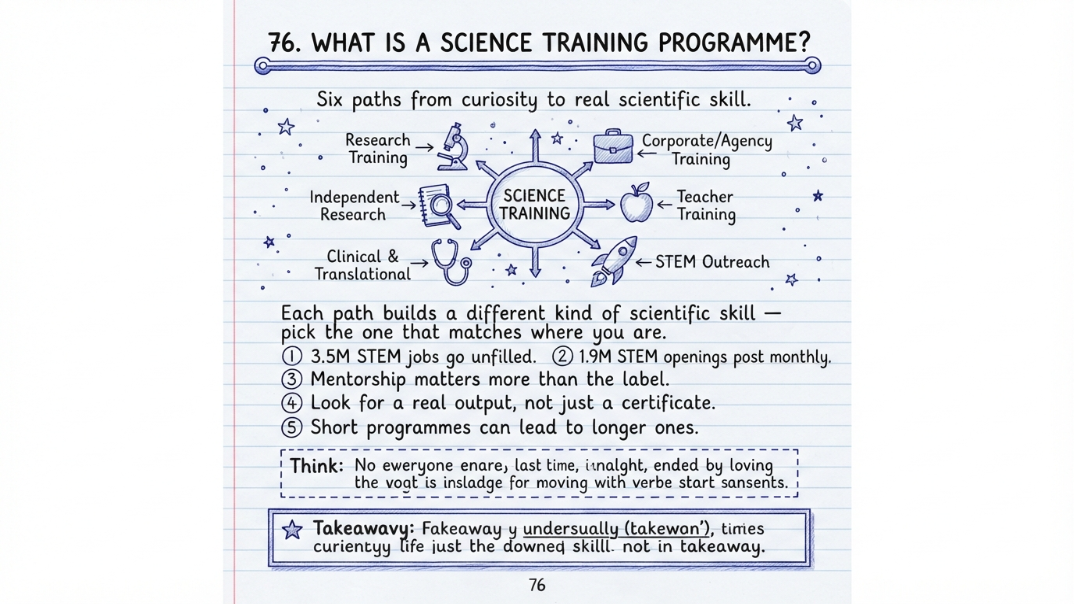
The 6 Types of Science Training Programmes
Understanding which category you actually need is the single most important step before applying to anything, because the application process, time commitment, and outcome are completely different across categories.
| Type | Who It's For | What It Involves | Typical Duration |
|---|---|---|---|
| Academic & Research Training Programmes | Graduate students, postdocs, early-career researchers | Structured research placements, lab rotations, methodology training, and mentored publication or thesis work inside a university or research institute | 6 months – 3+ years |
| Corporate & Agency Scientific Training | Working scientists, regulatory staff, government researchers | Internal upskilling on specific methods, tools, or regulatory frameworks — e.g. risk assessment methodology, data platforms, or compliance procedures | Days to a multi-year rolling curriculum |
| Teacher & Educator Training Programmes | K-12 and university science educators | Placements inside real scientific organizations, curriculum development, and leadership training to bring authentic research experience back into the classroom | Several months to 18 months |
| STEM Outreach & Immersion Programmes | School and high school students | Short, intensive exposure to labs, university research environments, and hands-on experiments designed to spark interest and build science capital | Days to a few weeks |
| Clinical & Translational Science Training | Postdocs, clinical fellows, junior faculty in biomedical fields | Structured coursework and mentored projects moving research from 'bench to bedside' — trial design, translational methodology, and career development | 6 months – 2 years |
| Independent Research & Citizen Science Programmes | Motivated students of any level, including those without institutional access | Self-directed or lightly mentored research projects, often culminating in an award, badge, or competition entry rather than formal academic credit | Weeks to a full school year |
Why Science Training Programmes Matter More in 2026
Three trends have made structured science training more consequential than it was a decade ago, rather than less.
First, the skills gap is now measured, specific, and persistent rather than anecdotal. The U.S. Chamber of Commerce's analysis puts unfilled STEM roles at 3.5 million, concentrated specifically in cybersecurity, data science, and advanced manufacturing — fields where formal degree pipelines haven't kept pace with demand. Roughly 1.9 million STEM job openings are posted every month in the U.S. alone, and national assessments have shown only partial recovery in K-12 math and science performance since the pandemic, which puts more pressure on later-stage training programmes to close gaps that earlier education didn't.
Second, representation gaps remain wide enough that targeted training is doing real structural work, not just symbolic work. Women make up roughly 35% of the STEM workforce despite earning about half of all college degrees and comprising 48% of the overall workforce — a gap that widens further in engineering and computing specifically. Structured training and mentorship programmes are one of the few interventions shown to meaningfully affect who continues into and stays in STEM careers, rather than just who enters them.
Third, government science agencies and research bodies are formalizing internal training at a pace that didn't exist before. Regulatory and scientific agencies across the EU, for example, now run structured multi-year scientific training programmes with dedicated need-identification and review cycles — a sign that even institutions employing career scientists have concluded that degree-level training alone isn't sufficient to keep pace with evolving methods and regulatory frameworks.
| Data Point | Figure | Source |
|---|---|---|
| Unfilled U.S. STEM jobs due to skills gaps | 3.5 million, concentrated in cybersecurity, data science, and advanced manufacturing | U.S. Chamber of Commerce |
| STEM job openings posted | 1.9 million per month | U.S. Chamber of Commerce / labor market data |
| Women's share of the STEM workforce | 35%, despite earning ~50% of all college degrees | National Girls Collaborative Project, 2026 |
| STEM major switching rate | 48% of students who start as STEM majors switch to a non-STEM field before graduating | STEM education research, 2026 |
| Impact of structured independent research (CREST Silver Award) | 21% more likely to take a STEM subject at the next academic level | Pro Bono Economics analysis for the British Science Association |
Academic and Research Training Programmes: What to Expect
This is the category most people picture first: structured research placements inside a university, national lab, or research institute, typically aimed at graduate students, postdocs, and early-career researchers. The defining feature is mentored, hands-on methodology training that a standard degree curriculum doesn't fully provide — learning to design an experiment from scratch, manage a dataset end-to-end, or navigate the politics of co-authorship and publication.
- Lab rotation programmes: short placements across multiple labs before committing to a specific research group — common in the first year of many PhD programmes.
- Fellowship-style training: a named fellowship (often funded by a foundation, government body, or university) that combines coursework, mentored research, and a career-development component.
- Cross-institutional placements: programmes that place researchers temporarily inside a partner institution, industry lab, or international collaborator to build methods or equipment access their home institution lacks.
- What to check before applying: whether the programme includes a genuine mentor relationship (not just nominal supervision), whether output — publications, data, posters — is realistically achievable in the timeframe, and whether the stipend or funding actually covers the cost of living where the programme is based.
Corporate and Government Agency Scientific Training
Once scientists are already employed — inside a pharmaceutical company, a regulatory agency, a national research council, or a government ministry — training doesn't stop. It shifts toward keeping pace with evolving methods, tools, and compliance frameworks. This category is less visible publicly because it's usually internal, but it's often the most structured of all six types, run on annual or multi-year cycles with formal needs assessment.
A representative example: European food safety and regulatory bodies run structured, multi-year scientific training programmes for their own scientific officers and expert panel members, built around a formal cycle of identifying learning needs, prioritizing and approving specific courses, and reviewing outcomes before the next cycle begins. Government-to-government partnerships also fall in this category — short, intensive courses bringing together government, academic, and private-sector participants to build shared scientific and technical coordination capacity, often as part of broader economic development strategy.
- Best suited to: professionals already working in a scientific, regulatory, or technical role who need to formalize or update specific skills without leaving their job.
- How to find them: usually announced internally by your employer or agency, or through professional bodies and sector associations rather than public job boards.
- What good ones look like: tied to a specific, named skills gap (a new method, tool, or regulation) rather than generic 'professional development,' with a clear owner responsible for the curriculum.
Teacher and Educator Training Programmes
These programmes address a specific, well-documented problem: most science teachers were trained to teach the content of science, not to have done science themselves recently. Programmes in this category place working teachers inside real research organizations for an extended placement, then support them in bringing that experience back into curriculum and classroom leadership.
A representative structure: a teacher is released from part of their normal teaching load (often with the placement organization funding the release) for a term or two of embedded work inside a science-focused organization, followed by 12 to 18 months of school-wide curriculum and leadership work applying what they learned. Eligibility is typically restricted to teachers with a minimum number of years of classroom experience, since the goal is leadership development, not initial teacher training.
- Best suited to: experienced science teachers looking to move into curriculum leadership or department-head roles, not new or trainee teachers.
- Funding: often subsidized or fully funded by the sponsoring science body or government ministry, including the cost of the teacher's release time — worth confirming explicitly before applying, since this varies significantly by programme.
- Real payoff: the school-wide, multi-year component matters as much as the placement itself — programmes that end when the placement ends have far less lasting impact than ones with a structured follow-on phase.
STEM Outreach and Immersion Programmes
Aimed at school and high school students, these are typically the shortest and most accessible category — a few days to a few weeks, often run by universities during school breaks, combining lectures from real researchers, lab access, and hands-on demonstrations. Their purpose isn't deep skill-building; it's building 'science capital' — the confidence, exposure, and sense of belonging that predicts whether a student continues pursuing science at all.
- What they typically include: campus-based lectures, laboratory access (sometimes to equipment students would never otherwise touch, like electron microscopes), hands-on experiments, and often a certificate tied to a minimum attendance threshold and a short assessed challenge.
- Who runs them: usually universities, national science fairs and expos, or bilateral government/education partnerships aimed at building STEM pipelines in a specific region or between countries.
- What to look for: genuine hands-on lab time rather than passive lecture-watching, and a clear certification or output the student can point to afterward, particularly for older high schoolers building a college application profile.
Clinical and Translational Science Training
This is a specialized subset aimed squarely at biomedical researchers — postdocs, clinical fellows, and junior faculty — built around moving discoveries from the lab bench into actual clinical and community practice, commonly summarized as 'bench to bedside.' Programmes in this category are usually run by a university's clinical and translational science center, often in partnership with a regional network of hospitals and research institutions.
A typical structure runs over roughly six months, combining regular structured class sessions with a mentored translational research project. Candidates are usually nominated by department chairs or division directors based on career trajectory, rather than applying cold, and selection runs through a competitive review by a panel of senior investigators. If you're in a biomedical research career and haven't been nominated, it's worth asking your department directly whether your institution runs or partners with one of these programmes — many don't advertise broadly.
Independent Research and Citizen Science Programmes
The most flexible and often the most accessible category: self-directed or lightly mentored research projects that don't require institutional affiliation, run by charities, science associations, or citizen-science platforms. These typically culminate in an award, badge, or public science fair entry rather than academic credit, but the research skills built are genuinely transferable.
This category is particularly valuable for students without access to a university lab or a well-resourced school science department, since the barrier to entry is usually just a mentor relationship (sometimes remote) and a defined project scope, rather than physical lab access. Independent research project schemes have documented, measurable effects on continued STEM participation — not just interest — making them worth taking seriously rather than treating as a lightweight add-on to a CV.
How to Choose the Right Programme: A Decision Framework
With six distinct categories and dramatically different time commitments, the choice isn't about finding the 'best' programme in the abstract — it's about matching the category to your actual current position and goal.
- Start with your current status, not your ambition: a career switcher with no scientific background needs a fundamentally different entry point (often outreach, then a bridging course, then research training) than a working postdoc who needs a specific methodology gap filled.
- Check who actually runs and funds it: programmes run by a named university department, a government agency, or an established charity with a multi-year track record are lower-risk than one-off programmes with no visible prior cohorts.
- Confirm the real time and cost commitment before applying, not after acceptance: 'flexible' and 'part-time' can still mean 10+ hours a week for six months — treat the stated duration as a floor, not a ceiling.
- Ask what you'll have at the end that you can show someone: a completed project, a portfolio, a publication, a certificate with a defined credit value, or a direct employer connection. Programmes with a vague or purely experiential outcome are harder to convert into a career step afterward.
- Look for a real mentor relationship, not just a lecture series: the programmes with measurable career impact — from CREST Awards to clinical and translational science fellowships — are built around individual mentorship, not just content delivery.
How to Turn a Science Training Programme Into an Actual Career Outcome
- Treat the output as the point, not the certificate: a completed project, dataset, or publication is what a hiring committee or admissions panel actually evaluates — the certificate is just proof it happened.
- Ask for a reference commitment before the programme ends, not after: mentors and supervisors are far more responsive to a reference request made while the relationship is active and fresh.
- Document as you go: keep a running log of specific techniques, tools, and decisions you made during the programme — this becomes the raw material for interview answers and application essays months later.
- Follow the programme's stated pathway if one exists: employer consortiums, alumni networks, and follow-on fellowships attached to a programme are usually underused by participants who complete the programme and then apply cold elsewhere instead.
- If the programme was short (outreach or immersion), use it as a stepping stone, not an endpoint: apply what it revealed about your interests into the next, more substantial category — an independent research project, then a longer research training placement.
Conclusion
There is no single 'science training programme' to find and complete — there's a landscape of six genuinely different categories, each solving a different gap in how science education actually works. The 3.5 million unfilled STEM roles and 1.9 million monthly job postings aren't primarily a pipeline problem at the entry point; they're a structured-training problem at every stage from school-age curiosity through mid-career skill updates. Closing that gap for yourself starts with correctly identifying which of the six categories actually matches where you are right now, not with chasing the most prestigious-sounding name.
The programmes that produce measurable, lasting outcomes — whether that's a 21% increase in continued STEM study after a school-age independent research award, or a career pivot after a clinical and translational science fellowship — share the same underlying structure: a real mentor, a concrete output, and a follow-on pathway the participant actually uses. Whichever category fits your situation, evaluate any specific programme against that structure before you apply, and you'll filter out most of the weaker options immediately.
FAQ
Frequently Asked Questions
What is a science training programme?
A science training programme is a structured, time-bound programme designed to build specific scientific skills, research capability, or applied knowledge that a standard degree or on-the-job learning doesn't fully cover. They range from short school outreach immersions to multi-year research fellowships, and are typically run by universities, government agencies, companies, or scientific charities, usually including a mentor relationship and a defined output or certification at the end.
What are the main types of science training programmes?
Six main categories: academic and research training programmes for graduate students and postdocs; corporate and government agency scientific training for working professionals; teacher and educator training programmes for classroom leadership development; STEM outreach and immersion programmes for school students; clinical and translational science training for biomedical researchers; and independent research or citizen science programmes for self-directed learners without institutional access.
How do I choose the right science training programme?
Start by matching the programme category to your current status and goal rather than its reputation. Then check who runs and funds it, confirm the real time commitment before applying, verify there's a concrete output you'll have at the end (a project, publication, or credential with real value), and look for programmes built around a genuine mentor relationship rather than just content delivery.
Are science training programmes free?
It depends heavily on the category. Academic research fellowships and clinical/translational science training programmes are typically funded, sometimes including a stipend. Corporate and agency training is usually funded by the employer. Teacher training placements are often subsidized by the sponsoring science body, including covering the cost of the teacher's classroom release time. STEM outreach and independent research programmes vary widely — some are free or subsidized for students, others charge a participation fee, so it's worth confirming funding explicitly before applying.
Do science training programmes actually help with careers?
The evidence for well-structured programmes is measurable, not just anecdotal. An analysis of the British Science Association's CREST Awards found students who completed a CREST Silver Award were 21% more likely to continue into a STEM subject at the next academic level. More broadly, given that the U.S. Chamber of Commerce estimates 3.5 million unfilled STEM jobs due to skills gaps, structured training that builds specific, in-demand applied skills is one of the more direct ways to convert scientific interest or a general degree into an actual hire-able skill set.
What's the difference between a science training programme and a regular science course?
A course typically teaches content on a fixed syllabus with limited individual mentorship. A training programme is built around applied, hands-on skill-building — a placement, a mentored project, or embedded work inside a real scientific organization — with an expectation that participants produce something (a project, dataset, or portfolio) rather than just complete assessments. The mentorship and applied output are the two features that most reliably separate a genuine training programme from a course marketed with that label.
Can I do a science training programme without a science degree?
Yes, for several categories. STEM outreach and immersion programmes are specifically designed for students who haven't yet chosen or completed a science pathway. Independent research and citizen science programmes are explicitly built for participants without institutional lab access. Career switchers without a formal science background typically start in this kind of entry-level or bridging programme before moving toward research training or specialized industry training that does require a degree.
How long do science training programmes typically last?
It varies enormously by category: STEM outreach and immersion programmes often run for a few days to a few weeks; teacher training placements typically run several months to 18 months including follow-on school-wide work; clinical and translational science training programmes commonly run around six months to two years; and academic research training, including PhD-integrated placements and fellowships, can run anywhere from six months to several years.
Who runs science training programmes?
Universities and research institutes run most academic, clinical/translational, and outreach programmes. Government science, health, or education agencies run internal scientific training and cross-national partnership programmes. Charities and scientific societies — such as national science associations — run independent research and award-based programmes. Companies and regulatory bodies run internal corporate scientific training for their own staff, usually not advertised publicly.
What should I ask before applying to a science training programme?
Ask what specific output you'll have at the end (a project, publication, certificate, or credential), whether there's a named individual mentor rather than just group instruction, exactly how funding and any stipend or fees work, what the realistic weekly time commitment is, and whether the organization running it has a track record of prior cohorts you can verify — ideally by speaking to a past participant directly.