Google Data Analytics Certificate: Worth It in 2026?
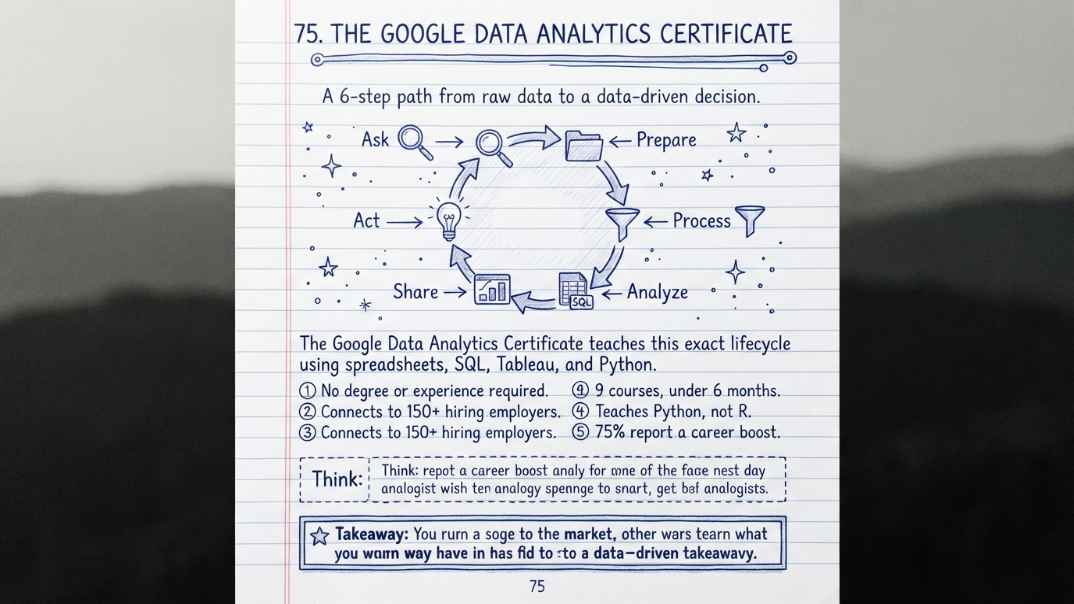
Over 3.7 million people have enrolled in the Google Data Analytics Professional Certificate on Coursera since its 2021 release. Despite its immense popularity, it remains widely misunderstood. Some career switchers view it as an automatic golden ticket to a six-figure salary, while skeptical hiring managers sometimes dismiss it as a lightweight online badge. The reality sits squarely in the middle: it is a practical, beginner-friendly framework designed to build core tool fluency, structured thinking, and basic workflow habits.
The curriculum has undergone major updates. Google retired the original R programming module in favor of Python, introduced a ninth module centered around Gemini-driven job search strategies, and integrated AI-assisted data cleaning workflows throughout the material. If you researched this program a couple of years ago, key details about what you'll actually learn have changed.
This guide provides an updated walkthrough of the full 9-course series, total out-of-pocket costs, college credit transferability, employer network access, and how to convert your capstone case study into a job interview.
What the Google Data Analytics Program Actually Offers
Offered via Coursera as part of Google’s Career Certificates initiative, the program requires no prerequisites, technical background, or prior degree. The learning format is entirely asynchronous and self-paced, using video walkthroughs, readings, interactive quizzes, and browser-based labs.
Because assessments are auto-graded to accommodate millions of students, you won't receive individual qualitative feedback on your analytical reasoning from a instructor. Success depends on your willingness to test formulas independently and build personal projects outside the assigned labs.
| Key Feature | Program Details |
|---|---|
| Total Courses | 9 self-paced modules (expanded from 8 to include AI job search) |
| Instructional Hours | 180+ hours of video, labs, and assessments |
| Estimated Completion | 3 to 6 months (studying 8–10 hours per week) |
| Total Cost | $49/month Coursera subscription after 7-day free trial |
| Core Tech Stack | Python (Pandas, NumPy), SQL, Tableau, Spreadsheets, Gemini AI |
| College Credits | Up to 12 ACE college credits (or 7 ECTS credits internationally) |
| Graduate Outcomes | 75% report a new job, raise, or promotion within 6 months |
| Employer Access | Direct applications to Google's 150+ hiring consortium companies |
Breakdown of the 9-Course Curriculum
The modules mirror the standard operational workflow of a professional analyst: Ask, Prepare, Process, Analyze, Share, and Act. Taking them sequentially ensures you master core concepts before attempting technical coding.
| # | Module Name | Est. Hours | Core Focus & Deliverables |
|---|---|---|---|
| 1 | Foundations: Data, Data, Everywhere | 13 hrs | Introduces the analyst mindset, business ecosystems, data ethics, and basic tool roles. |
| 2 | Ask Questions to Make Data-Driven Decisions | 15 hrs | Focuses on scoping problems, understanding stakeholder needs, and basic spreadsheet structure. |
| 3 | Prepare Data for Exploration | 19 hrs | Covers database architecture, data privacy, bias prevention, and basic SQL queries. |
| 4 | Process Data from Dirty to Clean | 16 hrs | Hands-on data integrity practices using SQL string functions and spreadsheet validation formulas. |
| 5 | Analyze Data to Answer Questions | 26 hrs | Heavy emphasis on filtering, sorting, multi-table SQL JOINs, and complex spreadsheet calculations. |
| 6 | Share Data Through the Art of Visualization | 19 hrs | Dashboard design, chart formatting, data storytelling, and stakeholder presentations in Tableau. |
| 7 | Introduction to Data Analysis Using Python | 27 hrs | Python syntax, control flow, Jupyter Notebooks, Pandas, and NumPy libraries (replaces old R course). |
| 8 | Google Data Analytics Capstone: Case Study | 11 hrs | A complete end-to-end analytical project to showcase in your portfolio. |
| 9 | Accelerate Your Job Search with AI | 6 hrs | Using Gemini and Career Dreamer for resume tailoring, tracking applications, and mock interviews. |
The Real Cost and How to Save Money
Because the certificate is billed as a flat $49 monthly Coursera subscription, your total expense depends on completion speed. Completing the program in three months costs under $150, whereas taking six months costs roughly $294.
- Maximize the 7-Day Free Trial: Complete Course 1 during the trial period so your paid subscription starts at Course 2.
- Increase Weekly Study Time: Dedicating 15–20 hours per week allows motivated learners to finish all 9 modules in 8–10 weeks.
- Apply for Coursera Financial Aid: Eligible students can request financial assistance directly on each course page prior to enrolling.
- Evaluate Coursera Plus: If you plan to take additional certificates (such as Google Advanced Analytics or Project Management), a $399 annual subscription offers better long-term value.
Career Impact: What the Certificate Does (and Doesn't Do)
Understanding what the certificate provides helps set realistic job search expectations:
What It Does: Graduates gain access to Google's Employer Consortium—a network of 150+ companies (including Deloitte, Target, Verizon, and Google) that consider certificate completers for entry-level openings. It also awards an ACE credit recommendation of up to 12 college credits, making it valuable for students completing bachelor's degrees.
What It Doesn't Do: A certificate alone won't land senior-level positions or bypass technical screening interviews. Because the capstone datasets (like the popular Cyclistic bike-share case study) are completed by thousands of students, submitting the default capstone without customization will make your resume look identical to other applicants.
A Practical Checklist for Job-Hunters
- Build a Unique Capstone: Substitute the default sample dataset with a unique topic (e.g., local transit data, e-commerce sales, or sports statistics) to demonstrate true problem-solving skills.
- Publish Work on GitHub & Tableau Public: Upload documented SQL queries, Jupyter Notebooks, and interactive dashboards where hiring managers can review them.
- Leverage Course 9 AI Tools: Use Gemini to refine bullet points on your resume, practice responding to technical interview questions, and organize job application logs.
- Apply Before Finishing Course 9: Core technical topics (SQL, Spreadsheets, Tableau) are covered in Courses 1–6. Begin applying to junior analyst roles as soon as you complete Course 7 Python fundamentals.
Frequently Asked Questions
Does the Google Data Analytics Certificate teach Python or R?+
The current curriculum teaches Python. Course 7 ('Introduction to Data Analysis Using Python') covers Python basics, control structures, Pandas, and NumPy, replacing the former R programming module.
How much does the Google Data Analytics Professional Certificate cost?+
There is no static fee. You pay $49/month for a Coursera subscription until completion. Studying 10 hours per week typically leads to finishing in 3–6 months ($150–$300 total).
Can I get college credit for completing this certificate?+
Yes. The certificate holds an American Council on Education (ACE) recommendation for up to 12 college credits, though acceptance depends on your specific university's transfer policies.
Do I need prior coding or technical experience to start?+
No. The program is explicitly designed for beginners with no prior background in statistics, programming, or data tools.