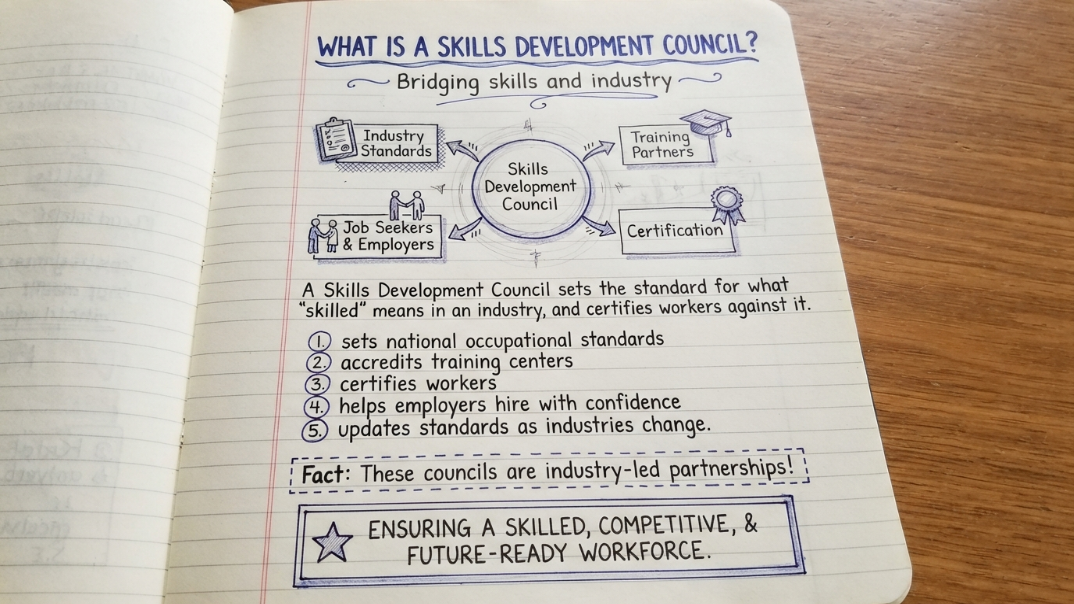
India adds close to a crore young people to its workforce every year, yet employer surveys consistently point to a wide gap between what graduates can do and what jobs actually require — a mismatch that costs both sides time and money. Skills Development Councils, more formally known as Sector Skill Councils (SSCs), exist specifically to close that gap: industry bodies that define what 'skilled' actually means for a given trade, certify workers against that standard, and give employers a reliable signal they can hire against. This guide breaks down what a Skills Development Council is, how it fits into India's broader skilling ecosystem, and how both job seekers and employers can actually use one.
What Is a Skills Development Council
A Skills Development Council, most commonly referred to in India as a Sector Skill Council (SSC), is an industry-led body responsible for defining the skill standards for a specific sector — such as retail, construction, healthcare, or IT-ITeS — and certifying that workers actually meet those standards. Unlike a college or a private training institute, an SSC doesn't primarily deliver training itself; it sets the benchmark that training providers train against and that assessors certify against, so a certificate from one part of the country means the same thing as a certificate from another.
Why Skills Development Councils Matter
Most first-time job seekers and small employers underestimate how much a shared, verifiable standard actually solves. Without one, an employer has no reliable way to know whether a candidate's 'certified electrician' training covered the same ground as another candidate's, and a candidate has no reliable way to prove their skill to an employer who's never heard of the training institute. A candidate with a mediocre-sounding resume but a recognized Sector Skill Council certification often gets shortlisted over a candidate with more impressive-sounding but unverifiable claims — which is exactly the trust problem these councils were built to solve.
How a Sector Skill Council Works
Sector Skill Councils in India operate under the National Skill Development Corporation (NSDC), which itself works under the Ministry of Skill Development and Entrepreneurship (MSDE). Each SSC is registered as an autonomous, industry-led society with representation from companies in that sector, and its core job is threefold: define the skill and knowledge requirements for specific job roles in the sector, accredit training partners and assessment bodies to deliver and test against those requirements, and issue nationally recognized certifications to candidates who pass.
- Defining job roles and the skills required for each one within a sector
- Accrediting training centers and assessors to deliver standardized training
- Conducting or overseeing skill assessments and practical exams
- Issuing certifications recognized across the sector and, often, by government schemes
- Working with industry to keep standards updated as job requirements change
National Occupational Standards and Certification
The backbone of every Sector Skill Council's work is the National Occupational Standard (NOS) — a detailed, written description of what a competent person in a specific job role should know and be able to do, broken down into measurable performance criteria. A group of related NOSs is bundled into a Qualification Pack (QP), which maps to a specific job role and a specific level on the National Skills Qualification Framework (NSQF). A candidate is trained and assessed against a Qualification Pack, not against a vague notion of 'skilled,' which is what makes the resulting certificate portable and comparable across employers.
Major Sector Skill Councils in India
There are dozens of Sector Skill Councils covering the breadth of India's economy, each focused on a distinct industry. Some of the most active include the Retailers Association Skill Council of India (RASCI), IT-ITeS Sector Skill Council NASSCOM, Healthcare Sector Skill Council, Construction Skill Development Council of India (CSDCI), Automotive Skills Development Council (ASDC), Agriculture Skill Council of India (ASCI), and Beauty and Wellness Sector Skill Council (B&WSSC). A candidate looking to get certified should identify the SSC that governs their specific trade, since certification pathways and recognized job roles differ significantly from one sector to another.
Benefits for Job Seekers
For a job seeker, especially one coming from a non-formal or vocational background, a Sector Skill Council certification offers something a resume alone can't: independent, third-party proof of competence that an employer doesn't have to take on faith. It's also often a prerequisite or a scoring advantage for placement under government skilling schemes like the Pradhan Mantri Kaushal Vikas Yojana (PMKVY), which are frequently tied directly into the SSC certification framework. Candidates who complete SSC-recognized training also tend to have an easier time proving eligibility for jobs that specify a formal skill certification requirement, rather than relying on an employer's willingness to test them personally.
Benefits for Employers
For employers, especially in sectors with high hiring volume like retail, logistics, or construction, screening every candidate personally for basic competence is expensive and slow. Hiring against a recognized Sector Skill Council certification shifts that verification cost onto a standardized, industry-agreed process instead of onto every individual hiring manager. Many larger employers also participate directly in shaping the National Occupational Standards for their sector through the SSC, which means the certification they're hiring against was built, in part, by companies like their own — reducing the mismatch between what's taught and what's actually needed on the job.
Skills Development Council vs Traditional Vocational Training
Not every training path serves the same purpose, and confusing an SSC-aligned certification with a general vocational course is a common source of wasted time.
| Aspect | Sector Skill Council Certification | Traditional Vocational Training |
|---|---|---|
| Standard | Based on a National Occupational Standard tied to a specific job role | Varies by institute, often not standardized nationally |
| Recognition | Portable across employers and government schemes | Recognition depends on the individual institute's reputation |
| Assessment | Independent third-party assessment against defined criteria | Often assessed by the same institute that delivered training |
| Updates | Periodically revised by industry as job roles evolve | May lag behind current industry practice |
How to Get Certified Through a Sector Skill Council
Most working candidates don't need a full-time course to get certified — a shorter, standardized path is usually available for the right job role.
- Identify the Sector Skill Council relevant to your trade through the NSDC website or Skill India portal
- Locate the specific Qualification Pack and job role that matches your target position
- Enroll with an accredited training partner, or apply directly for assessment if you already have relevant experience (Recognition of Prior Learning)
- Complete the required training hours and practical components tied to that Qualification Pack
- Sit for the independent skill assessment conducted by an accredited assessment body
Common Mistakes Candidates Make
A few patterns show up again and again among candidates who don't get the full value out of a Sector Skill Council certification.
- Enrolling with a training center without confirming it's actually accredited by the relevant SSC
- Choosing a Qualification Pack based on convenience rather than the specific job role they actually want
- Assuming certification alone guarantees a job, rather than treating it as a credibility boost within a broader job search
- Not checking the NSQF level of the certification against what the target employer or role actually requires
- Overlooking the Recognition of Prior Learning route for candidates who already have years of on-the-job experience
Resources and Where to Start
Several official channels exist to help candidates and employers navigate the Sector Skill Council ecosystem without confusion. The Skill India portal and the National Skill Development Corporation (NSDC) website list all recognized Sector Skill Councils along with their contact details and accredited training partners. The Pradhan Mantri Kaushal Vikas Yojana (PMKVY) offers free or subsidized short-term training aligned directly to SSC-defined Qualification Packs for eligible candidates. Individual SSC websites, such as those for RASCI, ASDC, or CSDCI, typically publish the full list of job roles, Qualification Packs, and accredited assessment bodies specific to that sector.
Future of Skills Development Councils
As industries adopt automation and AI-driven tools faster than traditional curricula can keep pace, Sector Skill Councils are increasingly focused on updating Qualification Packs to reflect hybrid, tech-enabled job roles rather than only manual ones. The councils that stay relevant will likely be the ones that revise standards quickly as sectors change and that make certification pathways shorter and more accessible for working adults, rather than treating skilling as a one-time, early-career event.
FAQs
What is the difference between NSDC and a Sector Skill Council?
NSDC (National Skill Development Corporation) is the overarching body that funds, coordinates, and recognizes Sector Skill Councils; individual SSCs are the industry-specific bodies under NSDC that actually define occupational standards and certify skills for their own sector.
Is a Sector Skill Council certification recognized by employers?
Yes, particularly in sectors like retail, construction, healthcare support, and logistics where SSC-defined job roles and Qualification Packs are widely used in hiring and are also tied into government skilling and placement schemes.
Do I need prior training to get certified through an SSC?
Not necessarily. Candidates with existing on-the-job experience can often pursue certification through the Recognition of Prior Learning (RPL) route, which assesses existing skill directly rather than requiring a full training course.
How do I find the right Sector Skill Council for my industry?
The Skill India portal and the NSDC website list all recognized Sector Skill Councils by sector, along with the specific job roles and Qualification Packs each one covers.
Is Sector Skill Council training free?
It depends on the pathway. Training delivered under government schemes like PMKVY is often free or subsidized for eligible candidates, while training through a private accredited partner may carry a fee.
What is a Qualification Pack in the context of a Skills Development Council?
A Qualification Pack is a set of National Occupational Standards bundled together to define a specific job role at a specific level on the National Skills Qualification Framework; candidates are trained and assessed against a Qualification Pack rather than a general skill category.