Skills to Put on Your Resume: The Complete 2026 Guide (Hard, Soft & AI Skills)
75% of resumes get rejected by an Applicant Tracking System (ATS) before a human recruiter ever reads a single word, and a weak or generic skills section is one of the most common reasons why. That's a genuinely high bar, and it explains why 'what skills should I put on my resume' has become one of the most consequential questions in the entire job search — not a minor formatting detail, but frequently the difference between getting screened out automatically and actually landing an interview.
The honest problem with most resume advice on this topic is that it hasn't kept pace with how hiring actually works now. Listing 'Microsoft Office' and 'team player' and calling it done isn't just underwhelming — it's actively working against you, since both ATS software and human recruiters are now looking for specific, verifiable, current skills that map directly to the job description, not generic filler that could describe almost anyone.
This guide covers the three categories of skills that actually matter in 2026 — hard skills, soft skills, and the newer category of AI/tool fluency — with real current data on what's trending in each, how to choose the right ones for your specific target role, how to actually prove a skill rather than just listing it, and the specific mistakes that quietly undermine an otherwise solid resume.
The 3 Categories of Resume Skills
| Category | What It Is | Examples |
|---|---|---|
| Hard Skills | Teachable, measurable technical abilities gained through education, training, or direct experience | Python, SQL, data analysis, Excel (advanced), Google Analytics, Tableau, financial modeling |
| Soft Skills | Interpersonal and behavioral abilities that shape how you work with others and adapt to change — harder to measure, but increasingly weighted just as heavily | Adaptability, communication, critical thinking, collaboration, ownership, time management |
| AI / Tool Fluency | A newer, fast-growing category covering practical fluency with AI tools and modern software workflows | ChatGPT/Gemini for work tasks, prompt writing, automation tools, Notion AI, workflow optimization |
The strongest resumes in 2026 balance all three categories deliberately, rather than leaning entirely on one. A resume packed with technical hard skills but no evidence of communication or adaptability can read as narrowly capable; a resume full of soft-skill buzzwords with no hard skills to back them up can read as vague. AI/tool fluency, as a newer category, is increasingly expected as a baseline signal that you can work efficiently with current workplace tools, not just a bonus.
Hard Skills: What's Actually in Demand by Category
| Field | In-Demand Hard Skills |
|---|---|
| Technology / Data | Python, SQL, JavaScript, cloud platforms (AWS/Azure/GCP), data analysis, machine learning fundamentals |
| Cybersecurity | Threat detection, network security, penetration testing, security architecture — currently the fastest-growing resume keyword cluster, up 185% since 2024 |
| Marketing | Google Analytics, SEO/SEM, content strategy, marketing automation platforms, A/B testing |
| Finance / Business | Financial modeling, advanced Excel, forecasting, budgeting, data visualization (Tableau, Power BI) |
| Design | UX/UI design, Figma, Adobe Creative Suite, prototyping, design systems |
| Operations / Project Management | Process optimization, project management software (Jira, Asana), supply chain analysis, agile methodology |
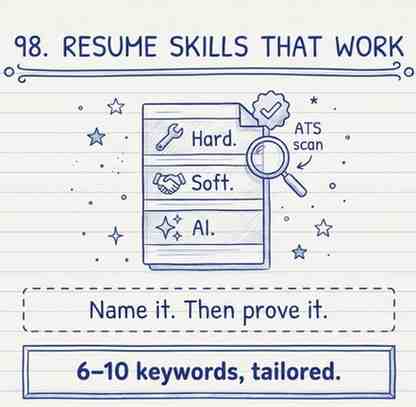
The specific hard skills worth listing should be pulled directly from the job description you're applying to, not from a generic master list. ATS systems and recruiters are both scanning for alignment with that specific posting, and a resume with 6 to 10 keywords matching the job description gets meaningfully higher callback rates than one with either far fewer or an unfocused flood of unrelated ones.
Soft Skills: What's Actually Changed in 2026
Soft skills have moved from a nice-to-have afterthought to something recruiters weight nearly as heavily as technical ability — 85% of recruiters now say they consider soft skills equally as important as hard skills. What's changed most is which specific soft skills are rising fastest, and why.
- Adaptability: cited as the single most-wanted soft skill for 2026, directly driven by how quickly AI and new tools are reshaping day-to-day job requirements.
- Communication: particularly written communication, given how much collaboration now happens asynchronously.
- Critical thinking: increasingly emphasized as AI tools handle more routine, repetitive tasks.
- Emotional intelligence and cross-functional collaboration: reflecting how much modern work depends on navigating relationships across teams.
- Problem-solving: the single most commonly listed soft skill on resumes overall.
AI and Tool Fluency: The Newest Resume Category
This category didn't meaningfully exist on resumes a few years ago, and it's now treated as close to a baseline expectation in many roles.
- General AI tool fluency: ChatGPT, Gemini, etc.
- Prompt writing: the ability to get useful output efficiently.
- Automation tools: workflow automation platforms.
- AI-assisted design and productivity tools: tools like Canva AI or Notion AI.
- Workflow optimization: restructuring how work gets done using current tools.
This category should be included honestly and specifically — naming the actual tools and how you've used them — rather than as a vague 'AI-savvy' claim.
How to Actually Prove a Skill, Not Just List It
This is the single most important shift separating resumes that get callbacks from resumes that don't: a skill listed alone is easy for an ATS or human to discount. A skill paired with a specific, measurable example is what builds credibility.
| Weak (Skill Alone) | Strong (Skill + Proof) |
|---|---|
| Communication | Presented weekly project updates to a 12-person cross-functional team, reducing status-check emails by 30% |
| Data analysis | Built a Python-based reporting pipeline that cut monthly reporting time from 6 hours to 45 minutes |
| Leadership | Led a 4-person team through a product launch that shipped two weeks ahead of schedule |
| Problem-solving | Diagnosed and resolved a recurring customer churn issue, reducing it by 18% over one quarter |
How to Format Your Skills Section for ATS
- Use standard section headers like 'Skills' or 'Core Competencies'.
- Use plain bullet points, not tables, columns, or icons — infographic resumes fail ATS parsing 95% of the time.
- Match the exact phrasing used in the job description.
- Save as DOCX for better parsing, though PDF is fine for recruiters.
- Use a clear, custom file name like 'John-Doe-Resume.docx'.
Conclusion
The skills section of a resume has quietly become one of the highest-leverage parts of the entire document. Getting it right in 2026 means treating it as three distinct categories: specific hard skills, differentiated soft skills, and honest AI/tool fluency.
FAQ
Frequently Asked Questions
What are the most important skills to put on a resume in 2026?+
A balanced mix across three categories: job-specific hard skills, high-demand soft skills (adaptability, communication), and AI/tool fluency.
How many skills should I list?+
LinkedIn data indicates 6 to 10 keywords matching the specific job description get the highest callback rate.
Should I include AI skills?+
Yes — practical fluency with AI tools has become a baseline expectation in many roles.