Toughest Exam in the World: Ranked and Explained
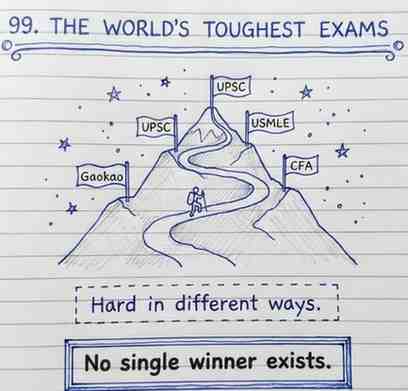
The toughest exam in the world isn't one exam — it's Gaokao, UPSC, JEE Advanced, USMLE and a handful of others, each brutal for a different reason.
My Honest Answer First
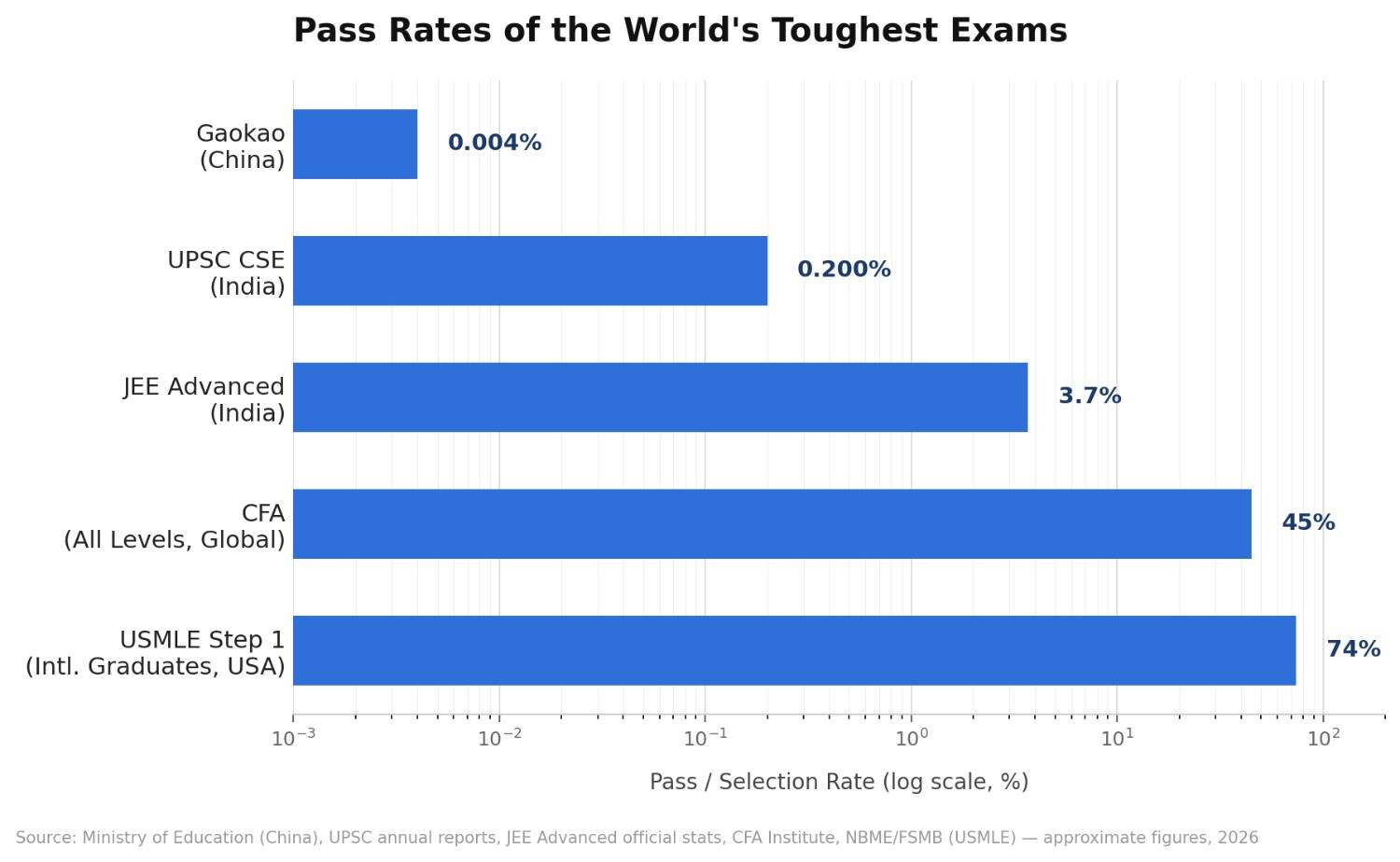
I'll answer the toughest exam in the world question straight, no build-up. If you go purely by numbers — how many people apply versus how many get through — China's Gaokao is the toughest exam in the world, with around 13 million students competing for a small number of top-university seats every year.
But here's the thing. If you ask a doctor, they'll say the USMLE is harder. Ask a sommelier, and they'll swear nothing beats the Master Sommelier Diploma, where under 300 people have passed since 1969.
So "toughest" depends on what you're measuring — pure competition, technical depth, years of prep, or how much you lose if you fail. I'm going to break all of that down so you get the full picture, not just a ranked list copied from ten other articles.
Key Takeaways
- Gaokao (China) wins on raw scale — 13 million candidates, under 0.01% get into the top schools.
- UPSC CSE (India) wins on selection ratio and years lost — about 0.2% of candidates make the final list after three brutal stages.
- JEE Advanced (India) wins on speed and pressure — 3 hours to solve problems that stump engineering graduates.
- USMLE (USA) wins on sheer volume of knowledge you must hold in your head for real patients.
- Master Sommelier Diploma wins on rarity — fewer than 300 people worldwide have ever passed it.
- No single exam is "the" toughest for everyone. It depends on your field, your country, and what you're willing to sacrifice.
How I'm Judging "Toughest" (Read This Before the List)
Before I rank anything, you should know my yardstick. I'm not just picking exams with scary pass rates and calling it a day — a lot of "toughest exam" articles do exactly that, and it's lazy.
I judged every exam on five things:
- Selection ratio — how many people apply versus how many actually get through.
- Content depth — how much real knowledge (not memorised facts) you need.
- Number of stages — one paper is very different from three rounds spread over a year.
- Time and money cost — years of prep, coaching fees, lost income while you study.
- What you lose if you fail — a re-attempt next year, or your whole career plan.
I'm scoring exams on all five, not just one flashy stat. That's why USMLE (which has a "high" pass rate on paper) still makes this list — the difficulty is in the depth, not the rejection rate.
The Real Ranking: Toughest Exams in the World
Gaokao (China) Is the Hardest Exam in the World by Sheer Scale
The Gaokao is China's national college entrance exam, and it decides almost everything about a Chinese teenager's future in one sitting. Around 13 million students took it in 2026, all competing for roughly 50,000 to 60,000 seats at China's top national universities — that's about 260 students fighting for every single seat.
I've read a lot about how Chinese cities basically shut down during Gaokao week. Traffic gets redirected near exam centres, construction noise gets banned, and parents wait outside for two straight days while their kid sits a 9-hour exam spread across the paper.
- Max score: 750 points, and you generally need 600+ for a top university.
- Prep starts: Often from middle school, with many students studying 12–16 hours a day in their final year.
- What it means for you: if you're comparing your board exam stress to Gaokao, there's genuinely no comparison — this is one of the most academically punishing systems on Earth.
UPSC Civil Services Exam (India) Is the Toughest for Selection Ratio
I'd argue UPSC CSE is the single hardest exam to actually win, not just take. Roughly 5–10 lakh candidates register for the Prelims every year, but only around 1,000 to 1,050 finally get selected — that's a pass rate close to 0.2%.
What makes it brutal isn't one hard paper. It's three stages — Prelims, Mains, and an Interview — spread across close to a year, where failing at any single stage sends you back to square one.
- Syllabus: history, polity, economy, science, ethics, and current affairs — genuinely vast.
- Attempts: limited by age and category, so a failed year isn't just wasted time, it's a used chance.
- My take: if I had to pick one exam where the process itself is the punishment, not just the paper, it's this one.
JEE Advanced (India) Is the Toughest for Speed and Precision
JEE Advanced is the gateway to India's IITs, and you can only sit it after clearing JEE Main first. In 2026, over 15 lakh unique candidates appeared for JEE Main, but only around 56,000 finally cleared JEE Advanced — a qualification rate under 4% of the Main pool.
I think what really separates JEE Advanced from a "hard school exam" is the negative marking combined with a 3-hour window. You can know the concept perfectly and still lose marks from one careless guess, which is a completely different skill from just knowing physics or chemistry.
- Subjects: Physics, Chemistry, Maths — all tested at a level well beyond a standard 12th-grade syllabus.
- Negative marking: wrong answers cost you marks, so guessing is genuinely risky.
- My take: this exam rewards calm, not just intelligence — I've seen genuinely bright students crack under the clock and underperform.
USMLE (USA) Is the Toughest for Depth of Knowledge
The United States Medical Licensing Examination is what stands between a medical graduate and the right to actually treat patients in the US. It's split into multiple steps, each running 7–9 hours, and around 80,000 candidates sit it across all steps in a given year.
On paper, the pass rate looks almost generous — often 90%+ for US medical graduates and around 74% for international medical graduates on Step 1. But don't let that fool you: the reason the pass rate is "high" is that only people who've already survived years of medical school even attempt it, and the content spans nearly every organ system in medicine.
- What it tests: clinical reasoning, not just textbook facts — real patient scenarios.
- Stakes: a low score can quietly end a residency application before it starts.
- What it means for you: if you're pre-med, treat this less like "one big test" and more like a multi-year marathon that starts on day one of med school.
Master Sommelier Diploma Is the Rarest Exam on This List
This one surprises people. The Master Sommelier Diploma is the top certification in the wine world, and since the exam started in 1969, fewer than 300 people globally have ever passed all three parts.
I find this exam fascinating because it's not about memorising facts from a textbook — it's a live, oral, high-pressure performance. You get 25 minutes to blind-taste six wines and correctly name the grape, country, region, and vintage using only smell and taste, with zero notes to check.
- Oral theory: a 50-minute spoken exam with no written cheat sheet.
- Blind tasting: six wines, 25 minutes, judged purely on your palate.
- Cost: candidates often spend upwards of USD 30,000 on travel and practice bottles before even attempting it.
Chartered Accountancy (CA/CMA — India) Is the Toughest for Endurance
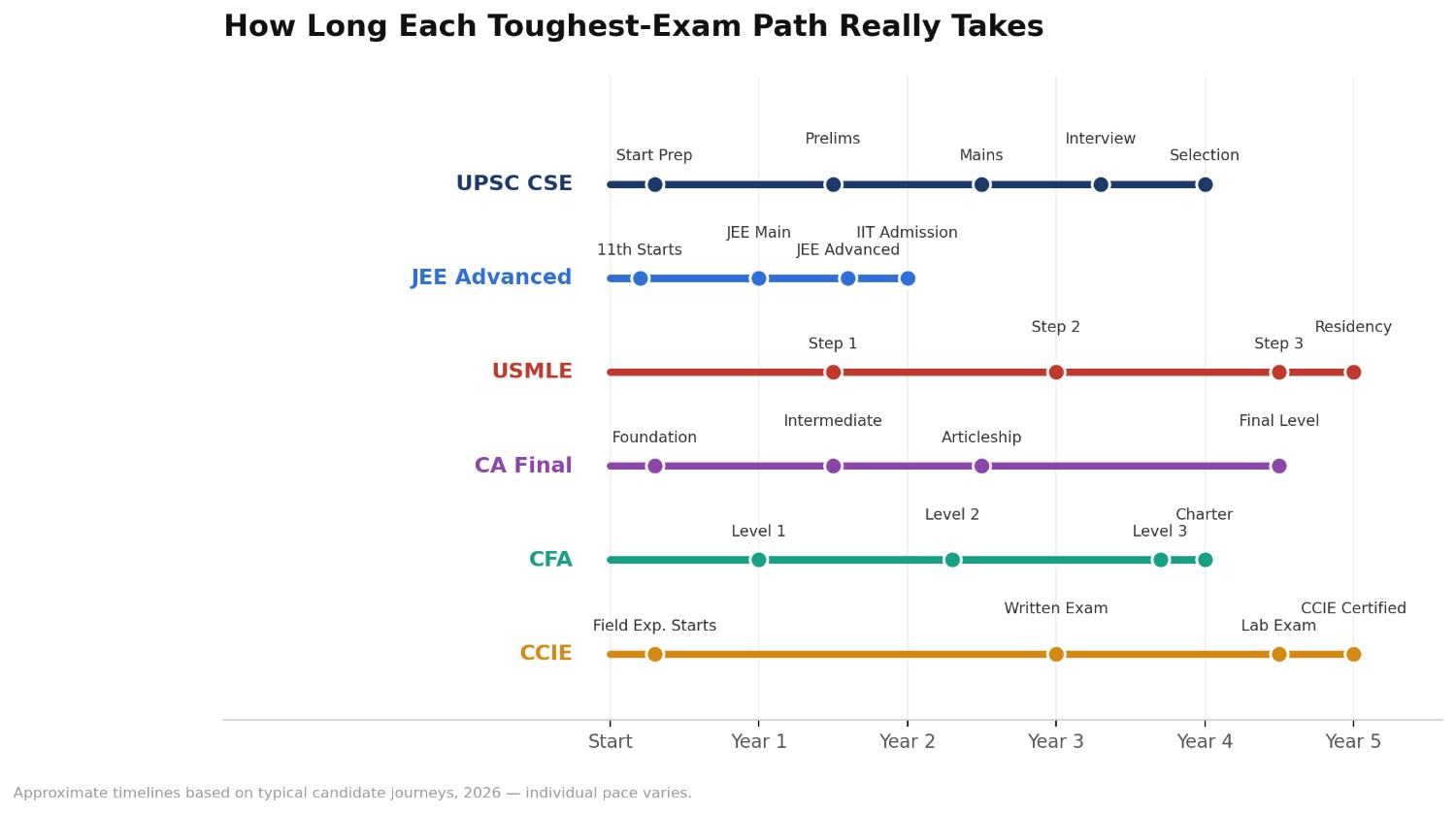
CA is a three-level exam — Foundation, Intermediate, and Final — and most candidates take 3 to 5 years to clear it while also working as interns. Final-level pass rates typically sit around 5–15% per attempt, which is why so many students fail one level multiple times before qualifying.
- Passing rule: you need 40% in every single subject and 50% overall — one weak paper can sink the whole attempt.
- Article training: you study and work under a senior CA at the same time, which is exhausting in a way pure students don't experience.
- My take: CA doesn't test if you're smart in one sitting — it tests if you can stay consistent for years without burning out.
CCIE (Cisco Certified Internetwork Expert) Is the Toughest Tech Certification
CCIE is aimed at senior network engineers, and the lab exam — a hands-on, live troubleshooting test — has a pass rate around 25%. Around 8,000 people attempt it globally each year, and most have already spent years working in networking before they try.
- Format: an 8-hour, live, practical lab — not multiple-choice theory.
- Retake cost: each lab attempt costs real money, so failing is expensive, not just disappointing.
- What it means for you: this is one of the few "toughest exams" where experience matters more than raw study hours.
CFA (Chartered Financial Analyst) Is the Toughest for Global Finance Careers
CFA has three levels, and each one is a 4-hour session you have to clear in sequence. Pass rates typically land between 40–52% depending on the level, and most candidates take 3–4 years to finish all three.
- Study time: CFA Institute itself recommends around 300+ hours of study per level.
- My take: CFA is less about raw genius and more about whether you can grind through dense material consistently over multiple years — a very different skill from a one-shot entrance exam.
California Bar Exam and All Souls Prize Fellowship Deserve a Mention Too
The California Bar Exam is famous for having one of the lowest first-time pass rates among US state bar exams — around 34% for first-timers in 2025. Meanwhile, Oxford's All Souls Prize Fellowship exam picks roughly 2 fellows out of about 150 applicants each year, a pass rate near 1.33%, making it one of the smallest, most elite academic selections on the planet.
Asia's Toughest Exam — And Why It's Not Always the Same Answer
If you're asking specifically about Asia's toughest exam, most rankings land on Gaokao in China, purely because of the sheer number of students competing for a fixed number of seats. But if you narrow it down to India alone, UPSC CSE usually takes the top spot because of its selection ratio and multi-stage structure.
Here's what I'd actually say if a friend asked me this: Gaokao is harder to survive emotionally and physically because of the sheer scale and national pressure, but UPSC is harder to strategically win because of how many stages you have to clear back-to-back over almost a year. Both deserve the "Asia's toughest" label for different reasons, and I wouldn't pick a fake winner just to give you a clean answer.
Toughest Exams in India (And the Truth About "2nd Toughest")
Indian competitive exams show up on nearly every global "toughest exam" list, and there's a real reason for that — not just national pride. Population size plus limited seats plus multi-stage selection creates a level of competition you rarely see elsewhere.
Why Indian exams dominate these lists:
- Massive applicant pools: JEE and NEET each pull in millions of applicants against a tiny number of seats.
- Multiple stages: UPSC alone has three full rounds, each of which can eliminate you.
- Long prep windows: many aspirants spend 2–5 years preparing, often through dedicated coaching.
- High stakes attached: clearing these exams is tied to lifelong career stability in a way that pushes competition even higher.
So which is India's 2nd toughest exam? Most rankings put it this way — UPSC CSE first, and JEE Advanced second, based on selection ratio and difficulty of content combined. That said, you'll find some lists that swap the order depending on whether they're weighing pure selection rate (which favours UPSC) or technical difficulty under time pressure (which favours JEE Advanced). I lean toward UPSC as #1 simply because losing an attempt costs you a full year and one of your limited tries, which JEE doesn't do to the same degree.
| Rank in India | Exam | What It's For | Rough Selection Rate |
|---|---|---|---|
| 1 | UPSC CSE | IAS, IPS, IFS officer posts | ~0.2% |
| 2 | JEE Advanced | Admission to IITs | ~4% of JEE Main pool |
| 3 | NEET UG | MBBS/BDS medical seats | Varies by year, very low for top colleges |
| 4 | CA Final | Chartered Accountant licence | ~5–15% per attempt |
| 5 | GATE | Engineering PG admission / PSU jobs | Single digits at top ranks |
Is NEET among the toughest exams in India? Yes — with over 2 million students registering some years for a fixed number of MBBS/BDS seats, NEET absolutely belongs on this list, even though it's not usually ranked #1.
Top 20 Toughest Exams — Quick List
If you're just here to see the full spread across fields, here's a fast list without the deep dives. I'm keeping this section short on purpose so it doesn't repeat what I already explained above in detail.
- Gaokao (China)
- UPSC Civil Services Exam (India)
- JEE Advanced (India)
- USMLE (USA)
- Master Sommelier Diploma (Global)
- All Souls Prize Fellowship (UK)
- CA Final / CMA Final (India)
- CCIE Lab Exam (Global)
- CFA (Global)
- California Bar Exam (USA)
- Mensa admission test (Global)
- NEET UG (India)
- GATE (India)
- LSAT (USA — for top law schools)
- Olympiad exams (International, subject-specific)
- MCAT (USA — medical school entrance)
- PLAB (UK — for overseas doctors)
- SSC-CGL (India)
- CLAT (India)
- Japan National Bar Exam (Japan)
A quick note on Mensa: it's technically not an "exam" you pass or fail in the traditional sense — it's an IQ test where you need to score in the top 2% to join. I'm including it here because it comes up constantly in "toughest exam" searches, but it's really a threshold test, not a competitive selection exam like the others.
Skills, Roadmap & Salary: What Happens After You Clear One
This is the part most "toughest exam" articles skip completely, and honestly, it's the part that actually matters to you. Passing is step one — here's what the skills, roadmap, and pay actually look like once you're on the other side.
Evaluation criteria for this section: I'm judging each path on three things — the core skills you build while preparing, the realistic roadmap (years, not months), and the typical career/salary outcome once you clear it. This isn't a ranking of which pays most; it's a realistic picture per path.
| Exam Path | Core Skills You Build | Realistic Roadmap | Typical Outcome |
|---|---|---|---|
| UPSC CSE | Analytical writing, current affairs mastery, decision-making under pressure | 2–4 years of serious prep | Government officer role (IAS/IPS/IFS), stable lifelong career |
| JEE Advanced | Deep problem-solving in Physics/Chem/Maths, speed under time pressure | 2 years (11th–12th) intensive prep | IIT engineering degree, strong campus placements |
| USMLE | Clinical reasoning, patient management, medical judgment | 4+ years of med school plus step-wise exam prep | US medical residency and licensed practice |
| CA Final | Accounting, taxation, audit, financial law | 3–5 years including articleship | Chartered Accountant role, high demand in finance/audit |
| CFA (all 3 levels) | Investment analysis, portfolio management, financial ethics | 3–4 years of part-time study | Roles in asset management, equity research, banking |
| CCIE | Live network design, troubleshooting under pressure | 3–5+ years of hands-on networking experience first | Senior network engineer/architect roles, strong global demand |
| Master Sommelier | Blind tasting, wine service, sales under pressure | 5–10+ years in the wine trade | Head sommelier, luxury hospitality, wine consulting |
A few honest notes from me here. If your goal is salary alone, CFA and CCIE tend to have the fastest return relative to prep time, because you can start earning in the field while you're still clearing levels. UPSC and CA, on the other hand, ask you to put your earning years mostly on hold while you prepare — the payoff comes later, but it's usually a longer, more stable career once you're in.
Common Myths I Keep Hearing About These Exams
I want to clear up a few things people genuinely believe, because some of it just isn't true and it scares people off unnecessarily.
- "Only geniuses clear these exams." Not true — most toppers I've read about are consistent, not necessarily the smartest person in the room.
- "You need to study 16+ hours a day." Focused 6–8 hour days usually beat unfocused 16-hour marathons.
- "Coaching is compulsory." Plenty of UPSC and JEE toppers each year clear it through self-study and good resources alone.
- "Failing once means you're finished." Most of these exams allow reattempts, and many successful candidates cleared on their second or third try.
Here's the thing — these exams are hard, but they're not random. They're built to be solvable with the right strategy, not designed as an impossible trap.
What I'd Actually Tell You If You're Deciding
If someone asked me point blank which exam to target, I wouldn't just say "the hardest one." I'd ask what career you actually want, because Gaokao-level toughness doesn't matter if your goal is finance, and CFA-level toughness doesn't matter if you want to be a civil servant.
My honest advice — pick based on the outcome you want first, then respect the difficulty of the path you've chosen instead of comparing it to someone else's. If you're still deciding between two of these paths, my next step would be to actually read the official syllabus and past cutoffs before picking one, not a random "hardest exam" ranking online.
Frequently Asked Questions
What is the toughest exam in the world?+
There's no single official answer, but China's Gaokao is most often ranked #1 due to scale, with UPSC CSE, JEE Advanced, USMLE, and the Master Sommelier Diploma close behind for different reasons.
Which is Asia's toughest exam?+
Gaokao (China) is usually named Asia's toughest exam because of the sheer number of candidates, though UPSC CSE (India) is a close contender based on its multi-stage selection process.
What are the top 30 hardest exams in the world?+
Beyond the top 10 covered here, the extended list includes NEET, GATE, LSAT, MCAT, PLAB, SSC-CGL, CLAT, Olympiad exams, the Japan Bar Exam, and other national civil service and licensing exams across countries.
What is the world's hardest test?+
If you mean pure selection difficulty, UPSC CSE's roughly 0.2% final selection rate makes it one of the hardest tests to actually win, even though Gaokao has more total applicants.
What is the 2nd toughest exam in India?+
Most rankings place JEE Advanced as India's second toughest exam after UPSC CSE, based on its low qualification rate and intense time pressure.
Is NEET among the toughest exams in India?+
Yes, NEET UG is widely considered one of India's toughest exams because of the huge applicant pool competing for a limited number of MBBS and BDS seats.
Why do pass rate numbers for these exams differ so much online?+
Different sources define "pass" differently — some count any qualifying score, others only count final selection — and a lot of older data keeps getting recirculated without updates, so always check the exam's official site for current numbers.
About the Author
Kush Verma is a Engineer, Teacher & Principal Editor, and Researcher at UKTU, with a background in Computer Science Engineering and full-stack development. He writes about software engineering, educational frameworks for readers seeking practical, fact-checked guides, drawing on a strict four-stage editorial process of primary research, technical validation, editorial refinement, and continuous auditing.