What Skills Do You Actually Need to Be a Software Developer in 2026?
You need one language mastered deeply, Git fluency, and communication skills — not a checklist of ten frameworks. Here's what actually gets you hired and promoted.
- The fastest path in isn't ten languages — it's one, done properly. Depth in a single language beats shallow exposure to five, every time I've hired.
- Git isn't optional and it isn't just "commit and push." If you can't rebase or resolve a merge conflict, you'll stall out on any real team within a week.
- Soft skills aren't the soft part. Writing clear PR descriptions and giving useful code review feedback is what separates people who get promoted from people who plateau at mid-level.
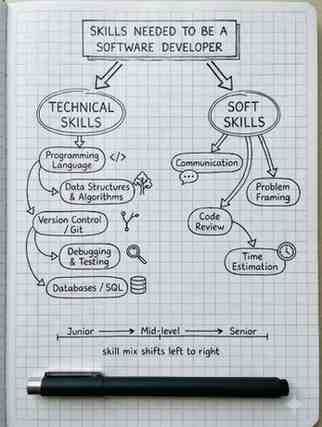
- The skill bar is different at every level. What gets you hired as a junior is not what gets you promoted to senior — and most guides don't separate the two.
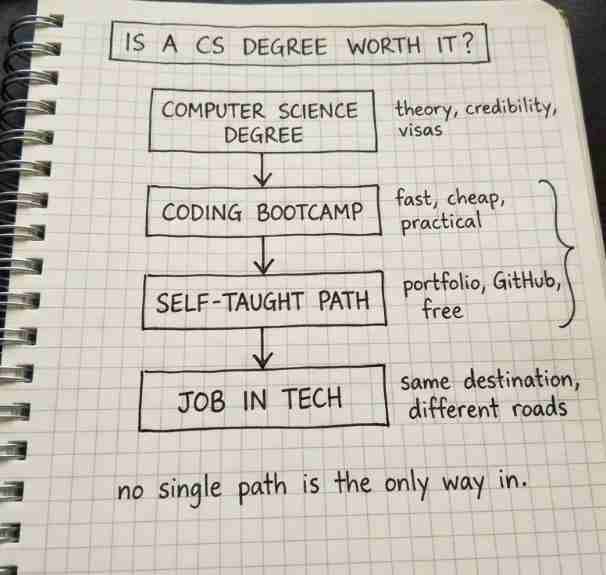
- The market rewards proof over credentials. Employers care less about a CS degree and more about whether you can actually ship and debug real code.
I'll say something that'll annoy a lot of career-advice blogs: most "skills you need" lists are written by people who've never actually sat on the hiring side of a technical interview. They're recycled from job postings, not from watching real candidates succeed or fail.
I've run technical screens, sat in on promotion committees, and mentored a dozen or so juniors through their first two years. The skills that actually matter — and when they matter — don't match the generic lists.
So here's the honest version: what gets you hired, what gets you promoted, and where I've watched good developers waste months on the wrong thing. What skills are needed to be a software developer really comes down to three buckets — core technical ability, a handful of engineering-specific habits, and communication skills nobody puts on a job posting but every manager quietly screens for. Let's get into it.
What Skills Are Needed to Be a Software Developer?
Being a software developer requires three things working together: deep fluency in one programming language, comfort with the tools that make code collaborative (Git, testing, debugging), and the ability to communicate your work clearly to other humans. Most guides stop at the first bucket and barely mention the third — which is exactly why so many technically strong developers stall out at mid-level.
If you're prepping to apply, see the linked guide on how to actually present these skills on a resume — including what recruiters skim past.
How Many Software Developer Jobs Are Actually Out There Right Now?
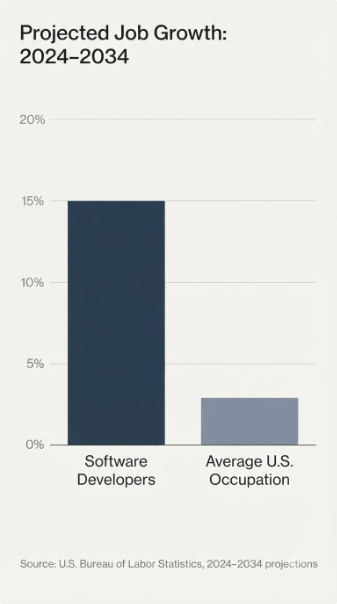
The U.S. Bureau of Labor Statistics projects 15% employment growth for software developers, quality assurance analysts, and testers from 2024 to 2034 — well above the average for all occupations. That translates to roughly 129,000 new openings a year, and median pay sits around $133,080 as of May 2024 data.
Here's what that number actually means for you: the aggregate market is strong, but hiring has gotten more selective at the entry level specifically. Junior req volume at companies worked with has genuinely shrunk while senior and mid-level demand stayed steady or grew.
What Technical Skills Do You Need to Be a Software Developer?
The technical skills you need to be a software developer are: deep fluency in one programming language, working knowledge of data structures and algorithms, Git version control, systematic debugging, basic testing, and enough SQL to work with a database.
Pick One Language and Actually Get Good at It
It's better to hire someone who's genuinely fluent in one language — writing it the way an experienced developer would, not just code that technically runs — than someone who's dabbled in five languages at a beginner level. Breadth is useful later. It's a liability early on, because it usually means you're shallow everywhere.
Data Structures and Algorithms — Yes, You Still Need Them
You're not going to hand-write a red-black tree at your day job. But you will need to reason about why one approach is O(n) and another is O(n²), especially once you're working with real user data at scale.
One candidate wrote functionally correct code that would've timed out in production because it looped over a dataset three separate times when one pass would do.
Git — The Skill That Quietly Filters People Out
Real teams don't work off single local commits. They work off branches, pull requests, and rebases against a shared main branch, multiple times a day.
git checkout -b feature/login-form       # isolate your work
git add .
git commit -m "Add login form validation"
git push origin feature/login-form       # open a PR

# keep your branch synced so merge conflicts don't pile up
git fetch origin
git rebase origin/mainDebugging and Testing
Debugging is a process, not a guessing game: reproduce it, isolate it, form a hypothesis, test the hypothesis. Writing unit tests as you go — not after — is what catches the edge cases before a reviewer (or a user) does.
| Technical Skill | Why It Matters | What "Good Enough" Looks Like Early On |
|---|---|---|
| One language, deeply | You need to read and write production code fluently | Idiomatic code a senior dev wouldn't wince at |
| Data structures & algorithms | Underpins interviews and real performance decisions | Arrays, hash maps, trees, and basic Big-O intuition |
| Git | Non-negotiable for any team-based work | Branching, rebasing, resolving conflicts without panic |
| Debugging | Resolves real production issues efficiently | Reproduce → isolate → hypothesize → verify |
| Testing | Prevents regressions, builds reviewer trust | Writing assertions, basic mocking |
| SQL | Handles persistent data storage and retrieval | Joins, indexing basics, parameterized queries |
What Soft Skills Do Software Developers Need?
The soft skills that matter most for software developers are clear technical writing, the ability to frame ambiguous problems into scoped tasks, and giving and receiving code review feedback without ego.
One mentored junior developer, Priya, was one of the strongest coders on the team technically. For her first six months, her pull requests got stuck in review constantly — not because the code was wrong, but because her PR descriptions said things like 'fixed bug' with zero context.
Once she started writing three sentences explaining what broke, why, and how she verified the fix, her review turnaround time dropped by more than half.
- Technical writing: Clear commit messages and PR descriptions save the next person (often future-you) real time.
- Problem framing: Turning a vague product ask into a scoped technical task is genuinely one of the hardest skills to build, and almost nobody teaches it directly.
- Code review etiquette: Giving specific, kind, actionable feedback — and not getting defensive when you receive it — accelerates everyone's velocity.
- Realistic estimation: Padding your estimate isn't dishonest. Pretending technical debt doesn't exist is.
- Knowing when to ask vs. dig: Struggling for 20 minutes builds skill. Struggling for four hours burns everyone's time, including yours.
Not sure how to talk about soft skills without sounding vague on a resume? See the linked guide for how to phrase it.
How Do Required Skills Change from Junior to Senior?
The skills required for a junior developer center on syntax, Git workflows, and executing scoped tasks, while senior developers need system design judgment, risk assessment, and the ability to align technical decisions with business goals.
| Level | Main Technical Focus | What Actually Changes |
|---|---|---|
| Junior | Syntax, Git, basic testing, debugging | Absorbing feedback, navigating an unfamiliar codebase |
| Mid-level | Shipping complex features independently | Mentoring, module-level design decisions |
| Senior | System architecture, trade-off calls | Setting standards, owning ambiguity across teams |
It's a common mistake to assume senior means 'knows more syntax.' It doesn't. It means you're trusted to make judgment calls with incomplete information, and that trust is earned through soft skills as much as code quality.
Do Required Skills Change by Specialization?
Yes — the core fundamentals (a language, Git, debugging, testing) stay constant, but each specialization layers on its own required skill set. A backend-heavy full-stack developer needs different depth than someone doing mobile or infrastructure work, even though both are 'software developers.'
- Full-stack web: HTML/CSS, JavaScript or TypeScript, REST or GraphQL APIs, and database integration.
- Mobile: Native SDKs (Swift or Kotlin) or a cross-platform framework, plus real attention to memory and network constraints.
- Data engineering: Advanced SQL, distributed processing, and ETL pipeline design.
- Cloud/DevOps: Docker, Kubernetes, CI/CD pipelines, and infrastructure-as-code tools like Terraform.
As of 2026, Stack Overflow's developer survey found Python's adoption accelerated significantly, with a 7-percentage-point jump in usage from 2024 to 2025, largely driven by AI and data work.
A Realistic Roadmap for Building These Skills
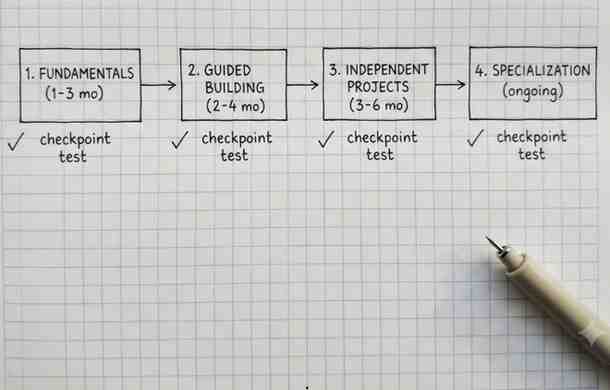
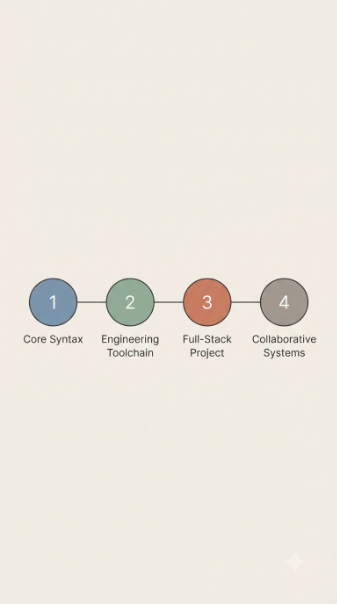
If you're starting from zero, here's the order to actually follow — not the order most bootcamps market, but the order that avoids the traps seen most often.
- Core syntax and logic (1–3 months): Build something real — a command-line tool, not another to-do list tutorial — without following a step-by-step guide.
- Engineering toolchain (2–4 weeks): Get comfortable enough with Git that a merge conflict doesn't make you panic. Write your first real unit tests.
- Full-stack project execution (2–4 months): Ship something with a database and real user authentication — not a mockup, something that actually stores and retrieves data.
- Collaborative systems (ongoing): Get a pull request merged into someone else's codebase. Open source, a team project, anything with a real reviewer on the other end.
Mistakes That Quietly Slow People Down
- Framework chasing: Jumping to the next hot framework before your fundamentals in the current one are solid.
- Coding in isolation: Never experiencing a real merge conflict or a real code review means your first one happens on the job, under pressure, in front of people you want to impress.
- Treating errors as failures instead of clues: The best debuggers get curious about a bug, not frustrated by it.
- Skipping written communication practice: Weak PR descriptions and thin documentation are the single most common gap seen in otherwise strong junior engineers.
So, What Skills Do You Actually Need?
Boiled down to one sentence: get genuinely good at one language, learn Git like you'll use it every day (because you will), and practice writing about your code as much as you practice writing the code itself. Everything else — the frameworks, the specializations, the fancy system design vocabulary — builds on that foundation, not around it.
The developers who stall out aren't the ones who know fewer algorithms. They're the ones who never got comfortable with the collaborative, communicative side of the job. Start there, and the rest compounds a lot faster than you'd expect.
Frequently Asked Questions
Do you need a computer science degree to become a software developer?+
No. Employers increasingly evaluate candidates on demonstrated ability — a portfolio, open-source contributions, or a strong technical interview — over formal credentials. A degree can help, but it's not required, especially at companies hiring through skills-based screens.
How long does it take to learn the skills needed to be a software developer?+
Most people reach a hireable junior level in 6–12 months of consistent, project-based learning, not tutorial-watching. It depends heavily on prior technical exposure and how much time you can put in weekly.
What programming language should I learn first?+
Python and JavaScript are the most commonly recommended starting points because of their large communities and job market demand. The 'right' language matters less than actually getting deep in whichever one you pick.
Is Git really necessary if I'm just starting out?+
Yes — nearly every real engineering job uses Git daily, and interviewers frequently ask about it directly. Learning it early avoids a painful adjustment once you're on a team.
What's the difference between a software developer and a software engineer?+
In most companies today, the titles are used interchangeably, though 'engineer' sometimes implies a slightly more systems-focused role. The actual skill requirements overlap almost completely.
Do soft skills really matter as much as coding ability?+
For getting your first job, coding ability matters more. For getting promoted past your first or second role, soft skills like communication and code review often matter more than raw technical output.
What's the biggest mistake beginners make when learning to code?+
Chasing new frameworks and languages before mastering fundamentals in one. Depth beats breadth, especially in your first year.