Creative Ability Test: The Complete Guide to How Creativity Is Actually Measured
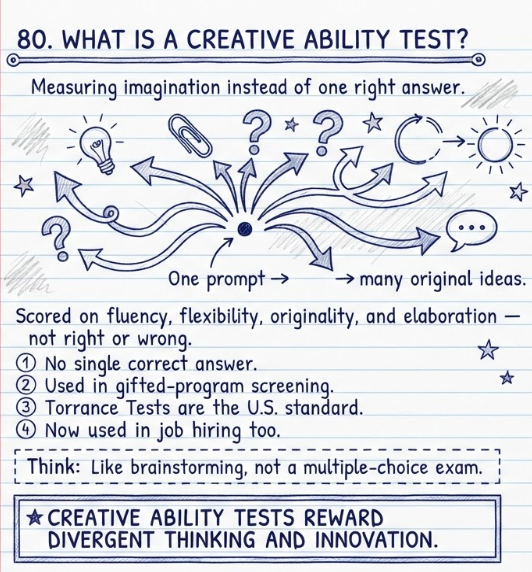
Standard IQ and achievement tests are built to find one correct answer as fast as possible. That's the opposite of what creativity actually looks like, which is why a completely different category of assessment exists specifically to measure it: the creative ability test. If you've heard the term because your child's school district mentioned it during gifted and talented screening, or because a job application asked you to complete an unusual open-ended exercise, you've run into one branch of a testing tradition that's been developed and refined in the U.S. for almost 70 years.
The core problem these tests are trying to solve is genuinely hard: creativity doesn't have a single correct answer to check against, so it can't be scored the way a math test or a vocabulary test can. Instead, creative ability tests measure specific, observable components of creative thinking — how many distinct ideas someone generates, how varied those ideas are, how statistically unusual they are, and how much detail they add — and combine those component scores into a picture of someone's creative thinking capacity.
This guide covers what a creative ability test actually measures and why, the Torrance Tests of Creative Thinking — the most widely used creativity test in American schools — in full detail, the other tests used in education and hiring, how scoring actually works, where these tests get used in practice, and their real, well-documented limitations.
What a Creative Ability Test Actually Measures
The foundational concept behind nearly every creative ability test is divergent thinking — the ability to branch outward from a single starting point toward many different possible ideas or solutions, rather than converging on one right answer. This idea traces back to psychologist J.P. Guilford's research on the structure of intellect, which argued that traditional intelligence testing captured only convergent thinking and was missing an entire category of mental ability.
Rather than asking test-takers to select or calculate a single correct response, a creative ability test typically presents an open-ended prompt — an incomplete drawing, an ambiguous picture, an ordinary object — and asks the test-taker to generate as many original responses as possible within a set time limit. The test isn't judging whether any individual response is 'right'; it's measuring patterns across the full set of responses a person produces.
The Torrance Tests of Creative Thinking (TTCT): How It Works
The TTCT is the most widely used creativity test of its kind in the U.S. today, largely because it requires the test-taker only to reflect on ordinary life experience rather than specialized knowledge, making it usable across a very wide range of ages, backgrounds, and abilities. It was originally developed as the Minnesota Tests of Creative Thinking, first administered to elementary and high school students in the fall and winter of 1958–1959, and was renamed the Torrance Tests of Creative Thinking in 1966 after Torrance moved to the University of Georgia. It's published today by Scholastic Testing Service and remains the field's benchmark instrument.
The full test has two distinct parts, and school districts often administer only selected activities from one or both parts rather than the complete battery, depending on their specific screening goals.
| Part | Format | What It Involves |
|---|---|---|
| Figural TTCT | Drawing-based, three activities | Test-takers draw and title pictures based on an incomplete shape or figure — for example, building a picture around a gray, kidney-shaped form, or completing ten incomplete figures into full images. |
| Verbal TTCT | Writing-based, seven subtests | Test-takers write responses to prompts such as asking questions about a picture, guessing causes and consequences of a depicted situation, or listing unusual uses for a common object — measuring fluency and originality in written ideas. |
The complete TTCT battery is administered by a psychologist over roughly 90 minutes. In practice, many school districts select just one figural and one verbal activity to administer alongside other intelligence or achievement testing, rather than running the full battery — which keeps total testing time manageable while still capturing a meaningful creativity signal.
How TTCT Scoring Actually Works
This is the part most people outside of psychology and education never see: TTCT responses aren't scored as simply 'creative' or 'not creative.' They're broken down into specific, separately measured dimensions, several of which are norm-referenced against a large existing dataset of prior test-takers.
| Dimension | What It Measures |
|---|---|
| Fluency | The total number of interpretable, meaningful, and relevant ideas a person generates in response to a prompt. |
| Flexibility | The number of distinct categories or approaches represented across those ideas — shifting between different types of thinking rather than variations on one idea. |
| Originality | The statistical rarity of a response, based on how unusual it is compared to the norm-referenced dataset of prior responses. |
| Elaboration | The amount of detail added to a response beyond its basic, minimally complete form. |
| Abstractness of Titles (Figural only) | The sophistication of a person's synthesizing and organizing thinking, reflected in how well a title captures the essence of a drawing rather than simply describing it literally. |
| Resistance to Premature Closure (Figural only) | A person's ability to keep possibilities open long enough to reach a more original idea, rather than settling on the first obvious interpretation. |
Beyond these primary norm-referenced measures, the TTCT also includes thirteen additional criterion-referenced indicators — a checklist of specific creative strengths, each scored on a simple 0–1–2 scale — which are pooled together with the norm-referenced scores to produce an overall Creativity Index.
Where Creative Ability Tests Are Actually Used in the U.S.
- Gifted and talented (GT) identification: many U.S. school districts and states incorporate some form of creativity testing into their broader gifted-identification matrix, particularly to help identify creatively gifted students whose strengths might not fully show up on IQ or achievement tests alone. This use is especially emphasized in multicultural and diverse student populations, since divergent-thinking tasks rely less on specific accumulated academic knowledge than traditional testing does.
- Pre- and post-testing for creativity programs: because the TTCT is published in two equivalent forms (Form A and Form B), schools and researchers can administer it before and after a creativity-focused curriculum or intervention to measure whether the program produced a measurable shift in students' divergent thinking scores.
- Corporate hiring and workplace assessment: outside of education, versions of the same underlying divergent-thinking testing approach now appear in employment assessment platforms, particularly for roles in design, marketing, product development, and other functions where idea generation is a core job requirement.
- Research on creative development: longitudinal and cross-sectional studies of how creativity develops or changes over a lifespan frequently rely on TTCT-style measures, given the decades of normative data now available for comparison.
Other Creativity Assessments You Might Encounter
The TTCT is the most widely used, but it isn't the only creativity assessment in circulation — several other instruments measure related but distinct aspects of creative ability.
- Guilford's Alternative Uses Test: one of the earliest divergent-thinking tasks, asking test-takers to list as many uses as possible for a common object (like a brick or a paperclip) — the direct ancestor of several TTCT-style verbal subtests.
- Wallach-Kogan Creativity Tests: developed as an alternative to Torrance's approach, focused specifically on measuring 'creative tendencies' through untimed, game-like tasks rather than a formally timed test format.
- Remote Associates Test (RAT): presents three seemingly unrelated words and asks the test-taker to find a fourth word that connects all three — used more often in adult and workplace creativity research than in K-12 school settings.
- Consensual Assessment Technique (CAT): rather than scoring specific dimensions, this approach has a panel of expert judges independently rate real creative products (like artwork or writing samples) for creativity, based on the idea that experts in a domain can reliably recognize creativity even without a formal scoring rubric.
What to Actually Expect If You (or Your Child) Take One
- There's no way to 'study' for a creative ability test in the traditional sense — since responses are scored on originality and fluency rather than factual correctness, memorized answers don't transfer the way they would for a content-based exam.
- Expect open-ended prompts with generous time limits per activity — the format rewards generating multiple distinct ideas within the time given, rather than perfecting a single response.
- For the Figural TTCT specifically, expect drawing-based tasks (completing an incomplete shape, building a picture from a given form) rather than writing — don't worry about artistic skill, since scoring focuses on originality and elaboration of the idea, not draftsmanship.
- For the Verbal TTCT, expect writing-based tasks like listing questions about a picture, or generating unusual uses for an everyday object — quantity and variety of ideas both matter, so it's generally better to generate more distinct responses than to spend all your time perfecting one.
- A full TTCT administration is typically proctored by a trained psychologist and takes about 90 minutes for the complete battery, though many school settings only administer selected portions.
- Results are typically reported alongside other testing (like IQ or achievement scores) as part of a broader gifted-identification profile, not usually as a standalone pass/fail outcome.
Real Limitations Worth Knowing About
Creative ability tests, including the TTCT, are widely used but not without genuine, well-documented limitations that are worth understanding rather than treating the score as a definitive verdict on someone's creative potential.
- A single test captures divergent thinking specifically, which is only one component of what most psychologists consider the fuller picture of real-world creativity — motivation, domain expertise, and persistence all matter enormously in actual creative achievement and aren't directly measured by a 90-minute assessment.
- Scores can be influenced by test-taking comfort and familiarity with open-ended formats, which isn't identical across all students, particularly younger children encountering this kind of unstructured task for the first time.
- Even test publishers and researchers are explicit that the TTCT is most useful alongside other measures and direct observation, not as a standalone determination of whether someone is 'creative' or not.
- Because scoring for certain dimensions (like originality) depends on comparison against a norm-referenced dataset, results can shift somewhat as cultural context and common response patterns change over time, which is part of why the test has been periodically updated and re-normed since its original development.
Conclusion
A creative ability test isn't measuring whether someone is broadly 'creative' in some abstract, unmeasurable sense — it's measuring a specific, well-defined set of divergent-thinking behaviors: how many original ideas someone generates, how varied those ideas are, how statistically unusual they are, and how much detail and organizing thought they bring to them. The Torrance Tests of Creative Thinking has stayed the dominant instrument in American schools for close to seven decades because it captures those behaviors in a format that works across a genuinely wide range of ages and backgrounds, and because Torrance's own long-term follow-up research gave the field unusually strong evidence that early scores connect to real creative outcomes later in life.
Whether you're encountering one of these tests through a school's gifted-identification process, a research study, or an employer's hiring assessment, the most useful mindset going in is the same: there's no single correct answer to find, so the goal is simply to generate as many genuine, varied ideas as the format allows, rather than searching for the one response the test 'wants.'
Frequently Asked Questions
What is a creative ability test?+
A creative ability test is a psychological assessment designed to measure divergent thinking — the capacity to generate multiple original ideas or solutions from an open-ended prompt — rather than convergent thinking, which is what standard IQ and achievement tests measure. Rather than checking for one correct answer, it evaluates patterns across all the responses a person produces, typically scoring dimensions like fluency, flexibility, originality, and elaboration.
What is the Torrance Tests of Creative Thinking (TTCT)?+
The TTCT is the most widely used creativity assessment in U.S. schools, originally developed by psychologist E. Paul Torrance starting in 1958 as the Minnesota Tests of Creative Thinking and renamed in 1966. It has two parts — a drawing-based Figural test and a writing-based Verbal test with seven subtests — and is scored across dimensions including fluency, flexibility, originality, elaboration, abstractness of titles, and resistance to premature closure.
Who administers creative ability tests and where are they used?+
In schools, the full TTCT battery is typically administered by a trained psychologist, often as part of a broader gifted and talented identification process alongside IQ and achievement testing. Many districts select specific activities rather than the full 90-minute battery. Outside education, similar divergent-thinking assessments increasingly appear in workplace hiring evaluations, particularly for design, marketing, and product roles.
How is the TTCT scored?+
Responses are scored across several norm-referenced dimensions — fluency (number of relevant ideas), flexibility (variety of categories represented), originality (statistical rarity of responses), and elaboration (amount of detail) — plus, for the Figural test, abstractness of titles and resistance to premature closure. An additional set of thirteen criterion-referenced indicators is pooled with these scores to produce an overall Creativity Index.
Can you study or prepare for a creative ability test?+
Not in the traditional sense, since there are no correct answers to memorize — scoring is based on originality and fluency of ideas rather than factual accuracy. The most useful preparation is simply understanding the format in advance (open-ended prompts, generous time limits, drawing or writing-based responses) so the unfamiliarity of the task itself doesn't limit performance, particularly for younger children.
Are creative ability tests reliable predictors of real creativity?+
The TTCT specifically has unusually strong longitudinal evidence behind it, including a well-documented 22-year follow-up study of original test-takers examining whether childhood scores predicted real-world creative achievement. That said, both test publishers and researchers are explicit that these tests capture divergent thinking specifically — one component of creativity — and work best combined with other measures and direct observation rather than as a standalone verdict.
What's the difference between the Figural and Verbal TTCT?+
The Figural TTCT is drawing-based, involving three activities like completing incomplete shapes or building an image from a given form, and measures dimensions including abstractness of titles and resistance to premature closure that don't apply to the verbal test. The Verbal TTCT is writing-based, with seven subtests such as asking questions about a picture or listing unusual uses for an object, focused on fluency and originality in written ideas.
Are there other creativity tests besides the TTCT?+
Yes. Guilford's Alternative Uses Test, an earlier divergent-thinking task, is a direct ancestor of several TTCT-style subtests. The Wallach-Kogan Creativity Tests use untimed, game-like tasks instead of a formal timed format. The Remote Associates Test asks test-takers to find a connecting word between three unrelated terms, and is used more in adult and workplace research. The Consensual Assessment Technique instead has expert judges directly rate real creative work, rather than scoring a standardized task.
Do employers use creativity tests when hiring?+
Yes, increasingly. Employment assessment platforms have adapted the divergent-thinking approach behind tests like the TTCT into workplace-relevant exercises, particularly for roles where idea generation is central to the job, such as design, marketing, and product development.
What does a low score on a creative ability test actually mean?+
A single test score reflects performance on a specific set of divergent-thinking tasks at one point in time, under specific conditions — it doesn't capture the full range of what contributes to real-world creative achievement, including domain expertise, motivation, and persistence. Test publishers and researchers consistently recommend interpreting results alongside other measures and direct observation rather than treating a single score as a definitive assessment of someone's creative potential.