Science Training Programme: Which Type Actually Fits You?
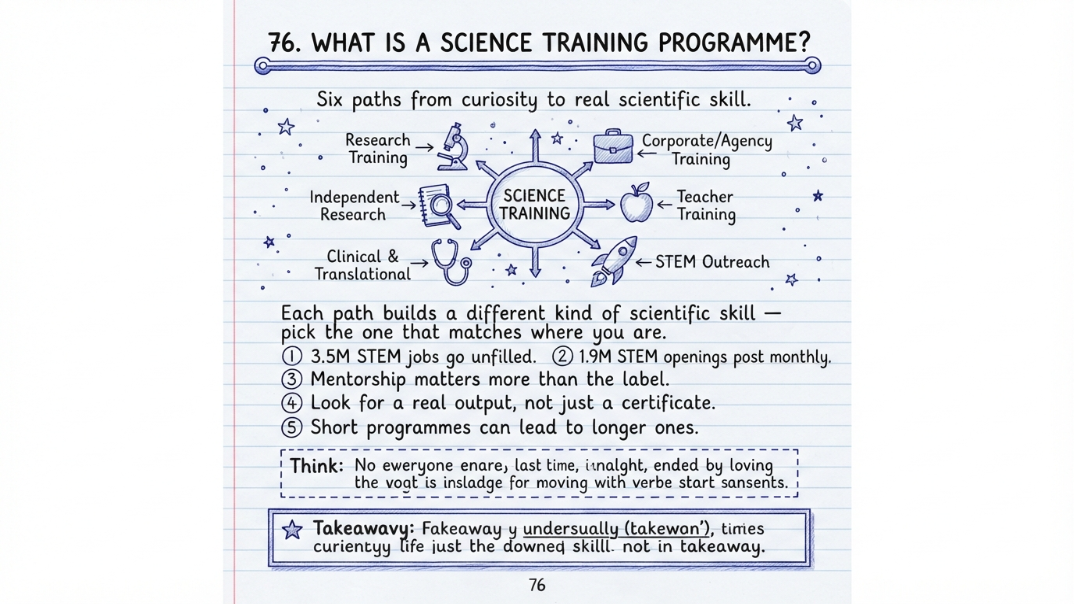
Type 'science training programme' into a search engine and you'll get a dizzying mix of results: high school weekend immersions, government regulatory bootcamps, multi-year clinical fellowships, and teacher leadership retreats. They all use the exact same label, but they serve completely different career stages.
This fragmentation is a big reason so many people miss out on the right opportunities. The demand for applied scientific talent has never been higher. According to recent U.S. Chamber of Commerce labor reports, roughly 3.5 million STEM jobs remain open due to critical skill gaps, particularly across data analytics, cybersecurity, and advanced biomanufacturing. Every month, around 1.9 million STEM positions are posted.
Degree programs build a foundation of theory, but they rarely teach you how to manage an active clinical trial, navigate complex science policy, or transition a lab discovery into an industrial workflow. A structured science training programme bridges that exact gap. This guide breaks down the six main categories, how to spot high-quality options, and how to leverage your completed training into a long-term career advantage.
What a Science Training Programme Actually Delivers
Strip away the institutional jargon, and a true science training programme is a structured, time-bound framework designed to deliver hands-on, applied capability. Unlike a standalone online course, a genuine training programme provides four distinct anchors:
- Cohorted cohorts: You learn and work alongside a dedicated peer group rather than in isolation.
- Direct mentorship: Access to senior investigators, industry scientists, or policy leaders who guide your progress.
- Practical rotations or projects: Real work in lab settings, policy hubs, or field environments.
- Concrete portfolio outputs: A published paper, a formal poster presentation, or a validated dataset you can present to future employers.
The 6 Core Types of Science Training Programmes
Identifying which structure matches your goals is the vital first step before drafting applications.
| Programme Type | Target Audience | Core Focus & Activities | Typical Duration |
|---|---|---|---|
| Academic & Research Fellowships | Graduate students, postdocs, early-career researchers | Lab rotations, grant-writing workshops, methodology mastery, and co-authored publication pipelines | 6 months to 3+ years |
| Corporate & Government Scientific Upskilling | Working scientists, regulatory officers, agency staff | Targeted modules on emerging frameworks (e.g., food safety compliance, computational toxicology, advanced data platforms) | A few days to multi-year rolling tracks |
| Teacher & Educator Placements | K-12 and university science faculty | Immersion in active research labs paired with curriculum design to bring real-world science back to classrooms | 3 months to 18 months |
| STEM Outreach & Youth Immersions | Middle and high school students | Hands-on lab access, equipment exposure, and guided experiments designed to build early scientific confidence | 1 to 4 weeks |
| Clinical & Translational Science (CTSA) | Junior faculty, clinical fellows, biomedical postdocs | Translating laboratory discoveries into real-world medical practice ('bench-to-bedside'), trial design, and regulatory strategy | 6 months to 2 years |
| Independent Research & Citizen Science | Self-directed learners, students without institutional lab access | Mentors guide independent inquiry projects, leading to competitive science awards, badges, or public registry entries | 1 month to a full academic year |
Why Structured Science Training Is Critical Right Now
Three industry shifts make structured scientific training essential today:
1. Specific, Persistent Talent Gaps: The 3.5 million open STEM roles aren't evenly distributed. They are heavily concentrated in specialized sub-fields like computational biology, regulatory compliance, and machine learning for materials science. Standard degree tracks often adapt too slowly to keep up with these needs.
2. Bridging Workforce Representation Gaps: While women make up nearly half of the general workforce and college graduates, they account for roughly 35% of STEM workers—a number that drops even lower in engineering and computer science. Mentorship-heavy training schemes provide the structural support needed to keep underrepresented talent moving upward.
3. Rapid Regulatory & Methodological Changes: Organizations like the FDA and European Food Safety Authority (EFSA) now run mandatory, ongoing scientific training cycles. Modern research tools and compliance rules evolve so fast that even veteran scientists must periodically upskill.
Deep Dive: What Each Pathway Expects From You
Before submitting applications, understand the realistic demands and expectations of each pathway:
Academic & Research Fellowships focus heavily on output. You are expected to master advanced tools quickly, manage raw data, and write publication-ready papers. Watch out for programs that treat trainees as extra lab hands without offering true mentorship.
Corporate & Agency Training is typically paid for by employers and tightly aligned with internal goals. If you are aiming for regulatory compliance or corporate R&D roles, these programs are gold standards for career advancement.
Clinical & Translational Programs demand high cross-disciplinary collaboration. You'll often present findings to medical doctors, biostatisticians, and bioethics boards simultaneously.
A Practical Checklist: How to Select the Right Program
- Audit the Output: Will you walk away with a co-authored paper, a patent filing, or a recognized certification? Avoid vague experiential programs that offer no tangible proof of work.
- Verify Funding & Stipends: Academic and translational fellowships should provide a fair living stipend. Corporate tracks should be paid positions. Ensure there are no hidden lab or material fees before enrolling.
- Inspect the Mentor Ratio: Ask how many trainees each mentor handles. One-on-one or small-group mentorship accelerates career growth far better than large lecture halls.
- Talk to Alumni: Reach out to past participants on professional platforms. Ask whether the program opened real career doors or simply served as filler on their resumes.
How to Turn Your Training into a Job Offer
- Document Tech & Lab Tools Daily: Track the exact software pipelines, assays, and machinery you use. Hiring managers care deeply about tool-specific expertise.
- Secure References Early: Ask your assigned mentor for a recommendation letter while your project contributions are fresh in their mind.
- Highlight Tangible Artifacts: Feature your final research poster, code repository, or published paper at the top of your resume and portfolio site.
Frequently Asked Questions
What is a science training programme?+
It is a structured, time-bound training initiative focused on building practical, hands-on scientific skills, research capabilities, or regulatory knowledge that traditional academic degrees don't fully cover.
Are these training programs typically paid or free?+
Academic research fellowships and clinical programs usually pay participants a living stipend. Corporate training is fully funded by employers. High school outreach programs vary—many are free or grant-funded, though a few private camps charge tuition.
Can I enroll in a science training program without a STEM degree?+
Yes. Entry-level tracks, outreach programs, and independent citizen-science initiatives do not require prior technical degrees and serve as ideal stepping stones for career switchers.
How long do these programs usually last?+
Duration ranges from 1 to 4 weeks for outreach immersions, up to 6 months to 3 years for clinical fellowships and post-doctoral research placements.