MCA Course: Full Form, Duration, Eligibility, Fees, and Career Path Explained
If you have a bachelor's degree and are considering a postgraduate route into IT and software, the MCA course is one of the first names that comes up in almost every conversation about it. But most students searching for 'MCA course' actually have a handful of specific questions — what it stands for, how long it takes, who can apply, what it costs, and what comes after it. This guide answers each of those questions directly, based on how the course is currently structured under India's regulatory framework.
What Is MCA Course (Full Form, Meaning)
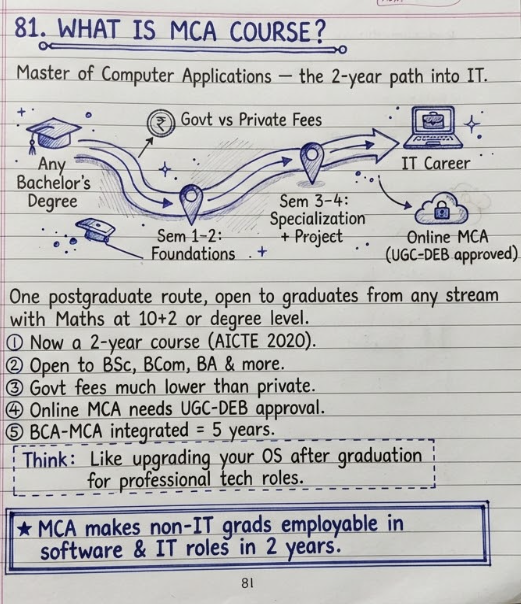
MCA stands for Master of Computer Applications. It is a postgraduate academic degree in India designed for students who want to build advanced, specialized knowledge in computer science, software development, and IT systems after completing a bachelor's degree.
Unlike an MTech in Computer Science, which usually requires a bachelor's degree in engineering, MCA is open to graduates from a wider academic background — including BSc, BCom, and BA graduates — as long as they meet the mathematics requirement described later in this article. This is one of the main reasons MCA has remained a popular route into the IT sector for students who didn't originally study engineering at the undergraduate level.
The MCA curriculum typically covers programming languages, data structures, database management systems, computer networks, operating systems, software engineering, and, in more recent syllabi, subjects like cloud computing, cybersecurity, and data analytics. The degree is offered by universities and institutions recognized or approved by the University Grants Commission (UGC) and, where applicable, the All India Council for Technical Education (AICTE).
MCA Course Duration & How Many Years
This is one of the most frequently confused points about the MCA course, mainly because the duration has changed in recent years.
Why some listings still mention three years: A number of websites and even some university pages still describe MCA as a three-year course. This is because a small number of legacy programmes, certain state university formats, and some distance or online variants had not fully transitioned at the time of writing, or continue to offer an older curriculum structure. If you're evaluating a specific college, it's worth confirming directly on the official website or with the admissions office whether the programme currently follows the two-year or an older three-year structure.
Semester structure: In the standard two-year format, the course is divided into four semesters, generally with a mix of core computer science subjects in the first two semesters, more specialized and elective subjects in semester three, and a major project or industry internship component in the final semester.
MCA Course Eligibility Criteria
Eligibility requirements are broadly similar across most universities, though individual institutions may set slightly different minimum marks or additional entrance exam requirements. The general criteria are:
- Educational qualification: A bachelor's degree (typically a minimum of three years) in any discipline from a recognized university.
- Mathematics requirement: Most universities require that the candidate has studied Mathematics either at the 10+2 (higher secondary) level or as a subject during their undergraduate degree. This is a near-universal requirement across MCA programmes because the course builds directly on mathematical and logical foundations needed for programming and algorithm design.
- Minimum marks: A minimum aggregate of around 50% marks in the qualifying bachelor's degree is commonly required at most institutions, with a relaxation (often to around 45%) for candidates belonging to SC/ST/OBC and other reserved categories, as per each university's specific policy.
- Entrance exams: While some universities offer direct, merit-based admission, many colleges and universities admit MCA students through entrance examinations. Commonly referenced entrance exams for MCA admission in India include NIMCET (NIT MCA Common Entrance Test), CUET PG, MAH MCA CET (Maharashtra), TANCET (Tamil Nadu), and university-specific tests conducted by individual private universities.
Because eligibility criteria and entrance exam requirements can differ from one university to another, it's important to check the specific admission brochure of the college or university you're applying to, rather than relying only on general guidelines.
MCA Course Fees (Govt vs Private Colleges, Approximate Range in INR)
MCA course fees in India vary considerably depending on whether you choose a government-run institution, a government-aided college, or a private university, as well as the reputation and location of the institution.
| Institution Type | Approximate Total Fee (2 Years) | Notes |
|---|---|---|
| Government / government-aided colleges | ₹20,000 – ₹1,00,000 | Often regulated by a state Fee Regulation Committee; varies by state |
| Private universities and colleges | ₹1,00,000 – ₹6,00,000+ | Varies by infrastructure, placement support, location, and brand reputation |
| Online MCA programmes | ₹50,000 – ₹4,00,000 | Depends on university and chosen specialization |
These figures are indicative ranges based on typical fee patterns across Indian institutions and are meant to help you set expectations, not to represent an exact quote for any specific college. Scholarships may also be available for eligible students — for instance, AICTE offers postgraduate scholarships for GATE-qualified candidates, and several states and universities run merit-based or category-based fee concessions.
MCA Course Subjects & Syllabus Overview
While the exact syllabus differs from one university to another, most MCA programmes are built around a common core of computer science subjects, supplemented by electives and specialization tracks in the later semesters. A typical subject breakdown looks like this:
| Semester | Focus | Typical Subjects |
|---|---|---|
| Semester 1–2 | Core Foundations | Programming fundamentals (C, Python, or Java), data structures and algorithms, DBMS and SQL, computer organization and architecture, operating systems, discrete mathematics and probability/statistics, object-oriented programming |
| Semester 3 | Advanced & Applied Subjects | Software engineering and project management, computer networks, web technologies, mobile application development, electives such as AI, machine learning, cloud computing, cybersecurity, or data analytics |
| Semester 4 | Project / Internship | A major academic project involving design and development of a working software application, often combined with or allowing for an industry internship component |
Some universities also include subjects on professional and business communication, IT project management, and emerging technology electives such as blockchain or the Internet of Things (IoT), reflecting how the syllabus has evolved to stay aligned with current industry trends.
Online MCA Course (Recognized Options, UGC-DEB Approval Note)
Online MCA programmes have become a genuine, recognized alternative to the traditional on-campus format, particularly for working professionals who want to upskill without leaving their jobs.
- Recognition to check for: For an online MCA degree to be valid and recognized in India, the offering university must have approval from the UGC's Distance Education Bureau (UGC-DEB) for its online programmes, in addition to any relevant AICTE approvals where applicable. Before enrolling, independently verify the university's current UGC-DEB approval status directly on the UGC's official website, since approval lists are updated periodically and can be programme-specific and time-bound.
- Typical structure: Most recognized online MCA programmes follow the same two-year, four-semester structure as the on-campus format, delivered through recorded and live online lectures, digital study material, online assessments, and, in many cases, proctored online examinations.
- Specializations: A number of universities now offer specialization tracks within their online MCA programmes, such as artificial intelligence and machine learning, cloud computing, full-stack development, cybersecurity, or data analytics, allowing students to align the degree more closely with their intended career direction.
- Eligibility: Eligibility criteria for online MCA programmes are broadly similar to on-campus programmes — a bachelor's degree from a recognized university, typically with a minimum aggregate mark requirement that varies by institution (commonly somewhere between 40% and 50%).
As with any online degree, it's worth confirming the university's approval status, accreditation, and how employers in your target industry view online postgraduate degrees, before making a final decision.
BCA to MCA Integrated Course
Some universities in India offer an integrated BCA-MCA programme, combining the Bachelor of Computer Applications (BCA) and Master of Computer Applications (MCA) into a single continuous academic track, typically spanning around five years in total.
- How it works: Rather than completing a standalone three-year BCA and then separately applying for a two-year MCA, students admitted to an integrated programme move through both degrees as part of one structured academic pathway at the same institution, often without needing to sit a separate MCA entrance exam partway through.
- Potential advantages: This format can offer continuity in learning, potentially reduced overall programme duration compared to doing both degrees separately with gaps in between, and, at some institutions, a more integrated and progressively advanced curriculum designed specifically for the combined pathway.
- What to check before choosing this route: Because the integrated BCA-MCA format is offered by a comparatively smaller number of universities compared to standalone BCA and MCA programmes, confirm the specific institution's accreditation, the recognition of the integrated degree structure, and whether the programme allows for an exit option (such as receiving the BCA degree independently) if a student chooses not to continue into the MCA portion.
After MCA, Which Course/Certification Is Best (Career Advancement Options)
Many MCA graduates choose to strengthen their profile further with additional certifications or higher studies, depending on their specific career interests. There is no single 'best' option — the right choice depends on the direction you want your career to take.
- Cloud computing certifications: Certifications from major cloud platforms (such as AWS, Microsoft Azure, or Google Cloud) are commonly pursued by MCA graduates interested in cloud infrastructure, DevOps, or systems architecture roles, since cloud skills are widely used across the IT industry.
- Data science and analytics certifications: For graduates interested in data-focused roles, structured certification programmes in data science, machine learning, or business analytics can help build specific, demonstrable skills that complement the broader MCA curriculum.
- Cybersecurity certifications: Given the growing focus on information security across industries, certifications in ethical hacking, network security, or related cybersecurity domains are a common next step for MCA graduates drawn to this specialization.
- MTech or MS in Computer Science: Some MCA graduates choose to pursue further academic study, such as an MTech or an MS (including options abroad), particularly if they're interested in research-oriented or highly specialized technical roles.
- MBA: For graduates who want to move toward IT management, product management, or business-facing technology roles rather than a purely technical track, an MBA (particularly with a systems or IT specialization) is a commonly considered option.
- UGC-NET / PhD: For those interested in an academic or research career, qualifying the UGC-NET examination and pursuing a PhD in Computer Science is a recognized pathway toward teaching and research positions.
Rather than assuming any single certification or degree guarantees a particular outcome, it's more useful to identify the specific technical or managerial direction you want to move toward, and then choose a certification or further qualification that builds directly relevant, demonstrable skills in that area.
MCA Course Details in Hindi (हिंदी सारांश)
MCA का पूरा नाम Master of Computer Applications है। यह भारत में स्नातक (bachelor's degree) के बाद की जाने वाली एक पोस्टग्रेजुएट डिग्री है, जो कंप्यूटर एप्लिकेशन, सॉफ्टवेयर डेवलपमेंट और IT क्षेत्र में गहन ज्ञान प्रदान करती है।
अवधि: AICTE के 2020 के पाठ्यक्रम सुधार के बाद, अधिकतर संस्थानों में MCA अब 2 वर्ष (4 सेमेस्टर) का कोर्स है, हालांकि कुछ पुराने या डिस्टेंस प्रोग्राम अब भी 3 वर्ष की संरचना में हो सकते हैं — विशेष कॉलेज की जानकारी उसकी आधिकारिक वेबसाइट से अवश्य जांचें।
पात्रता: किसी भी विषय में स्नातक डिग्री, जिसमें 10+2 स्तर या स्नातक स्तर पर गणित (Mathematics) विषय होना अनिवार्य है, तथा सामान्यतः न्यूनतम 50% अंक (आरक्षित श्रेणी के लिए छूट संभव) की आवश्यकता होती है।
फीस: सरकारी कॉलेजों में फीस अपेक्षाकृत कम (लगभग ₹20,000 से ₹1,00,000 पूरे कोर्स के लिए) होती है, जबकि निजी विश्वविद्यालयों में यह ₹1,00,000 से ₹6,00,000 या उससे अधिक तक हो सकती है। यह आंकड़े केवल सांकेतिक हैं — सटीक फीस के लिए संबंधित संस्थान से संपर्क करें।
ऑनलाइन MCA: ऑनलाइन MCA डिग्री की मान्यता के लिए संबंधित विश्वविद्यालय के पास UGC-DEB (Distance Education Bureau) की स्वीकृति होना आवश्यक है — दाखिला लेने से पहले यह जांच अवश्य करें।
MCA के बाद: MCA के बाद विद्यार्थी क्लाउड कंप्यूटिंग, डेटा साइंस, साइबर सिक्योरिटी जैसे सर्टिफिकेशन, या MTech, MBA, अथवा UGC-NET/PhD जैसे उच्च शिक्षा विकल्पों में से अपनी रुचि और करियर लक्ष्य के अनुसार चयन कर सकते हैं।
Frequently Asked Questions
Is MCA a 2-year or 3-year course?+
Under AICTE's 2020 curriculum reform, MCA is now predominantly a two-year (four-semester) postgraduate programme at most institutions. However, some legacy or distance-mode programmes may still follow an older three-year structure, so it's best to confirm the exact duration with the specific college or university you're applying to.
Can a non-computer science graduate do MCA?+
Yes. MCA is open to graduates from a range of academic backgrounds — including BSc, BCom, and BA — as long as the candidate has studied Mathematics either at the 10+2 level or during their undergraduate degree, along with meeting the university's minimum marks requirement.
Is MCA better than MTech?+
Neither is universally 'better' — they serve different academic backgrounds and goals. MCA is generally more accessible to graduates from varied disciplines and focuses on computer applications and software development, while MTech in Computer Science typically requires an engineering background and often leans more toward research-oriented or core technical specialization. The right choice depends on your undergraduate background and career interests.
Is online MCA valid for government jobs and higher studies?+
An online MCA degree is generally considered valid for further studies and employment, including government job eligibility criteria that specify a postgraduate degree, provided the offering university has valid UGC-DEB approval for its online programmes. It's important to verify a specific university's current approval status directly before enrolling, since recognition can be programme-specific.
What is the difference between MCA and BCA-MCA integrated course?+
A standalone MCA is a two-year postgraduate degree pursued after completing any bachelor's degree separately. A BCA-MCA integrated course combines both degrees into one continuous programme, typically spanning around five years at the same institution, without necessarily requiring a separate entrance exam between the two stages.
Does MCA require an entrance exam?+
It depends on the university. Many colleges and universities in India admit MCA students through entrance examinations such as NIMCET, CUET PG, MAH MCA CET, or university-specific tests, while some institutions offer direct or merit-based admission. Check the specific admission process listed by your target university.
What subjects are covered in the first year of MCA?+
The first year (semesters 1 and 2) typically covers foundational subjects such as programming fundamentals, data structures and algorithms, database management systems, computer organization and architecture, operating systems, and discrete mathematics, before moving into more advanced and elective subjects in the second year.
Is MCA a good option after BCA?+
Many BCA graduates choose to pursue MCA as a natural next step to deepen their technical knowledge and improve their postgraduate qualifications for the IT sector. Whether it's the right choice depends on individual career goals, since some BCA graduates instead choose to enter the workforce directly or pursue alternative certifications based on their specific interests.