Mechanical Engineering: The Complete 2026 Guide to Branches, Curriculum, Careers, Salary, and Trends
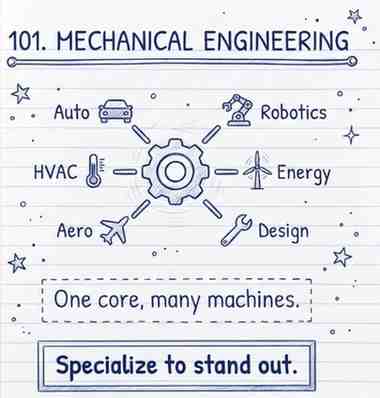
Mechanical engineering is the branch of engineering concerned with the design, analysis, manufacturing, and maintenance of mechanical systems — anything that involves motion, force, energy conversion, or physical structure. It's one of the oldest and broadest engineering disciplines, and that breadth is exactly what makes it hard to summarize in a sentence: a mechanical engineer might design a jet engine turbine, an artificial knee joint, a robotic arm, a car's suspension system, a building's HVAC system, or a satellite's thermal control system — genuinely different products, unified by the same underlying core: applying mechanics, thermodynamics, materials science, and design principles to build things that work reliably in the physical world.
That breadth is also why mechanical engineering has remained consistently in demand even as more specialized engineering fields have emerged around it. The U.S. Bureau of Labor Statistics projects roughly 19,800 annual job openings for mechanical engineers, with employment growth in the high single digits to low double digits through the early 2030s — and demand within specific specializations like robotics, renewable energy, and electric vehicle systems is currently outpacing that overall average by a meaningful margin.
This guide is built to be the single, complete reference for the topic: what mechanical engineering actually involves, every major branch and specialization within it, the full core curriculum you'd study in a degree program, the essential software and tools used on the job, degree and professional licensure paths, real salary data broken down by specialization, current job outlook and industry demand, the biggest trends reshaping the field in 2026, and how mechanical engineering compares to other engineering disciplines.
What Mechanical Engineering Actually Is
At its foundation, mechanical engineering applies the principles of physics — particularly mechanics (how forces act on objects), thermodynamics (how energy transfers and converts between forms), and materials science (how different materials behave under stress, heat, and load) — to design, analyze, build, and improve physical systems and machines. It's one of the broadest engineering disciplines precisely because those foundational principles apply to an enormous range of end products: engines, robots, HVAC systems, medical devices, manufacturing equipment, vehicles, and countless other mechanical systems all rely on the same underlying core knowledge, just applied differently.
Historically, mechanical engineering as a formal discipline emerged during the Industrial Revolution, driven by the need to design and improve steam engines, machine tools, and manufacturing equipment at scale. Its scope has expanded enormously since then — today's mechanical engineers work as comfortably on robotics and mechatronics as they do on classical mechanical systems, reflecting how the discipline has continuously absorbed and integrated with newer fields like electronics, computing, and materials science rather than staying static.
The Major Branches and Specializations of Mechanical Engineering
| Branch / Specialization | What It Focuses On |
|---|---|
| Thermal / Energy Systems | Heat transfer, thermodynamics, power generation, HVAC systems, and energy efficiency |
| Design Engineering | Product design, mechanical component design, CAD-based modeling, and design-for-manufacturing |
| Manufacturing Engineering | Production processes, machining, tooling, quality control, and manufacturing systems optimization |
| Robotics & Mechatronics | Integration of mechanical systems with electronics, sensors, and control systems — robotic arms, automation, and smart machines |
| Automotive Engineering | Vehicle design, powertrain systems, suspension, safety systems, and increasingly, electric vehicle (EV) systems |
| Aerospace-Adjacent Mechanical | Propulsion systems, structural design, and thermal systems for aircraft and spacecraft, closely overlapping with aerospace engineering |
| Materials Engineering (Mechanical Focus) | Material selection, failure analysis, and how different materials behave under real-world mechanical and thermal stress |
| Fluid Mechanics / Fluid Power | Behavior of liquids and gases in motion — hydraulics, pneumatics, pumps, turbines, and aerodynamics |
| Biomedical Mechanical Engineering | Medical devices, prosthetics, implants, and mechanical systems designed for the human body |
| HVAC Engineering | Heating, ventilation, and air conditioning system design for buildings and industrial facilities |
| Renewable Energy Systems | Mechanical design for wind turbines, solar thermal systems, and other sustainable energy technologies |
Core Mechanical Engineering Curriculum
| Stage | Typical Focus | Core Subjects |
|---|---|---|
| Foundational Years | Math, physics, and engineering fundamentals | Calculus, differential equations, physics (mechanics and thermodynamics basics), engineering drawing/graphics, programming fundamentals, statics and dynamics |
| Core Mechanical Engineering | The discipline's central theoretical foundation | Thermodynamics, fluid mechanics, heat transfer, strength of materials/mechanics of materials, machine design, kinematics and dynamics of machinery, manufacturing processes |
| Applied & Systems-Level | Applying core theory to real systems | Control systems, vibrations, CAD/CAM, mechatronics, materials science, instrumentation and measurement, engineering economics |
| Advanced & Elective | Specialization and depth | Robotics, renewable energy systems, automotive engineering, HVAC design, finite element analysis (FEA), computational fluid dynamics (CFD), sustainable design |
| Capstone | Applied, project-based synthesis | A major design or research project, often industry-sponsored, applying the full curriculum to a real engineering problem |
Skills Every Mechanical Engineer Needs
- Technical/analytical skills: strong grounding in mechanics, thermodynamics, and materials science, along with the mathematical fluency to apply them to real design and analysis problems.
- CAD/CAE proficiency: hands-on fluency with computer-aided design and engineering analysis software is treated as a baseline expectation for nearly every entry-level role, not an optional bonus.
- Problem-solving under real constraints: mechanical engineering work is defined by designing within genuine limits — cost, available materials, manufacturability, safety standards — not solving problems in a theoretical vacuum.
- Manufacturing and materials knowledge: understanding how a design will actually be produced, and how different materials will behave under real-world load, heat, and wear, is essential to designing something that's actually manufacturable and durable.
- Communication and cross-functional collaboration: mechanical engineers routinely work alongside electrical engineers, software engineers, and non-technical stakeholders, making the ability to explain technical decisions clearly a genuinely core skill.
- Adaptability to evolving tools and methods: as the field increasingly integrates robotics, AI-assisted design, and simulation, staying current with new tools and techniques throughout a career is expected rather than exceptional.
- Project and time management: especially for design and manufacturing roles, managing multiple concurrent design iterations, testing cycles, and deadlines is a routine, practical part of the job.
Essential Software and Tools
| Category | Common Tools |
|---|---|
| CAD (Computer-Aided Design) | SolidWorks, AutoCAD, CATIA, PTC Creo, Autodesk Inventor, Fusion 360 |
| CAE / Simulation (Computer-Aided Engineering) | ANSYS, Abaqus, COMSOL Multiphysics — used for finite element analysis (FEA), computational fluid dynamics (CFD), and thermal simulation |
| CAM (Computer-Aided Manufacturing) | Mastercam, Fusion 360 CAM, SolidCAM — used to generate machining instructions directly from CAD models |
| Programming & Analysis | MATLAB, Python, and increasingly C/C++ for mechatronics and embedded systems work |
| PLM (Product Lifecycle Management) | Systems like Windchill or Teamcenter, used to manage design data, revisions, and collaboration across engineering teams |
| 3D Printing / Additive Manufacturing Software | Slicer software and additive-specific design tools, increasingly relevant given the rise of rapid prototyping and small-batch production |
Degree Paths: Bachelor's, Master's, and PhD
- Bachelor's degree (BE/B.Tech/BS in Mechanical Engineering): the standard, minimum entry requirement for the vast majority of mechanical engineering roles, ideally from an ABET-accredited program (in the U.S.) or an equivalent recognized accreditation body elsewhere.
- Master's degree: not required for most entry-level roles, but commonly pursued for deeper specialization (robotics, thermal systems, materials science), research-oriented positions, or to accelerate promotion into more senior technical or leadership roles — some data suggests a master's degree is associated with a meaningful salary premium over a bachelor's alone.
- PhD: generally pursued for research-intensive careers, highly specialized technical roles, or academic and university teaching positions, rather than typical industry practice roles.
- Online and part-time options: online graduate certificates and part-time master's programs in mechanical engineering or adjacent specializations have become increasingly common, particularly for working engineers looking to specialize or qualify for promotion without leaving the workforce.
How to Become a Mechanical Engineer: Step by Step
- Complete a bachelor's degree in mechanical engineering (or a closely related field) from an accredited program, building the core curriculum described above.
- Gain hands-on experience through internships, co-ops, or capstone projects during your degree — real, demonstrable project work is consistently cited as a major differentiator in entry-level hiring, not just coursework alone.
- Build genuine CAD/CAE software fluency before graduating, since this is treated as a baseline expectation in most entry-level job postings rather than something you'll simply learn entirely on the job.
- Enter the workforce in an entry-level design, manufacturing, or analysis role, building practical experience under the guidance of more senior engineers.
- If pursuing licensure, pass the Fundamentals of Engineering (FE) exam, typically taken near graduation, as the first step toward becoming a licensed Professional Engineer (PE).
- Accumulate the required years of supervised professional experience (commonly around four years in the U.S.), then take the Principles and Practice of Engineering (PE) exam to become a fully licensed Professional Engineer, if your career path requires it.
- Continue building specialization — through further education, certifications, or focused project experience — in a high-demand area like robotics, renewable energy, or advanced manufacturing, based on genuine interest and market demand.
Professional Engineer (PE) Licensure
A PE license isn't required for every mechanical engineering role, but it is required for roles where an engineer's work directly and publicly affects safety — commonly in consulting, infrastructure-adjacent work, and roles requiring an engineer to formally sign off on and take legal responsibility for public-facing designs. The standard U.S. path involves passing the FE exam (often taken near graduation), accumulating a required period of supervised professional experience, and then passing the PE exam itself. Many mechanical engineers in private industry, particularly in manufacturing and product design roles that don't involve public-facing infrastructure work, practice successfully throughout their careers without ever needing to pursue formal PE licensure — whether it's necessary depends heavily on your specific career track.
Mechanical Engineering Career Paths and Job Roles
| Role | What They Actually Do |
|---|---|
| Design Engineer | Designs mechanical components and systems using CAD software, iterating through prototypes and refining designs based on testing and manufacturability |
| Manufacturing Engineer | Optimizes production processes, tooling, and quality control to ensure designs can be manufactured efficiently and reliably at scale |
| Robotics Engineer | Designs and integrates mechanical, electrical, and control systems for robotic and automated systems |
| HVAC Engineer | Designs heating, ventilation, and air conditioning systems for buildings and industrial facilities |
| Automotive Engineer | Works on vehicle systems including powertrain, suspension, safety systems, and increasingly EV-specific components like battery thermal management |
| Aerospace-Adjacent Mechanical Engineer | Works on propulsion, structural, or thermal systems for aircraft and spacecraft, often overlapping directly with aerospace engineering roles |
| Materials/Reliability Engineer | Analyzes material behavior and failure modes to improve product durability and reliability |
| Project/Program Engineer | Manages the technical and schedule aspects of larger engineering projects, coordinating across design, manufacturing, and testing teams |
| R&D Engineer | Works on early-stage research and development of new technologies, materials, or product concepts, often in a less production-focused environment |
Mechanical Engineering Salary Data
As with most engineering fields, reported salary figures vary somewhat across sources depending on the specific data year and methodology, but the general pattern is consistent: a solid national median, with meaningful upside tied to specialization, location, and experience.
| Metric | Reported Figure |
|---|---|
| U.S. median annual wage (BLS-based) | Approximately $102,320, with a mean around $110,080 |
| Bottom 10% | Approximately $61,000–$64,560 |
| Top 10% | Approximately $157,470 |
| Entry-level (0–2 years) | Roughly $60,000–$78,000, varying by specialization and region |
| Mid-career (5–10 years) | Roughly $90,000–$120,000, higher in specialized or high-demand fields |
| Senior / specialized (10+ years) | Roughly $130,000–$160,000+, with the highest figures concentrated in robotics, mechatronics, cleared defense/aerospace roles, and fusion/EV-adjacent specializations |
| Specialization | Approximate Salary Range |
|---|---|
| Robotics & Automation | $65,000 entry to $130,000–$160,000+ senior, among the fastest-growing specializations |
| Renewable Energy Systems | $60,000–$70,000 entry to $120,000–$150,000 senior |
| Biomedical Mechanical Engineering | Averaging around $108,000, with strong reported job satisfaction |
| HVAC Engineering | Generally stable around $100,000+, valued for consistent demand and comparatively predictable hours |
| Automotive / EV Powertrain | Competitive starting wages, with battery thermal management specifically cited as a current high-demand, higher-paying niche |
| Aerospace-Adjacent Mechanical | $68,000–$78,000 entry to $130,000+ senior, especially with security clearance or advanced degrees |
| Petroleum/Oil & Gas Mechanical | Among the higher-paying but more cyclical and volatile specializations, tied closely to energy sector conditions |
Job Outlook and Industry Demand
The U.S. Bureau of Labor Statistics projects continued, above-average job growth for mechanical engineers, with figures across recent projection cycles commonly cited in the range of roughly 9% to 11% growth, alongside approximately 19,800 projected annual openings — driven by both genuine new demand and the ongoing need to replace engineers who retire or leave the field. Growth within specific specializations is projected to outpace that overall average meaningfully: renewable energy and robotics/automation roles are cited among the fastest-growing segments, in some analyses reaching closer to 15–20% sector-specific growth for renewable energy design roles specifically.
A separately notable trend: multiple recent industry surveys report significant hiring difficulty for mechanical engineering roles — cited figures include a reported 49% hiring difficulty rate and, in some sources, up to 73% of firms reporting talent shortages in specific engineering and R&D functions. This combination — steady overall growth alongside genuine hiring friction in specialized areas — is part of why targeted specialization has become an increasingly significant lever for both salary and job security within the field.
Top Industries Hiring Mechanical Engineers
- Automotive and electric vehicles (EVs), particularly for powertrain, battery thermal management, and vehicle systems roles
- Aerospace and defense, including both commercial aviation and space-focused companies
- Robotics and automation, spanning industrial robotics, warehouse automation, and consumer robotics
- Renewable energy, including wind, solar thermal, and broader sustainable energy infrastructure
- Manufacturing and industrial equipment, covering both traditional manufacturing and increasingly automated 'smart factory' environments
- Healthcare and biomedical devices, including prosthetics, implants, and medical equipment design
- HVAC and building systems, for both commercial and industrial infrastructure
- Oil, gas, and traditional energy, though this sector is generally described as more cyclical and, in several analyses, facing a longer-term relative decline as investment shifts toward renewable and sustainable energy
The Biggest Trends Reshaping Mechanical Engineering in 2026
- Robotics and Industry 4.0 automation: as manufacturing continues shifting toward smart, automated factories, mechanical engineers with robotics, controls, and automation-integration skills are seeing some of the strongest demand in the entire field.
- Electric vehicle systems: battery thermal management specifically has emerged as a genuinely high-demand, comparatively talent-scarce specialization, as automakers and EV-focused companies scale production.
- Renewable energy engineering: continued government policy support and corporate investment in wind, solar, and other sustainable technologies is driving above-average projected growth in this specialization specifically.
- Additive manufacturing (3D printing): increasingly integrated into both prototyping and, in some industries, direct production, requiring mechanical engineers to understand design principles specific to additive processes rather than only traditional subtractive manufacturing.
- AI-assisted design and simulation: AI tools are increasingly used to accelerate CAD iteration, simulation, and design optimization, changing how design work is actually performed without eliminating the underlying engineering judgment required to evaluate the results.
- Sustainability-driven design: beyond renewable energy specifically, sustainability considerations (material choice, energy efficiency, lifecycle impact) are increasingly built directly into mainstream mechanical design work across industries, not treated as a separate specialization alone.
- Fusion energy and advanced energy systems: a smaller but genuinely fast-growing niche, requiring specialized skills like cryostat and high-vacuum system design, currently associated with a notable senior-level talent shortage.
Certifications Worth Pursuing
- Professional Engineer (PE) license: required for roles directly affecting public safety, and valuable more broadly as a recognized mark of professional competency.
- Certified Manufacturing Engineer (CMfgE): relevant specifically for manufacturing-focused career tracks, validating expertise in manufacturing processes and systems.
- Software-specific certifications: vendor certifications in tools like SolidWorks or ANSYS can meaningfully strengthen a resume for design- and simulation-heavy roles, demonstrating concrete, verifiable tool proficiency.
- Six Sigma certification: valuable particularly for manufacturing and process-improvement-focused roles, demonstrating structured quality and process optimization expertise.
- Project Management Professional (PMP): useful for mechanical engineers moving toward project or program leadership roles rather than staying purely in a technical individual-contributor track.
- Robotics-specific certifications: an emerging but increasingly relevant category given the field's fastest-growing specialization, though the specific most-recognized credentials are still maturing compared to more established certifications like the PE.
Mechanical Engineering vs. Other Engineering Disciplines
| Discipline | Core Focus | Key Overlap With Mechanical Engineering |
|---|---|---|
| Electrical Engineering | Electrical systems, circuits, power, and electronics | Mechatronics and robotics roles blend both disciplines directly |
| Civil Engineering | Infrastructure, structures, and the built environment | Some overlap in structural analysis and materials science principles |
| Aerospace Engineering | Aircraft and spacecraft systems | Substantial overlap in propulsion, structures, and thermal systems, particularly at the intersection often called 'mechanical/aerospace' |
| Computer Science / Software Engineering | Software systems and computing | Increasing overlap through robotics, embedded systems, and simulation/AI-assisted design tools |
| Industrial Engineering | Process, workflow, and systems optimization | Overlaps significantly in manufacturing engineering and production systems roles |
| Chemical Engineering | Chemical processes and industrial chemistry | Some overlap in thermodynamics and materials/process engineering, particularly in energy-related roles |
Pros and Cons of a Mechanical Engineering Career
| Pros | Cons |
|---|---|
| Genuinely broad career flexibility across many industries | Broad core curriculum can require additional specialization to stand out in a competitive job market |
| Strong overall job growth and consistent demand across economic cycles | Manufacturing-focused roles can require long, inflexible hours compared to design or consulting roles |
| High-demand specializations command meaningful salary premiums | Highest-paying niches (fusion, cleared aerospace, EV thermal) are narrow and can require significant additional specialization or clearance |
| Tangible, physical work — many engineers value seeing designs become real, working products | Some traditional sub-fields (like oil and gas) face longer-term relative decline as investment shifts elsewhere |
| Strong foundation for moving into robotics, sustainability, and other fast-growing adjacent fields | PE licensure adds real time and exam requirements for roles that specifically require it |
Conclusion
Mechanical engineering's defining strength is also what makes it hard to reduce to a single job description: it's less one career than a genuinely wide foundation — mechanics, thermodynamics, materials science, and design — that branches into dozens of distinct, meaningfully different career paths, from classical HVAC and manufacturing engineering to fast-emerging niches like EV battery thermal management and fusion energy systems. The field's overall outlook remains solidly positive by nearly every current metric: steady BLS-projected growth, tens of thousands of annual openings, and genuine, reported talent shortages in several of its highest-value specializations.
If you're evaluating or building a career in mechanical engineering, the most useful takeaway from the current data isn't the broad national median salary — it's that deliberate specialization, backed by real project experience and relevant certifications, is what actually separates an average outcome from a strong one in 2026's market. The discipline's breadth gives you the option to specialize almost anywhere; the current data suggests it's genuinely worth doing so.
FAQ
Frequently Asked Questions
What is mechanical engineering?+
Mechanical engineering is the branch of engineering focused on designing, analyzing, manufacturing, and maintaining mechanical systems, built on core principles of mechanics, thermodynamics, and materials science. It's one of the broadest engineering disciplines, spanning fields from robotics and automotive systems to HVAC, biomedical devices, and renewable energy systems.
What subjects do you study in a mechanical engineering degree?+
Core subjects generally include thermodynamics, fluid mechanics, heat transfer, strength of materials, machine design, kinematics and dynamics, and manufacturing processes, alongside foundational math and physics. Later years typically add applied topics like control systems, mechatronics, CAD/CAM, and elective specializations such as robotics or renewable energy systems.
What is the average salary for a mechanical engineer?+
In the U.S., the BLS-based median annual wage is commonly reported around $102,320, with a mean around $110,080. Reported ranges vary by source, generally spanning roughly $61,000 at the lower end to $157,470 at the top 10%, with specialization, location, and experience explaining most of the variation.
Which mechanical engineering specialization pays the most?+
Among the highest-reported specializations are robotics and mechatronics, cleared aerospace/defense roles, fusion energy systems, and EV battery thermal management — several sources cite senior professionals in these specific niches clearing $150,000+ base salary, driven by genuine reported talent shortages at the senior level in these areas specifically.
Do you need a master's degree to be a mechanical engineer?+
No. A bachelor's degree in mechanical engineering (ideally from an ABET-accredited or equivalent program) is the standard entry requirement for most roles. A master's degree isn't required for most entry-level positions but is commonly pursued for deeper specialization, research-oriented roles, or accelerated career advancement.
What software do mechanical engineers need to know?+
CAD software (SolidWorks, AutoCAD, CATIA, Creo, Fusion 360) is treated as a baseline requirement for most roles. Simulation/CAE tools (ANSYS, Abaqus, COMSOL) are important for design analysis and finite element analysis, while CAM software (Mastercam, SolidCAM) is relevant for manufacturing-focused roles, and MATLAB or Python are increasingly valuable for analysis and mechatronics work.
What is the job outlook for mechanical engineers?+
The U.S. Bureau of Labor Statistics projects continued above-average growth, commonly cited in the range of roughly 9% to 11%, with approximately 19,800 projected annual openings. Growth in specific specializations like robotics and renewable energy is projected to significantly outpace this overall average.
Do mechanical engineers need a Professional Engineer (PE) license?+
Not universally — it's required specifically for roles where an engineer's work directly affects public safety, such as certain consulting and infrastructure-related positions. Many mechanical engineers in manufacturing and product design roles practice successfully throughout their careers without pursuing PE licensure, depending on their specific career track.
What industries hire the most mechanical engineers?+
Major hiring industries include automotive and electric vehicles, aerospace and defense, robotics and automation, renewable energy, manufacturing and industrial equipment, healthcare/biomedical devices, and HVAC/building systems, with oil and gas generally described as a more cyclical and, in some analyses, longer-term declining sector relative to renewable energy investment.
How is mechanical engineering different from other engineering disciplines?+
Mechanical engineering focuses on physical, mechanical systems, distinct from electrical engineering's focus on circuits and power, civil engineering's focus on infrastructure, or computer science's focus on software. That said, real overlap is common and growing — mechatronics and robotics roles specifically blend mechanical and electrical engineering, and mechanical/aerospace roles frequently overlap substantially given shared propulsion and structural engineering principles.