National Entrance Screening Test (NEST): The Complete 2026 Guide
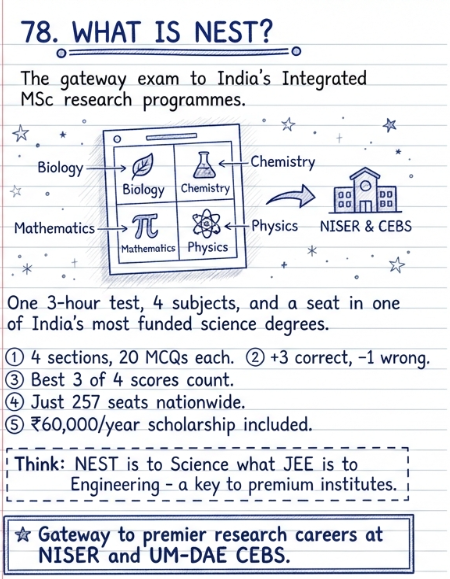
Most science students—whether studying within India's CBSE/State board systems or tracking international curricula like AP/IB frameworks abroad—spend years preparing for standard engineering or medical entrance tests without ever hearing about the National Entrance Screening Test. Yet, NEST leads to something most traditional undergraduate paths miss entirely: a fully funded, highly competitive, five-year integrated Master's degree in pure science backed by India's Department of Atomic Energy (DAE). NEST is the sole entrance route into the Integrated MSc programmes at two of India's premier research-focused undergraduate institutions: the National Institute of Science Education and Research (NISER), Bhubaneswar, and the University of Mumbai–Department of Atomic Energy Centre for Excellence in Basic Sciences (UM-DAE CEBS).
Both institutes were set up in 2007 by the DAE with a distinct mandate: build a national and international pipeline of high-caliber researchers in basic sciences, taught directly by practising scientists rather than standard exam-focused faculty. For international students or Indian students returning from abroad (such as NRI applicants meeting domestic board equivalency rules), these institutes offer a research immersion model comparable to elite global liberal arts or science colleges, but at a fraction of the cost. The catch is scale — between both campuses, the entire national seat count sits at just 257, filled through a single annual exam.
This guide covers exactly how NEST works: the exam pattern and marking scheme, eligibility requirements for both local and board-equivalent students, the syllabus breakdown, real seat matrices, fee structures, the ₹60,000 DISHA scholarship, the 2026 exam timeline, counselling workflows, and how NEST matches up against other premier global and domestic science tracks.
What NEST Actually Is, and Where It Leads
NEST is a compulsory, computer-based entrance test with no alternative backdoor or management quota entries into either institute's Integrated MSc programme. Jointly conducted for NISER and UM-DAE CEBS, a single NEST score feeds separate institutional merit lists and independent counselling tracks. The exam evaluates Biology, Chemistry, Mathematics, and Physics simultaneously because the integrated curriculum allows students to explore all four disciplines before declaring a major specialization in later years.
The resulting qualification is a unique hybrid degree: a residential, stipendiary, five-year curriculum merging undergraduate and graduate studies into a single track. Operating on a credit-based semester system, it integrates hands-on laboratory research from year one. NISER's credential is awarded under the Homi Bhabha National Institute (HBNI, a deemed university under the DAE), while CEBS degrees are awarded through the University of Mumbai, ensuring high academic recognition both domestically and internationally for students planning PhD pursuits abroad in the US, Europe, or UK.
NEST 2026 Exam Pattern and Marking Scheme
The exam layout was optimized for the 2026 cycle, cutting duration down from 3.5 hours to a streamlined 3-hour single-session computer-based test (CBT) distributed across nationwide centers.
| Detail | NEST 2026 Specification |
|---|---|
| Mode | Online, Computer-Based Test (CBT) |
| Duration | 3 hours, single shift |
| Sections | 4 Sections — Biology, Chemistry, Mathematics, Physics |
| Questions per section | 20 objective MCQs (single correct option out of 4) |
| Marks per section | 60 marks per section (240 total aggregate) |
| Marking scheme | +3 for correct answers, −1 for incorrect answers, 0 for unattempted questions |
| Merit calculation | Best 3 of 4 subject-section scores count; the lowest scoring section is automatically dropped |
| Language | Hindi and English (English version acts as final authority) |
| Exam footprint | Approx. 387 exam cities across India |
Eligibility Criteria for Local and International/Board Equivalency Students
- Academic background: candidates must have studied at least three out of the four core science subjects (Biology, Chemistry, Mathematics, Physics) during grades 11 and 12 (or international equivalents such as senior secondary board certifications, AP, or IB science tracks).
- Qualifying timeline: must have successfully completed high school examinations in 2024, 2025, or be concurrently appearing in 2026.
- Minimum marks threshold: minimum 60% aggregate marks for unreserved category applicants, relaxed to 55% for SC, ST, and Divyangjan (persons with disabilities) candidates.
- Age parameters: there is no upper age limit for taking the NEST examination or seeking institutional admission, provided academic prerequisites are met.
- Admission basis: meeting eligibility criteria unlocks candidacy, but final placement relies entirely on securing a competitive rank on the official NEST merit list.
NEST Syllabus and Preparation Framework
The syllabus aligns closely with standard senior secondary core science curricula (such as CBSE/NCERT frameworks), making it highly compatible for students balancing local board preparation, national engineering/medical tests, or rigorous international science syllabi.
- Core content: covers grade 11 and 12 Physics, Chemistry, Mathematics, and Biology concepts in depth.
- Foundational roots: select questions build on fundamental analytical principles taught from grade 10 onward, rewarding a clear conceptual framework over rote memorization.
- Evaluation style: unlike heavily compressed engineering entrance exams that require hyper-specialized shortcuts, NEST emphasizes genuine scientific reasoning, data interpretation, and core concept application within tight time limits.
- Preparation strategy: students with a robust conceptual command over core textbooks and analytical problem-solving are best positioned to excel across all four multidisciplinary sections.
- Official assets: NISER hosts official syllabus guides and practice mock CBT interfaces on its primary portal, which serve as the most accurate reference materials.
Seats, Reservation Matrix, and Competitiveness
Understanding total seat availability is vital for setting realistic preparation targets. For the 2026–31 academic cycle, the combined intake across both institutions is strictly capped at 257 seats.
| Institute | Seat Allocation (2026–31 Intake) |
|---|---|
| NISER, Bhubaneswar | 200 Seats |
| UM-DAE CEBS, Mumbai | 57 Seats |
| Total National Capacity | 257 Seats |
- 27% of total seats are reserved for OBC-NCL (Other Backward Classes, Non-Creamy Layer) candidates.
- 15% of seats are allocated for SC (Scheduled Caste) applicants.
- 7.5% of seats are designated for ST (Scheduled Tribe) candidates.
- 5% horizontal reservation within every individual category is set aside for Divyangjan (persons with disabilities) candidates.
Fee Structures and the DISHA Financial Support Model
One of NEST's most compelling advantages is its heavy public subsidization. Tuition costs are kept minimal, and nearly all admitted students qualify for direct financial stipends that offset the cost of education.
| Financial Component | Rate / Amount |
|---|---|
| Admission Fee (Semester 1) | ₹24,000 |
| Semester Fee (Subsequent Semesters) | ₹16,000 per semester |
| DISHA Annual Scholarship Grant | ₹60,000 per year |
| DISHA Summer Internship Stipend | ₹20,000 per year |
| Application Fee (Female, SC, ST, Divyangjan, UR-EWS) | ₹700 |
| Application Fee (Male, General/OBC categories) | ₹1,400 |
Directly funded by the DAE via the DISHA scheme, the scholarship is automatically extended upon admission without separate bureaucratic applications. The combined annual scholarship and summer grant largely nullifies baseline tuition costs for students throughout their enrollment.
NEST 2026 Application and Operational Timeline
| Milestone Event | 2026 Schedule Date |
|---|---|
| Application Portal Launch | January 5, 2026 |
| Final Application Deadline (Extended) | April 8, 2026 |
| NEST Examination Date | June 6, 2026 (2:00 PM session) |
| Official Answer Key Publication | June 8, 2026 |
| Answer Key Challenge Window | June 10–12, 2026 |
| Scorecard & Result Declaration | June 24, 2026 |
| CEBS Initial Merit List | July 17, 2026 |
| NISER Phase-1 Counselling Sessions | July 24–28, 2026 |
Because NEST runs on a consistent annual rhythm—portal opening in early January, testing in June, and admissions clearing in July—candidates can reliably structure their long-term timeline around these windows.
Navigating the Counselling and Admission Process
A crucial point for applicants: NEST delivers a unified score, but does not feature a single centralized clearinghouse like JoSAA does for engineering institutes. NISER and UM-DAE CEBS manage entirely independent counselling pipelines.
- Submit independent Expressions of Interest (EOI) or applications directly on both institute websites if you wish to be evaluated by both — missing one portal blocks consideration there regardless of your test score.
- Each institution generates separate merit lists according to raw scores and category frameworks.
- Candidates complete individual verification and seat acceptance procedures inside each institute's specific operational timelines.
- Due to overlapping schedules, applicants targeting both campuses must actively track distinct deadlines to secure admissions offers.
Global and Domestic Career Outcomes Post-Graduation
The Integrated MSc layout acts as a dedicated research incubator, heavily shaping long-term professional trajectories:
- Global PhD & Research Tracks: Graduates frequently secure direct admissions into top-tier doctoral programmes across the US, Europe, and domestic powerhouses (IISc, TIFR, IITs), supported by undergraduate publishing records and laboratory exposure.
- DAE Lab Integration: Due to institutional ties with the Department of Atomic Energy, graduates gain seamless access to major national atomic research facilities and high-tech government laboratories.
- Interdisciplinary Specializations: The multidisciplinary foundation in physics, chemistry, mathematics, and biology equips graduates to transition smoothly into emerging technological fields such as quantum computing, computational biology, and advanced materials science.
- Private Sector R&D: Strong quantitative training opens high-value pathways into specialized analytics, industrial R&D consulting, and scientific software engineering for those opting out of immediate doctoral studies.
NEST vs. Other Major Science and Engineering Entrance Pathways
| Exam Standard | Target Qualification | Core Test Format | Key Distinction |
|---|---|---|---|
| NEST | Integrated MSc at NISER & UM-DAE CEBS | 3-hour CBT covering 4 sections; best 3 of 4 scored | Exclusive gateway to DAE-backed research hubs; heavy scholarship backing |
| IISER Aptitude Test (IAT) | Integrated BS-MS across 7 IISER Campuses | CBT evaluating Biology, Chemistry, Math, Physics | Broader national seat availability across seven distinct regional campuses |
| JEE Main / Advanced | Engineering degrees at IITs, NITs, and technical institutes | Rigorous CBT focusing heavily on Physics, Chemistry, Math | Engineered primarily for technical engineering streams rather than pure science research |
| CUET-UG (Science tracks) | BSc programmes across central and regional universities | Modular CBT matching specific subject choices | Broad foundational undergraduate admission avenue rather than an intensive research pipeline |
Conclusion
NEST fills a unique space in the academic entrance ecosystem: a focused, board-aligned test providing access to heavily subsidized, research-driven science education under national nuclear and atomic energy frameworks. For students worldwide who prefer deep scientific inquiry over applied engineering, and want flexibility in choosing their specialization after entering university, NEST offers a direct pipeline into professional research.
The primary challenge is operational scale. With only 257 seats divided across two institutes and separate institutional counselling tracks, success requires meticulous planning, a strong command of foundational science concepts across all four subjects, and active deadline management during the admission window.
Frequently Asked Questions
What is the National Entrance Screening Test (NEST)?+
NEST is a compulsory computer-based entrance examination used exclusively for admission to the 5-year Integrated MSc programmes in Biology, Chemistry, Mathematics, and Physics at NISER Bhubaneswar and UM-DAE CEBS Mumbai, established by India's Department of Atomic Energy.
What is the exact exam pattern and scoring system for NEST?+
It is a 3-hour single-session computer test covering Biology, Chemistry, Mathematics, and Physics with 20 MCQs per section (60 marks per section). Correct answers earn +3 marks, incorrect answers deduct −1 mark, and unattempted questions score 0. Only the best 3 of the 4 section scores contribute to the final merit ranking.
Who is eligible to apply for NEST?+
Candidates must have studied at least three of the four core science subjects in grades 11 and 12 (or international equivalents), pass their senior secondary board exams within recent windows, and achieve at least 60% aggregate marks (55% for reserved categories). There is no upper age restriction.
How many seats are available through NEST?+
For the 2026–31 intake, NISER provides 200 seats and UM-DAE CEBS provides 57 seats, giving a combined total of 257 national seats subject to standard government reservation quotas (OBC, SC, ST, and Divyangjan).
What is the official syllabus for the NEST examination?+
The syllabus closely mirrors standard senior secondary science curricula (such as CBSE/NCERT frameworks) across Physics, Chemistry, Mathematics, and Biology, alongside select foundational science principles from grade 10.
What financial subsidies and scholarships are attached to NEST admission?+
Admitted students pay minimal tuition fees (€/₹ structured per semester) and receive the DAE DISHA scholarship grant providing ₹60,000 annually plus an additional ₹20,000 yearly summer internship stipend, neutralizing baseline tuition costs.
How does counselling work for NISER and UM-DAE CEBS?+
There is no joint centralized counselling body like JoSAA. Candidates must file independent Expressions of Interest (EOI) or applications with each institute separately to be considered during their respective merit list and counselling rounds.
What career paths follow the Integrated MSc degree?+
Graduates frequently transition into competitive PhD programmes at elite global and domestic institutions, secure research roles in DAE national laboratories, or enter advanced private sector R&D and quantitative technology sectors.
How does NEST compare against the IISER Aptitude Test (IAT)?+
Both examine core science aptitude based on board-level syllabi for integrated science degrees, but NEST admits students specifically into NISER and CEBS, whereas IAT serves the seven IISER campuses which collectively offer a larger pool of seats.
Can I apply to both participating institutes using a single NEST score?+
Yes, a single NEST score is valid for both institutions, but you must register and manage separate application and counselling procedures for each institute individually.