Summer Trainee Engineering Program: The Complete 2026 Guide (Eligibility, Top Organizations, Stipend & How to Apply)
A Summer Trainee Engineering Program is a short, structured industrial or research training placement — typically running one to two months during a student's summer break — that gives undergraduate or postgraduate engineering students hands-on exposure to a real organization's operations, projects, or research work. It's one of the most commonly required components of an Indian engineering degree, and one of the most confusingly named: 'Summer Trainee,' 'Summer Training,' 'Summer Internship,' and 'Industrial Training' are frequently used interchangeably across different colleges and organizations for essentially the same concept, which is part of why students researching this term often end up with fragmented, inconsistent information.
It's also genuinely easy to confuse with a completely different thing: a 'Graduate Trainee' role. A Summer Trainee program is a short-term training placement taken during your degree, usually unpaid or lightly stipended, with no job guarantee attached. A Graduate Trainee role, by contrast, is a formal, paid, entry-level job offer extended after graduation — organizations like ONGC run both, under names similar enough to cause real confusion for students searching online.
This guide covers exactly what a Summer Trainee Engineering Program involves, why most engineering colleges require one, the real difference between paid and unpaid tracks, a full breakdown of the major PSUs, IITs, and government bodies currently offering these programs, general eligibility and application steps, what you actually gain from completing one, and how to genuinely improve your odds of selection.
What a Summer Trainee Engineering Program Actually Is
At its core, a Summer Trainee program places an engineering student inside a real organization — a public sector company, a government body, a research institute, or occasionally a private firm — for a short, defined period, typically during the gap between academic years. Students are assigned to a specific department or project, work under the guidance of an experienced mentor or supervising engineer, and are generally expected to produce a project report or presentation by the end of the training period, which then usually needs to be submitted to their home college as part of their academic requirements.
Many Indian engineering curricula, particularly for pre-final and final-year students, formally require a documented summer training component — meaning this isn't purely an optional resume-builder for a large share of students, but an actual, evaluated part of the degree itself, often carrying academic credit or a mandatory certificate submission.
Summer Trainee vs. Graduate Trainee vs. Internship: Clearing Up the Confusion
| Term | What It Actually Means | Payment | Timing |
|---|---|---|---|
| Summer Trainee / Summer Training | A short, structured training placement for currently enrolled students, usually tied to academic requirements | Often unpaid, though a growing number of programs now offer a stipend | During a student's summer break, while still enrolled |
| Graduate Trainee | A formal, paid, entry-level job role for candidates who have already completed their degree, often the first rung of a permanent career track | Paid, typically a full starting salary | After graduation, as an actual job |
| General Internship | A broader umbrella term that can refer to either of the above, or to a private-sector internship, depending entirely on the specific organization's usage | Varies — some paid, some unpaid | Varies by program |
This distinction matters in practice: a student searching 'ONGC summer trainee' who instead lands on ONGC's Graduate Trainee recruitment notification — a real, paid, permanent E1-level job hiring process with its own separate eligibility, exam, and salary structure — is looking at an entirely different opportunity than the short-term, unpaid Summer Training program actually intended for currently enrolled students.
Paid vs. Unpaid Summer Trainee Programs
This is one of the most important practical distinctions to understand before applying, since it varies enormously by organization and program.
| Program Type | Example | Stipend |
|---|---|---|
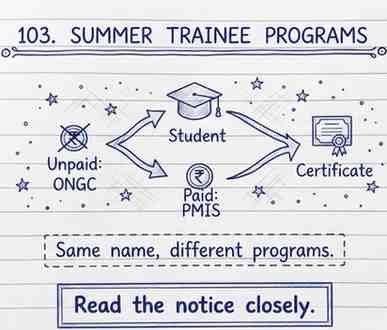
| Classic PSU Summer Training | ONGC Summer Training Program | No stipend or financial assistance provided; certificate and practical exposure only |
| Government Scheme-Linked Internship | ONGC's PMIS-linked internship (Prime Minister Internship Scheme) | Approximately ₹9,000 per month, open to a much larger pool (4,000+ opportunities), including 12th pass, ITI trainees, and diploma engineers |
| Institute-Run Research Internship | IIT Mandi Summer Internship Programme | Approximately ₹10,000 per month |
| Government Infrastructure Body Internship | NHAI (National Highways Authority of India) Summer Internship | Approximately ₹20,000 per month, plus a completion certificate |
| Fellowship-Style Programs | IIT Madras Summer Fellowship Programme (for students outside the IITs) | Approximately ₹15,000 per month |
Major Organizations Offering Summer Trainee Engineering Programs
| Organization | Program Name | Typical Duration | Notes |
|---|---|---|---|
| ONGC (Oil and Natural Gas Corporation) | Summer Training Program | 1–2 months (up to 6 months for MCA students) | 125 seats, unpaid, offline application, priority given to ONGC employees' wards and nearby college students |
| NTPC | Summer Internship Program | Typically 4–8 weeks | Offered across various NTPC plants and offices for engineering disciplines |
| IOCL (Indian Oil Corporation Limited) | Summer Training/Internship | Typically 4–8 weeks | Offered across refineries and other IOCL facilities |
| SAIL (Steel Authority of India Limited) | Summer Training | Typically 4–8 weeks | Offered at various SAIL plants for engineering students |
| BHEL (Bharat Heavy Electricals Limited) | Summer Training | Typically 4–8 weeks | Offered across BHEL manufacturing units |
| NHAI (National Highways Authority of India) | Summer Internship Programme | Approximately 2 months | Open to engineering, management, law, and mass communication students; paid, roughly ₹20,000/month |
| IIT Mandi | Summer Internship Programme | Approximately 2 months | Open to pre-final year BTech/BE and PG students; paid, roughly ₹10,000/month, research-focused |
| IIT Madras | Summer Fellowship Programme | Approximately 2 months | Specifically open to students outside the IITs; paid, roughly ₹15,000/month |
| ISRO / VSSC / PRL | Project Training / Internship | Varies by center and project | Highly competitive, research-oriented placements at India's space research centers |
This list reflects commonly recognized programs, but it isn't exhaustive — many additional PSUs, state electricity boards, research labs, and private companies run their own summer training programs under similar names, and specific seat counts, stipends, and dates shift from year to year. Always confirm current details directly against each organization's official notification for the specific year you're applying.
General Eligibility Criteria
- Enrollment status: candidates must generally be currently enrolled, full-time undergraduate or postgraduate engineering students — commonly restricted to pre-final year or final year students, though exact year requirements vary by program.
- Academic standing: some programs specify a minimum academic performance requirement, while others (like ONGC's classic Summer Training) operate more on a first-come, first-served basis combined with a merit list, without a strict published minimum grade cutoff.
- Discipline: most programs are open across common engineering disciplines (Mechanical, Electrical, Civil, Computer Science/IT, Chemical, and others), though some organizations restrict specific project areas to relevant disciplines only.
- Institutional affiliation: certain programs explicitly prioritize students from nearby colleges or those with a family connection to the organization (such as employees' wards), which can meaningfully affect actual selection odds beyond the published general eligibility.
- Broader eligibility programs: government scheme-linked internships (like ONGC's PMIS-linked program) can have notably broader eligibility, extending to 12th pass students, ITI trainees, and diploma engineers, not just degree-holding engineering students.
How to Apply: The General Process
- Identify the specific organization and program you're targeting, and confirm whether it's the short-term training track or a separate, larger scheme-linked program — since, as covered above, these can differ significantly in eligibility and stipend even within the same organization.
- Check the application mode: some programs (like ONGC's classic Summer Training) still use an offline application process with a downloadable form, while many others now run fully online through a dedicated portal.
- Prepare required documents in advance: these commonly include your academic transcripts/mark sheets, a college bonafide certificate, an identity proof, a passport-sized photograph, and sometimes a cover letter or statement of interest specifying your preferred department or project area.
- Submit your application within the specified window: application windows are typically short, often just a few weeks, so tracking the exact opening and closing dates for your target program is genuinely important rather than assuming a long runway.
- Await selection results: some programs (particularly ones with a large, broad applicant pool) select purely on a first-come, first-served basis combined with a merit list, while others involve a more formal shortlisting or interview process.
- Complete any required pre-training formalities: this can include submitting an undertaking or indemnity form, arranging your own accommodation and travel (rarely covered by the organization for shorter unpaid programs), and confirming your reporting date.
What You Actually Gain From a Summer Trainee Program
- A completion certificate: generally issued at the end of the program, and often required as part of your college's academic evaluation for the training component.
- Practical, applied exposure: hands-on experience with real industrial processes, equipment, or research work that classroom coursework typically doesn't replicate.
- A concrete project and report: most programs require you to complete and document a specific project, which becomes genuinely useful material for your resume and future job interviews.
- Professional mentorship: working under an experienced engineer or researcher, and the networking and, sometimes, reference value that comes with that relationship.
- A meaningful resume differentiator: completing training at a well-known PSU or research institute is a recognizable, verifiable credential that stands out in later graduate hiring processes, including for the same organization's own Graduate Trainee recruitment down the line.
How to Improve Your Chances of Selection
- Apply early and to multiple programs simultaneously: many programs, particularly unpaid, high-demand ones like ONGC's classic Summer Training, fill on a first-come, first-served basis, meaning application timing itself can genuinely matter as much as your academic profile.
- Tailor your application to a specific department or project area, rather than submitting a generic, undirected application — specifying genuine interest and relevant coursework tends to stand out favorably in review.
- Keep your academic documentation current and readily available: since application windows are often short, having transcripts, a bonafide certificate, and identity documents ready in advance avoids losing time during a tight submission window.
- Consider both classic unpaid PSU programs and newer, paid scheme-linked internships: if stipend matters to your circumstances, actively compare programs like NHAI's or IIT Mandi's paid internships against unpaid classic PSU training rather than assuming all 'summer trainee' opportunities pay the same (or nothing).
- Leverage institutional or geographic proximity where genuinely applicable: several programs explicitly prioritize students from nearby colleges or affiliated institutions — checking whether your college has any established relationship with a target organization can meaningfully affect your realistic odds.
Conclusion
'Summer Trainee Engineering Program' describes a genuinely wide range of real opportunities — from ONGC's classic, unpaid, 125-seat Summer Training program, to a government scheme-linked internship paying thousands of students a real monthly stipend, to research-focused placements at IITs and national labs — all sharing the same basic structure: a short, structured, real-world placement for currently enrolled engineering students, distinct from a formal post-graduation Graduate Trainee job.
The most useful thing to do before applying to any specific program is to read its exact notification closely — confirming payment terms, exact eligibility, application mode, and dates directly against the organization's current official source — rather than assuming any single 'summer trainee' listing works the same way as another, since, as this guide has covered, even the same organization can run genuinely different versions of this program side by side.
FAQ
Frequently Asked Questions
What is a Summer Trainee Engineering Program?+
It's a short-term (typically one to two month) structured training placement for currently enrolled engineering students, giving them hands-on exposure to a real organization's operations, projects, or research work, usually under the guidance of an experienced mentor, and often required as part of a student's academic curriculum.
Is a Summer Trainee program the same as a Graduate Trainee role?+
No. A Summer Trainee program is a short-term training placement taken during your degree, usually unpaid or lightly stipended, with no job guarantee. A Graduate Trainee role is a formal, paid, entry-level job offered after graduation, often the first step in a permanent career at that organization.
Do Summer Trainee Engineering Programs pay a stipend?+
It varies significantly by program. Some, like ONGC's classic Summer Training program, offer no financial assistance at all. Others, including government scheme-linked programs and several institute-run internships, offer a real monthly stipend — reported figures include approximately ₹9,000/month for ONGC's PMIS-linked internship, ₹10,000/month for IIT Mandi's program, ₹15,000/month for IIT Madras's fellowship, and ₹20,000/month for NHAI's internship.
Which organizations offer Summer Trainee Engineering Programs?+
Common examples include major PSUs like ONGC, NTPC, IOCL, SAIL, and BHEL, government infrastructure bodies like NHAI, premier institutes like IIT Mandi and IIT Madras, and research organizations like ISRO's various centers. Many additional PSUs, state bodies, and private companies also run comparable programs under similar names.
What is the eligibility for a Summer Trainee program?+
Generally, candidates must be currently enrolled, full-time undergraduate or postgraduate engineering students, often specifically in their pre-final or final year, though this varies by program. Some broader, scheme-linked internships extend eligibility further, including to 12th pass students, ITI trainees, and diploma engineers.
How long does a Summer Trainee program typically last?+
Most programs run for one to two months, generally scheduled during the summer academic break (commonly May through August in India), though some programs — such as accommodations for MCA students in certain PSU programs — extend up to six months.
How do I apply for a Summer Trainee Engineering Program?+
The process varies by organization — some, like ONGC's classic Summer Training program, still use an offline downloadable application form, while many others run a fully online application portal. In general, you'll need academic transcripts, a college bonafide certificate, identity proof, and a photograph, submitted within a typically short application window.
Is a Summer Trainee certificate valuable for future job applications?+
Yes, generally. A completion certificate from a recognized PSU, government body, or premier institute is a verifiable, recognizable credential that can meaningfully strengthen a resume, and the practical project experience gained is often directly useful in later job interviews, including for the same organization's own future recruitment.
What's the difference between ONGC's Summer Training and ONGC's internship under the PMIS scheme?+
ONGC's classic Summer Training program is a smaller (125 seats), unpaid, offline-application program traditionally aimed at engineering and other degree students, prioritizing employees' wards and nearby colleges. ONGC's separate PMIS-linked internship is a much larger (4,000+ opportunities), paid (approximately ₹9,000/month) program under the government's Prime Minister Internship Scheme, with broader eligibility extending to 12th pass, ITI, and diploma-level candidates.
Can final-year engineering students apply for Summer Trainee programs?+
Yes, in most cases — final-year (and often pre-final-year) students are the primary target audience for most Summer Trainee Engineering Programs, since the training is designed to fit within a student's ongoing degree, typically fulfilling an academic industrial training requirement before graduation.