Mechanical Engineering: Branches, Careers & Salary
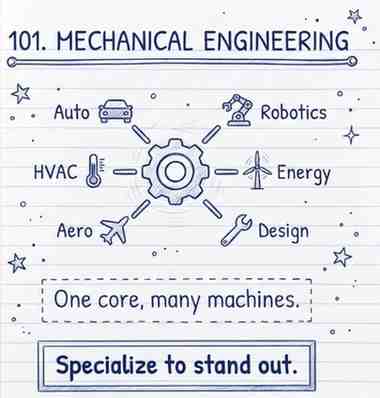
Mechanical engineering is the branch of engineering concerned with the design, analysis, manufacturing, and maintenance of mechanical systems — encompassing any physical structure involving motion, force, energy conversion, or thermal management.
Because its foundational principles apply across an immense variety of products—from jet turbines and medical implants to robotic automation and renewable energy grids—mechanical engineering offers exceptional career flexibility. The U.S. Bureau of Labor Statistics projects robust employment growth of about 9% through 2034 with roughly 18,100 annual job openings, while specialized high-demand sectors like robotics and electric vehicle systems command significant salary premiums.
What Mechanical Engineering Actually Is
At its core, mechanical engineering bridges theoretical physics with physical manufacturing. Practitioners apply mechanics (how forces act on solid bodies), thermodynamics (how energy transfers and transforms), and materials science (how substances behave under thermal and mechanical stress) to solve real-world problems. Unlike theoretical sciences, mechanical engineering requires constant balancing against practical constraints: cost, weight, manufacturability, and safety standards.
The Major Branches and Specializations
| Branch / Specialization | Primary Focus |
|---|---|
| Thermal / Energy Systems | Heat transfer, power generation, HVAC systems, and thermodynamic efficiency optimization |
| Design Engineering | Component architecture, CAD modeling, prototyping, and design-for-manufacturing (DFM) |
| Manufacturing Engineering | Production line optimization, CNC machining, tooling, quality control, and scalable fabrication |
| Robotics & Mechatronics | Integration of mechanical hardware with electronic sensors, actuators, and control software |
| Automotive Engineering | Powertrain design, chassis dynamics, vehicle safety systems, and EV battery architecture |
| Aerospace Mechanical | Aircraft and spacecraft propulsion, structural integrity, and thermal control systems |
| Materials Engineering | Material selection, alloy testing, failure analysis, and stress-strain performance modeling |
| Fluid Mechanics | Hydraulics, pneumatics, pump design, pipe networks, and aerodynamic performance |
Core Mechanical Engineering Curriculum
| Academic Phase | Focus Area | Representative Core Subjects |
|---|---|---|
| Foundational Years | Math and basic physics | Calculus, differential equations, engineering physics, statics, and dynamics |
| Core Mechanical Theory | Fundamental physical laws | Thermodynamics, fluid mechanics, heat transfer, and mechanics of materials |
| Applied Systems | Integration and analysis | Machine design, control systems, vibrations, mechatronics, and CAD/CAM |
| Advanced Electives | Domain specialization | Finite Element Analysis (FEA), CFD, robotics, and sustainable design |
| Capstone Experience | Project synthesis | Industry-sponsored engineering design project solving a real-world constraint |
Essential Software and Technical Tools
| Software Category | Industry Standard Tools |
|---|---|
| CAD (Computer-Aided Design) | SolidWorks, AutoCAD, CATIA, PTC Creo, Autodesk Inventor, Fusion 360 |
| CAE / Simulation | ANSYS, Abaqus, COMSOL Multiphysics (FEA, CFD, and thermal analysis) |
| CAM (Manufacturing) | Mastercam, Fusion 360 CAM, SolidCAM |
| Programming & Math | MATLAB, Python, and C/C++ for embedded mechatronics systems |
| PLM (Lifecycle Management) | PTC Windchill, Siemens Teamcenter for revision and data management |
Professional Engineer (PE) Licensure
While many mechanical engineers in private industry, product design, and software-adjacent roles practice successfully without a license, a Professional Engineer (PE) credential is legally required for roles affecting public safety, municipal infrastructure, and formal forensic engineering. The path requires passing the Fundamentals of Engineering (FE) exam, accumulating four years of verified professional experience under a licensed PE, and passing the discipline-specific PE exam.
Mechanical Engineering Salary Data
| Career Tier / Specialization | Approximate Annual Compensation Range |
|---|---|
| Entry-Level (0–2 years) | $60,000 – $78,000 |
| Mid-Career (5–10 years) | $90,000 – $120,000 |
| Senior / Specialized (10+ years) | $130,000 – $160,000+ |
| Robotics & Automation Niche | $65,000 entry to $150,000+ senior |
| EV Battery Thermal Management | $75,000 entry to $155,000+ senior |
| Cleared Aerospace & Defense | $80,000 entry to $160,000+ senior |
Actionable Steps to Launch Your Engineering Career
- Earn an ABET-accredited bachelor's degree in mechanical engineering or an equivalent global engineering credential.
- Master industry-standard CAD and simulation software (SolidWorks, ANSYS) outside of class assignments to build portfolio competence.
- Participate in collegiate design teams (Formula SAE, ASME Human Powered Vehicle, NASA Robotics) to gain hands-on fabrication and teamwork experience.
- Secure engineering internships or co-op placements to bridge academic theory with industrial manufacturing workflows.
- Register for the FE exam during your senior year as the foundational first step toward professional licensure.
Conclusion
Mechanical engineering offers a resilient, highly versatile career foundation bridging physical sciences with industrial execution. By mastering core computational tools, focusing on high-demand specializations like robotics or thermal management, and accumulating demonstrable project experience, engineers can secure rewarding roles across diverse sectors.
FAQ
Frequently Asked Questions
What is mechanical engineering?+
Mechanical engineering is the discipline dedicated to designing, analyzing, and manufacturing mechanical systems using foundational principles of mechanics, thermodynamics, and materials science.
What software do mechanical engineers use?+
Primary software includes CAD platforms like SolidWorks and AutoCAD, simulation tools like ANSYS and Abaqus for FEA and CFD, and programming languages like Python and MATLAB for analysis.
What is the average salary for a mechanical engineer?+
The U.S. national median wage is approximately $102,320, with total compensation ranging from $61,000 for entry-level positions to over $157,000 for senior specialists.
Do I need a PE license to work as a mechanical engineer?+
A Professional Engineer license is only mandatory for roles directly impacting public safety and infrastructure; many private industry design and manufacturing engineers practice successfully without one.