Bachelor of Science in Education: The Degree, Requirements, Careers & BS vs BA
A Bachelor of Science in Education (BSEd) is a four-year undergraduate degree that prepares students for teaching by integrating pedagogy and classroom methodology with a specialized focus on math, science, or technical content.
In practical implementation, prospective educators often encounter BSEd and BA options simultaneously, selecting based on titles rather than curriculum architecture. This guide breaks down core requirements, contrasts degree types, maps specializations, and outlines licensure milestones.
What a Bachelor of Science in Education Actually Is
A BSEd merges educational theory—including developmental psychology, classroom management, and assessment frameworks—with deep domain content. Most accredited tracks mandate a semester-long, supervised student-teaching placement, serving as the primary bridge between academic theory and active classroom practice.
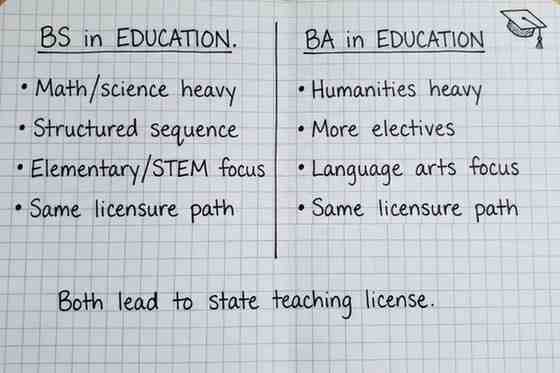
Bachelor of Science in Education vs. Bachelor of Arts in Education
| Aspect | Bachelor of Science in Education (BSEd) | Bachelor of Arts in Education (BA in Education) |
|---|---|---|
| Coursework emphasis | Heavier concentration in STEM, math, science, and structured methodology | Heavier focus on humanities, literature, and liberal arts electives |
| Common specializations | Elementary education, STEM teaching tracks, and special education | Secondary humanities, language arts, and foreign language instruction |
| Program structure | Highly sequenced curricula with rigorous prerequisite checkpoints | Greater flexibility in general elective selection |
| Licensure alignment | Directly prepares candidates for state subject-matter licensure exams | Leads to identical baseline state licensure paths depending on the major |
| Target student profile | Candidates focused on STEM, data-driven instruction, or structured elementary pedagogy | Candidates focusing on language, history, or broader interdisciplinary studies |
A common mistake to avoid is assuming a BSEd restricts graduates exclusively to science teaching; the designation reflects institutional course weighting rather than a limitation on grade levels or subjects.
Typical Admission and Retention Requirements
- A high school diploma with minimum GPA thresholds specifically required for upper-division education school entry.
- Clear background checks and fingerprinting clearance mandated prior to entering public school classrooms for observation.
- Passing scores on state-approved basic skills or basic competency exams prior to junior-year professional sequences.
- Prerequisite course completion for transfer students, ensuring general education credits match program requirements.
Core BSEd Specializations
Bachelor of Science in Elementary Education
Trains candidates to deliver multi-subject instruction across early childhood and elementary grades (typically K–6), emphasizing foundational literacy, arithmetic methodology, and developmental milestones.
Bachelor of Science in Secondary Education
Prepares candidates to teach specialized subjects (such as high school chemistry, biology, or algebra) by pairing advanced subject-matter study with adolescent psychology and secondary teaching frameworks.
Bachelor of Science in Special Education
Focuses on adaptive instructional strategies, Individualized Education Programs (IEPs), and federal compliance standards for students with diverse cognitive, emotional, or physical needs.
Typical Coursework and Academic Timeline
| Academic Year | Primary Focus | Representative Coursework |
|---|---|---|
| Year 1 | General education foundations and introductory pedagogy | Foundations of American Education, Child Psychology, General Gen-Eds |
| Year 2 | Educational theory and content-area prerequisites | Educational Psychology, Curriculum Design, Core Subject Courses |
| Year 3 | Instructional methods and supervised field observation | Classroom Management, Assessment Design, Practicum Observations |
| Year 4 | Culminating student teaching and licensure preparation | Full-Time Student Teaching Residency, State Licensure Exam Prep |
While standard programs run for four consecutive years, timelines expand for working professionals or transfer students adjusting to professional sequence prerequisites.
Career Paths and Licensure After Graduation
| Career Track | Operational Role | Prerequisite Requirement |
|---|---|---|
| Public School Educator | Classroom teacher within a public elementary, middle, or high school | State teaching license, content exams, and background clearance |
| Private or Charter Instructor | Teaching roles within independent or charter school networks | Varies by institution; licensure requirements are flexible |
| Instructional Designer | Building digital or print curricula for educational publishers | Typically requires classroom experience combined with instructional design training |
| Ed-Tech Specialist | Training faculty on classroom technology integration | BSEd combined with technical product familiarity |
| Graduate Study (M.Ed.) | Pursuing advanced degrees for leadership or specialized support roles | An accredited BSEd serves as direct prerequisite preparation |
On-Campus vs. Online BSEd Programs
Online BSEd degrees match campus standards if properly accredited, but require careful evaluation regarding student-teaching placement. Online providers coordinate mandatory local classroom residencies near the student. Verifying state-level licensure approval before enrollment prevents post-graduation credentialing bottlenecks.
Conclusion
A Bachelor of Science in Education equips candidates with structured methodological training and specialized content knowledge. By aligning institutional accreditation, specialization tracks, and state licensure rules, future educators can establish a predictable path toward a successful teaching career.
FAQ
Frequently Asked Questions
What can you do with a Bachelor of Science in Education?+
Graduates primarily become licensed K–12 public school teachers, while others transition into private school teaching, instructional design, educational technology support, or graduate studies toward administration.
What is the difference between a BSEd and a BA in Education?+
A BSEd features heavier coursework in STEM or structured methodology with rigid sequencing, whereas a BA leans toward humanities and provides greater elective flexibility.
How long does a BSEd program take to complete?+
A full-time program takes approximately four years, culminating in a supervised student-teaching placement during the final semester.
Are online Bachelor of Science in Education degrees valid for licensure?+
Yes, provided the institution holds regional accreditation and programmatic approval that satisfies the specific state Department of Education where you intend to teach.