How Long Does It Take to Get an Engineering Degree? (4 to 10+ Years, Explained)

The Quick Answer
Want the short version? A bachelor's degree in engineering takes 4 years of full-time study. That's based on a normal 120 to 130 credit program.
That's the number every college catalog gives you. Real life is messier than that.
So why do so many engineering students end up taking longer?
How Long Is a Bachelor's Degree in Engineering?
A Bachelor of Science in Engineering usually takes four to five years of full-time study, and around 120 to 130 total credits, based on how most US programs are set up. Almost every engineering school gives you this same range. But it comes with a catch: it only works if you take a full course load every semester and never fail or retake a class.
Here's the part no college brochure tells you. Most engineering programs are built for four years, but hitting that mark depends on a few things that most 18-year-olds can't plan for ahead of time.
The honest range is 4 to 6 years for most students. Some engineers finish in exactly four years, while others take six because they added a work term or switched from mechanical to biomedical halfway through.
| Engineering Credential | Typical Duration | Total Credits/Years Beyond Prior Degree |
|---|---|---|
| Associate Degree | 2 years | 60–70 credits |
| Bachelor's Degree | 4–5 years | 120–130 credits |
| Master's Degree | 1–2 years | 30+ credits |
| PhD | 4–6 years (after bachelor's) | Research + dissertation |
Why Do So Few Engineering Students Graduate in Exactly 4 Years?
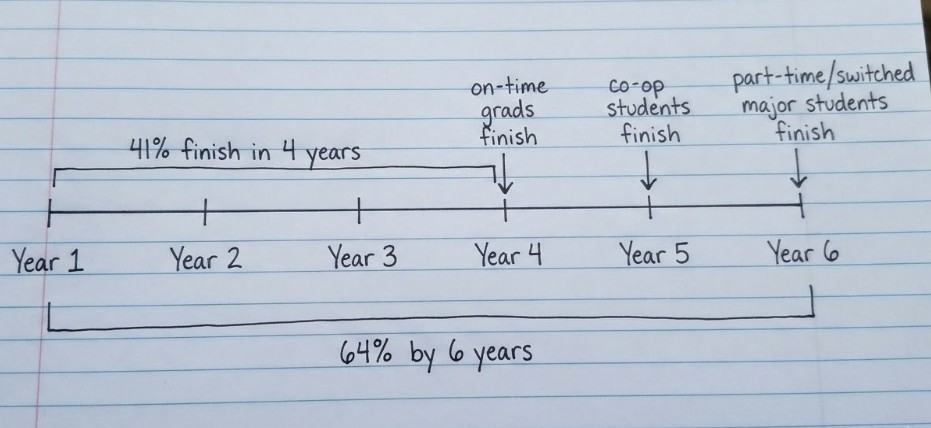
Most engineering students don't finish in exactly four years. Why? Classes build on each other, so one missed or failed class can push the whole plan back by a semester or more. Across all US majors, only 41% of bachelor's students finish within 4 years, while 64% finish within 6 years, based on NCES data on students who started college in 2014. Engineering sits on the harder end of that scale, since its classes depend so heavily on each other.
A mistake seen a lot in new students: they sign up for 12 easy credits their first semester 'to ease in.' That feels smart in September. It can cost you a fifth year in June.
- They switch majors mid-program — moving from general engineering into electrical engineering after year two often means repeating core classes
- They add a co-op or work-term year — many schools, like Georgia Tech and Northeastern, build in a full extra year of paid, real-world work
- They retake a 'gateway' class — Calculus, Physics, and Statics are the top reasons students lose a semester
- They go part-time — working while studying often stretches the timeline to 1.5 to 2 times as long
- They add a double major or minor — common for computer engineering students who also want a computer science degree
Would a fifth year really hurt you in the long run? For most engineers, no. But it's better to plan for it on purpose than to be surprised by it later.
How Long Does an Engineering Associate Degree Take?
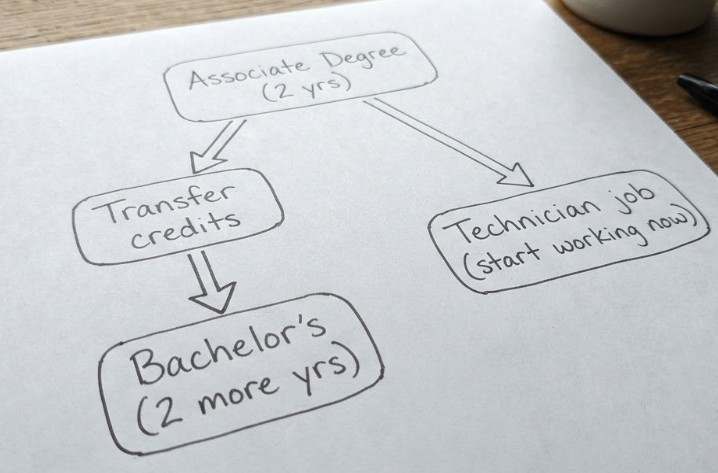
An engineering associate degree takes about 2 years of full-time study, and needs around 60 to 70 credits. Community colleges and technical schools offer these programs, covering the same basic math, physics, and intro engineering classes that a four-year program covers in its first two years. Full-time students often finish in about two years, while part-time students may need up to four.
Most people use it one of two ways. Path one: transfer those credits into a four-year bachelor's program, often saving a full year and real money on tuition. Path two: go straight into an entry-level engineering technician job, which doesn't need a bachelor's degree.
- Good choice if you want to: try engineering out cheaply before you commit to four more years
- Good choice if you want to: get into the workforce faster in a technician-level role
- Skip it if: you already know you want a PE license — most states need an ABET-accredited bachelor's degree for that
How Long Does a Master's in Engineering Take?
A master's degree in engineering usually takes 1 to 2 years of full-time study, but the real average is closer to 3 years once you count part-time and working students. On average, it takes three years to finish a master's in engineering, even when the program itself is built as a two-year plan. An annual US News survey found that just over half of online master's students finish within three years.
- Fast-track programs: some schools can get you done in 12 to 18 months if you go full-time from the start
- Thesis vs. no-thesis tracks: a thesis means original research, and it usually adds a semester or more
- Part-time while working: the most common path for engineers who already have a job, usually taking 2.5 to 3 years
Engineers who go back for a master's while working almost always guess low on time. Life gets in the way — a busy work quarter, a new baby, a promotion — and a 'two-year' program quietly turns into three.
How Long Does a PhD in Engineering Take?
A PhD in engineering usually takes 4 to 6 years after a bachelor's degree. It can take less time if you already have a master's when you start. It's the longest path in engineering education because it's built around original research and a dissertation, not just classes. A PhD usually takes about 3 to 5-plus years after a master's, and can take longer if pursued straight from a bachelor's degree.
This isn't the right path for most engineers. A PhD makes sense if you want to teach at a university, do original research, or work in a highly specialized job. For a normal industry engineering job, it's often overkill, and an expensive way to spend your twenties.
Does Engineering Degree Length Change by Major?
Not really. At the bachelor's level, almost every major (mechanical, civil, electrical, chemical, biomedical, computer) follows the same 4-year, 120-to-130-credit setup. A mechanical engineering degree, for example, usually needs four years of full-time study at an ABET-accredited school, the same as civil or electrical.
What really changes by major isn't the degree length. It's what happens after you graduate.
| Major | Bachelor's Length | What Usually Adds Time After Graduation |
|---|---|---|
| Civil Engineering | 4 years | PE license almost always expected; 4 more years of work needed |
| Mechanical Engineering | 4 years | PE is optional unless you work for the government |
| Electrical Engineering | 4 years | PE is less common outside of power or utility work |
| Computer Engineering | 4 years | PE is rarely needed; usually the fastest path to a first job |
| Biomedical Engineering | 4 years | Often paired with a master's for stronger job options |
| Chemical Engineering | 4 years | PE is common in plant and process jobs |
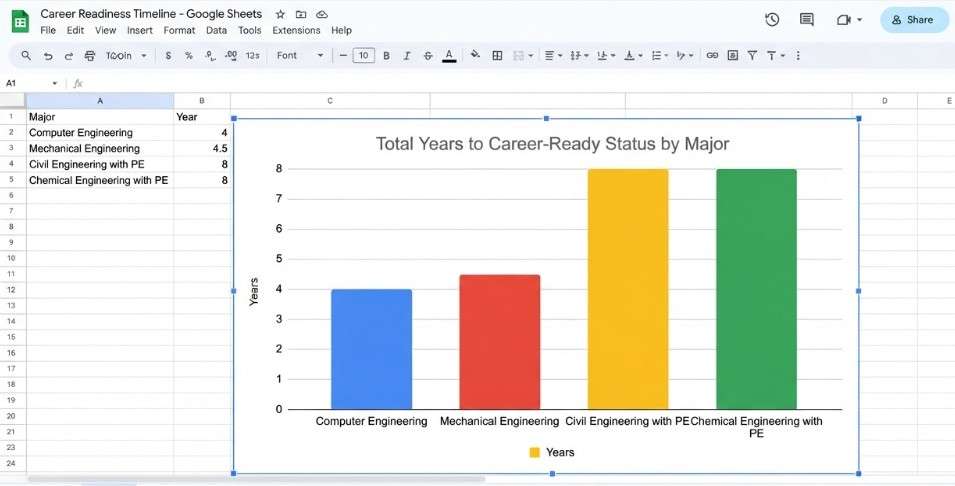
Ever wonder why your civil engineering friend is still 'getting licensed' four years after graduation, even though you both finished at the same time? Now you know why.
How Long Does It Take Outside the US?
Engineering degrees outside the US often take one year less than the American 4-year norm. Three-year bachelor's degrees are common across much of Europe. In the US, an engineering bachelor's degree usually takes four years, while in several European countries it takes three. Germany and many other countries follow the Bologna model, which builds a bachelor's around three years, followed by an optional two-year master's.
- United States, Canada, Australia: 4 years for a bachelor's, following the usual 4-year setup
- United Kingdom: 3 years for a BEng, or 4 years for a combined MEng
- Germany and much of Europe: 3 years for a bachelor's, plus 2 years for a master's
- India: 4 years for a Bachelor of Technology (BTech) — diploma holders can skip ahead into year two and finish in 3 years
This matters most if you're comparing job offers or grad schools across countries. A 3-year European degree isn't 'less' — it's simply built tighter, with fewer general classes than US programs.
How Long to Become a Licensed Professional Engineer (PE)?
Becoming a licensed Professional Engineer takes about 8 years total, counting from the day you start your bachelor's degree — 4 years for the degree, plus about 4 more years of supervised work before you can take the final licensing exam. This is the part people usually forget to ask about. The degree is just step one.
- Get an ABET-accredited bachelor's degree — required in almost every state
- Pass the Fundamentals of Engineering (FE) exam — most students take this right before or right after graduation, while the material is still fresh
- Work for 4 years under a licensed PE — this step adds real time, and there's no shortcut around it
- Pass the Principles and Practice of Engineering (PE) exam — the last step, specific to your field
Real-world example: civil, structural, and environmental engineers seek PE licenses far more often than computer engineers do, because they're the ones legally signing off on public buildings and infrastructure. One civil engineer took the standard 4-plus-4 path himself: four years at a state university, then four years working under a senior PE at a city engineering department, before sitting for his final exam at age 26.
Not every engineer needs this. Computer engineers, many electrical engineers, and most private-sector mechanical engineers can build full careers without ever getting licensed.
What Actually Adds Time to an Engineering Degree?
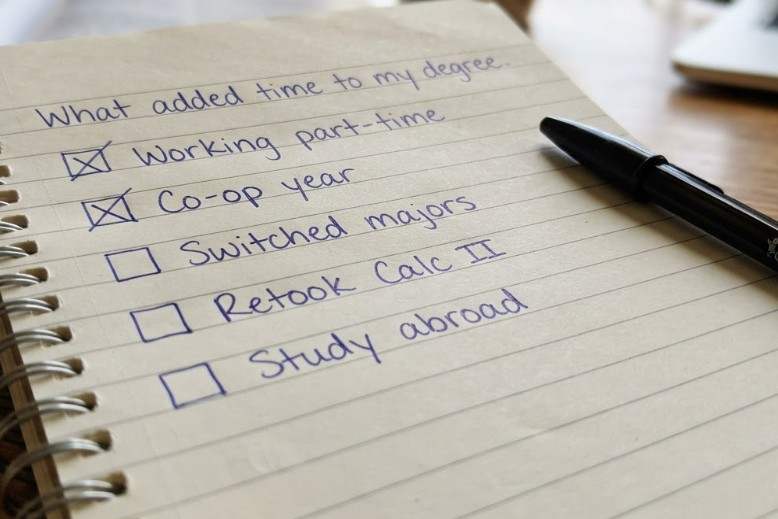
The single biggest thing that adds time is a light course load. Students who can't take a full 15 to 18 credits every single semester almost never finish in exactly four years. That's not a knock on anyone — engineering classes are genuinely harder than most, and life happens alongside them.
- Working part-time or full-time while studying — the number one delay; a student working 20+ hours a week often needs 1.5 to 2 times as long to finish as a full-time-only student
- Co-op programs — these add a planned extra semester or year, but graduates come away with 12 to 18 months of real, paid work experience on their résumé
- Switching engineering fields — moving from chemical to mechanical after year two can cost a full extra year of classes
- Underestimating math — students who need pre-calculus before Calculus I often add a full year before their core engineering classes even start
- Study abroad semesters — popular and valuable, but almost always add one extra semester
That stat, 'only 41% finish in four years,' matters most for your own planning. It means you should plan for 4.5 to 5 years, financially and mentally, right from day one. That way, an extra semester feels like part of the plan, not a failure.
Is a Longer Engineering Degree Worth the Cost?
Yes, most of the time. Engineering is still one of the highest-paying bachelor's degrees out there, whether you finish in four years or six. The median pay for all engineers is about $106,070, based on Research.com's 2026 review of federal labor data. That number holds up whether you graduated in the standard four years or took an extra year for a co-op.
- Cost of one extra year: in-state tuition at top public engineering schools averages around $13,000; out-of-state runs closer to $45,000
- What you get from a planned co-op year: most co-op students land a job offer from that same employer before they even graduate
- What you get from an unplanned extra year (like failed classes or a late major switch): the same tuition bill, but none of the résumé benefit
How to Finish Your Engineering Degree Faster
- Take AP or dual-enrollment credit seriously in high school — Calculus, Physics, and Chemistry AP credits can cut a full semester off your first year
- Meet with your academic advisor every semester, not just when something goes wrong — these class sequences are unforgiving, and one wrong choice can cost you a full term
- Pick your major before sophomore year, if you can — switching after that point is the single biggest cause of an extra year
- Take summer classes for gateway courses like Calculus or Statics — retaking a failed class in summer, instead of waiting a full year, keeps you on track
- Build a 4-year course map on day one, and check it every semester — a free engineering course-planning template can help you see every required class before you sign up for any of them
- Protect your grades in gateway classes, even if it means one fewer elective that semester — a failed Statics class costs you far more time than a lighter course load ever will
Key Takeaways
- A bachelor's degree in engineering takes 4 years on paper. In real life, it's closer to 4.5 to 5 years once you count extra classes, work terms, and changed majors
- Only about 41% of all bachelor's students finish in exactly 4 years, says the National Center for Education Statistics (NCES). Engineering students often take a bit longer than that
- An associate degree takes about 2 years. A master's adds 1 to 2 more years. A PhD adds 4 to 6 more years on top of that
- Getting licensed as a Professional Engineer (PE) takes longer than the degree alone. Plan on 4 more years of work after you graduate, plus two exams
- Co-ops and internships add time, but they pay off. They're one of the best ways to land a job before you even graduate
Conclusion
So, how long does it take to get an engineering degree? Plan for 4 to 5 years for the bachelor's degree. Add 1 to 2 more years if you want a master's. Add about 4 more years of work if your career needs a PE license. The catalog says 4 years, but the real number, once you count classes, work terms, and normal life, is closer to 5.
That extra year isn't a failure. It's the norm. Planning for it now saves you the stress of feeling behind later.
Next step: sit down with your school's advising office and map out your major's full 4-year course plan before you commit — it's the fastest way to avoid an extra year you didn't plan for.
Frequently Asked Questions
Is engineering a 4-year or 5-year degree?+
It's officially a 4-year degree at almost every US school, based on a standard 120 to 130 credit plan. In real life, many students take closer to 5 years because of tough classes, work terms, or a change in major.
What is the hardest year of an engineering degree?+
Most students and professors say sophomore year is the hardest, since that's when tough math and physics classes stack up against your first major-specific engineering classes. Freshman year is usually easier since it's more general education.
Can you get an engineering degree in 3 years?+
Yes, but it's rare in the US, usually requiring heavy AP credit, summer classes, and a full course load every single semester with no setbacks. It's far more common outside the US, where 3-year degrees are the norm across the UK and much of Europe.
Do you need a master's degree to be an engineer?+
No. A bachelor's degree is enough for most entry-level and mid-career engineering jobs. A master's mainly helps with specialized roles, leadership tracks, or research work.
How long does an online engineering degree take compared to in-person?+
About the same, roughly 4 years, if you study full-time. Most online bachelor's engineering programs are built to finish in about four years of full-time study, just like on-campus programs.
Is it too late to become an engineer at 30?+
No. Plenty of career-changers finish engineering degrees in their 30s and beyond, often through part-time or online study. It usually takes longer than the standard 4 to 5 years because of work and family, but it's a common path, not a rare one.
What GPA do you need to get into engineering school?+
Most engineering programs want a GPA around 3.0, or a spot in the top 25% of your graduating class. Competitive schools ask for more. Strong grades in math and physics matter more to most schools than your overall GPA.