How to Develop Public Speaking Skills: The Complete 2026 Guide (For Adults, Students & Kids)
You develop public speaking skills through repeated practice in front of real audiences, structured feedback, and specific technique work on voice, body language, and content structure — not by reading about confidence or waiting to feel ready.
In practical implementation, most people get the order backward. They wait to feel confident before they speak, when confidence is actually the output of enough repetitions, not the input. This guide covers what genuinely builds public speaking skill, a realistic roadmap with real checkpoints, how the approach shifts for public speaking skills in kids versus students versus working adults, practice methods that hold up under real pressure, and the common mistakes that quietly keep people at the same level for years.
Why Most People Get Stuck at 'Nervous Beginner'
A common mistake to avoid is treating stage fright as a character flaw instead of a physiological response. When you're about to speak in front of people, your body reacts to social evaluation the same way it reacts to physical threat — increased heart rate, shallow breathing, and a surge of adrenaline. This is completely normal and it doesn't go away entirely even for experienced speakers; what changes with practice is your relationship to that response, not the response itself.
A Reframing Exercise Worth Actually Trying
Before your next talk, instead of trying to calm down, deliberately label the sensation out loud to yourself as excitement rather than fear — 'I'm excited' instead of 'I'm nervous.' Physiologically, excitement and anxiety produce almost identical bodily sensations; the label your brain attaches to those sensations changes how you interpret and perform through them. This is a small technique, but it's one of the few anxiety interventions with real research behind it, rather than generic advice like 'just relax.'
The Core Components of Public Speaking Skill
| Component | What It Actually Means | How to Practice It |
|---|---|---|
| Voice control | Pace, volume, pauses, and vocal variety — not just clarity | Record a 2-minute talk and mark where you rushed or spoke in a flat tone |
| Body language | Posture, gestures, eye contact, and movement that match your content | Practice in front of a mirror or on video with sound muted, watching only your body |
| Content structure | A clear opening hook, a logical middle, and a memorable close | Outline every talk in three parts before you write a single full sentence |
| Audience engagement | Reading the room and adjusting in real time — pacing, tone, even content | Practice in front of small, real groups, not just alone in a mirror |
| Handling nerves live | Staying functional and coherent even when anxiety spikes mid-talk | Deliberately practice in slightly uncomfortable, lower-stakes settings first |
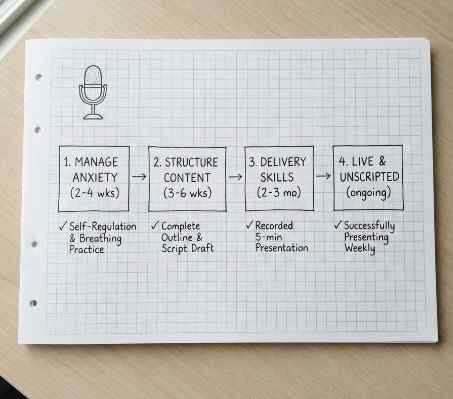
A Realistic Roadmap: Nervous Beginner to Confident Speaker
| Stage | Duration | Focus | Checkpoint Test |
|---|---|---|---|
| 1. Managing Physical Anxiety | 2–4 weeks | Breathing techniques, reframing exercises, low-stakes exposure | Speak for 60 seconds in front of 3–5 people without stopping |
| 2. Structuring Content | 3–6 weeks | Opening hooks, three-part outlines, clear closing statements | Outline and deliver a 3-minute talk with no notes, from an outline only |
| 3. Delivery Skills | 2–3 months | Voice variety, pacing, gestures, eye contact, pausing on purpose | Deliver a 5-minute talk on video and self-review against the component table above |
| 4. Live, Unscripted Situations | Ongoing | Q&A handling, impromptu speaking, reading and adjusting to a real audience | Take unscripted questions after a talk and answer without visible panic |
Practice Methods That Actually Work
Record and Review
Record every practice talk on your phone, even short ones, and watch it back with the sound off first to judge body language alone, then with sound only to judge voice alone. Most people avoid this because watching yourself on video is uncomfortable — but that discomfort fades within a few sessions, and it's the fastest way to catch habits you can't feel from the inside, like a repeated filler word or a stiff stance.
The 1-Minute Impromptu Drill
Pick a random, mundane topic (a household object, a recent meal, a childhood memory) and speak on it for exactly one minute with zero preparation, using a timer. Do this daily. It's one of the highest-leverage drills for public speaking because it trains you to structure thoughts on the spot, which is the exact skill that live Q&A and unscripted moments actually demand.
Structured Group Practice (Toastmasters-Style)
Joining a structured speaking group — Toastmasters is the most widely available example — gives you two things solo practice can't: a real, live audience, and structured feedback from people who've been through the same stages. In practical implementation, the feedback loop matters more than the club format itself; any setting with a real audience and honest feedback works the same way.
How to Develop Public Speaking Skills for Different Situations
How to Develop Public Speaking Skills in Kids
Public speaking skills in kids develop very differently from how they develop in adults. Children build speaking comfort mainly through playful, low-stakes repetition, not formal technique — introducing structured delivery rules (pacing, gestures, pauses) too early often increases self-consciousness rather than confidence. What works instead: short 'show and tell' style sharing at home, storytelling games where the child fills in the next part of a story out loud, reading aloud to a small, familiar audience like family members, and praising effort and clarity rather than correcting every stumble in the moment. Formal technique — outlines, structured speeches, feedback on delivery — tends to land much better once a child is already comfortable simply talking in front of others, typically from around age 8–10 onward, though this varies by child.
Public Speaking Skills for Students
For school and college students, the fastest gains usually come from volunteering for low-stakes speaking opportunities that already exist — class presentations, group project readouts, seminar questions — rather than waiting for a formal 'public speaking class.' Pairing this with the 1-minute impromptu drill before exams or vivas builds the same on-the-spot structuring skill that oral exams and interviews demand.
Public Speaking Skills for Job Interviews and the Workplace
In a workplace or interview context, public speaking skill shows up less as formal stage presence and more as the ability to answer questions clearly under mild pressure. The same core practice — recording yourself answering common interview questions, timing your answers, and reviewing for filler words and rambling — transfers directly, since an interview is essentially a short, high-stakes impromptu talk.
Common Mistakes That Quietly Stall Progress
- Memorizing a speech word-for-word, which makes any small forgotten phrase feel like total failure and removes the flexibility to adjust to the room
- Avoiding video review because it's uncomfortable, which removes the single fastest feedback loop available
- Practicing only alone, never in front of any real audience, which means the nervous-system response to being watched never actually gets trained down
- Over-preparing content while under-preparing delivery — spending all practice time on slides and script, none on voice, pacing, or body language
- Treating one bad talk as proof of no skill, instead of one data point in a longer trend across many reps
Building a Consistent Practice Habit
- Favor small, frequent reps over rare big performances — a daily 1-minute impromptu drill builds more real skill over a month than one nerve-wracking talk every few months
- Seek out real, low-stakes speaking opportunities deliberately, rather than waiting for a big one to force practice
- Keep a simple log of what you practiced and one specific thing you noticed on review, not just how nervous you felt
- Get feedback from real people, not just self-review, since blind spots in delivery are often invisible to the speaker
- Expect a slow, non-linear curve — some talks will feel worse than the one before, which is normal and doesn't indicate regression
Conclusion
Public speaking skill is built through reps in front of real people, structured feedback, and deliberate practice on voice, structure, and body language — not by waiting to feel confident first. The approach shifts by audience: playful, low-stakes repetition for kids, volunteering for existing opportunities for students, and pressure-tested delivery practice for interviews and the workplace. Pick one low-stakes opportunity to speak this week, record it, and review it honestly — that single rep will teach you more than another week of reading about confidence.
FAQ
Frequently Asked Questions
How can I develop public speaking skills in kids?+
Focus on playful, low-stakes repetition rather than formal technique — storytelling games, reading aloud to family, and short 'show and tell' sharing build comfort first. Introducing structured delivery rules too early often increases self-consciousness rather than confidence, so formal technique usually lands better once a child is already comfortable simply speaking in front of others.
How long does it take to become good at public speaking?+
Most people notice a real shift within 2–3 months of consistent, structured practice, with continued improvement over 6–12 months as delivery skills and live handling of nerves develop. The timeline depends heavily on how often you get real speaking reps versus solo, mirror-only practice.
What's the fastest way to reduce public speaking anxiety?+
Relabeling the physical sensation of nervousness as excitement rather than fear is one of the few techniques with real evidence behind it, since anxiety and excitement produce nearly identical bodily sensations. Pairing that with frequent, low-stakes exposure — rather than avoidance — reduces anxiety more reliably than trying to eliminate the nervous feeling entirely.
Do I need to join a class or club to improve my public speaking?+
Not strictly — the two ingredients that matter are a real audience and honest feedback, which a structured group like Toastmasters provides efficiently, but volunteering for presentations at school, work, or community events can supply the same reps if a formal club isn't accessible.