Texas Tech Acceptance Rate: The Complete 2026 Guide to Admissions, GPA, Test Scores & Requirements
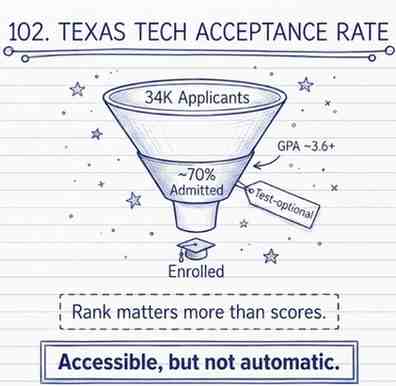
Texas Tech University's acceptance rate has held steady in the roughly 68% to 73% range over the past several years, with the most recently cited figures for the 2024–25 and 2025–26 admission cycles commonly reported between about 69% and 73%, depending on the exact source and reporting period. That places Texas Tech firmly in 'moderately selective' territory — considerably more accessible than flagship campuses like UT Austin, while still maintaining real, meaningful academic standards rather than functioning as an open-admission school.
But a single acceptance rate number, on its own, genuinely undersells how Texas Tech admissions actually works. The university publishes a structured, tiered assured admission system based on class rank and test scores, applies additional, stricter criteria for selective programs like the Rawls College of Business, the Edward E. Whitacre Jr. College of Engineering, and the Honors College, and operates under a test-optional policy that changes how much weight your GPA carries versus your SAT or ACT score. Understanding that fuller structure — not just the headline admit rate — is what actually tells you how competitive your own specific application is.
This guide covers the real, current acceptance rate and how it's trended, GPA and standardized test score ranges for admitted students, the assured admission tier system, selective-major requirements, the full application process and required documents, deadlines and fees, tuition and total cost of attendance, scholarship criteria, and concrete steps to strengthen your application.
Texas Tech's Actual Acceptance Rate
| Source | Reported Acceptance Rate |
|---|---|
| US News & World Report | 73% |
| BigFuture (College Board) | 72.64% |
| Common Data Set-based analysis (2024–25 cycle) | 69.1% |
| CollegeSimply | 71% |
| AcceptanceRate.com (2024–25 cycle) | 72.7% |
As with most college admissions statistics reported across different third-party sites, the exact figure varies slightly depending on the specific cycle being measured and how recently the source was updated — but every recent source lands within a tight band of roughly 69% to 73%, which is a genuinely consistent, reliable range to plan around. For the most current, precise figure for the cycle you're actually applying to, Texas Tech's own Common Data Set filing and official admissions site remain the most authoritative source.
For scale: in one recent cycle, Texas Tech received 34,356 applicants, admitted 24,958 of them, and ultimately enrolled 6,771 — meaning roughly 30% of admitted students chose to enroll (the school's yield rate), a detail worth knowing since it reflects how many admitted students Texas Tech is typically competing for against other schools those same students applied to.
GPA Requirements: What Admitted Students Actually Look Like
- Average unweighted GPA among admitted students: commonly cited between roughly 3.6 and 3.76 on a 4.0 scale.
- Middle 50% weighted GPA range: roughly 3.5 to 4.0 for recent cycles.
- Roughly 75% of admitted students land at or above a 3.50 unweighted GPA, with the single largest band sitting between 3.50 and 3.74.
- Only a small share of admits — roughly 7% in recent Common Data Set figures — fall below a 3.25 unweighted GPA.
- Since Texas Tech is currently test-optional, GPA carries proportionally more weight in the review process than it would at a school requiring standardized test scores from every applicant.
SAT and ACT Score Ranges
| Test | Middle 50% Range (Admitted Students) | Reported Average |
|---|---|---|
| SAT (Composite) | Roughly 1090–1280 (some sources cite 1070–1270) | Approximately 1155–1195 |
| ACT (Composite) | 23–28 | Approximately 25–26 |
- Texas Tech operates a test-optional policy for first-year applicants — submitting SAT or ACT scores is entirely your choice, and choosing not to submit does not count against your application.
- For the 2025–26 cycle, roughly 44% of applicants submitted some test score (about 33% submitted the SAT, 11% the ACT), meaning a majority of applicants are currently applying without standardized test scores at all.
- If you do submit scores, they're factored into your academic review alongside GPA and class rank, and they specifically matter for assured admission tiers and certain scholarship criteria, covered below.
- Without submitted scores, your file is reviewed holistically, based primarily on your transcript, course rigor, GPA, and class rank.
Assured Admission: The Tiered System Texas Tech Actually Uses
This is the part of Texas Tech's admissions process most general 'acceptance rate' articles skip entirely, and it's genuinely useful to understand: Texas Tech publishes a tiered assured admission model based on your high school class rank, combined with your test score if you choose to submit one.
- Top 10% of your graduating class: generally qualifies for assured admission with no minimum test score requirement.
- Lower class rank tiers: progressively require higher test scores to meet assured admission criteria as class rank standing decreases.
- Selective majors carry stricter requirements: programs including the Rawls College of Business, the Edward E. Whitacre Jr. College of Engineering, the Honors College, and select Arts & Sciences and Human Sciences programs only admit students who specifically meet assured admission criteria for that program — meeting the general university-wide bar alone isn't automatically sufficient for these specific colleges.
- Practical implication: if you're targeting a selective major like engineering or business, aim toward the upper end of the middle 50% SAT/ACT range rather than the lower end, since these specific programs apply a meaningfully higher effective bar than the university's overall acceptance rate suggests.
Application Process, Deadlines, and Fees
- Application platforms: apply through either ApplyTexas or the Common Application — both are accepted for first-year admission.
- Application fee: $75, non-refundable, payable online through ApplyTexas or via a separate secure payment portal for other application types.
- Fee waivers: available for students demonstrating financial need. Texas Tech participates in the College Board fee waiver program and accepts NACAC fee waiver forms, as well as ACT, SAT, and Common App fee waivers specifically for first-time freshman applicants.
- Regular Decision deadline: commonly cited as August 1, though Texas Tech also emphasizes applying earlier for priority consideration for scholarships and housing.
- Scholarship priority timing: many automatic merit scholarships specifically require admission before April 15 to qualify, making an earlier application meaningfully advantageous beyond just admission odds alone.
- Required documents: a completed application and fee (or waiver), your official high school transcript including class rank where available, and — depending on whether you choose to submit them — self-reported or official SAT/ACT scores.
- Essay/personal statement: Texas Tech rates the application essay as 'Important' rather than 'Very Important' in its official reporting, generally recommended at roughly 500–650 words addressing academic interests, career goals, and fit with the university.
Tuition and Total Cost of Attendance
| Cost Category | Texas Resident | Non-Resident (Out-of-State) |
|---|---|---|
| Tuition & fees | Approximately $11,850/year | Approximately $24,150–$24,450/year |
| Room & board | Approximately $10,400–$10,800/year | Approximately $10,400–$10,800/year |
| Books & supplies | Approximately $1,200/year | Approximately $1,200/year |
| Other expenses | Approximately $4,500–$5,900/year | Approximately $4,500–$5,900/year |
| Total estimated cost of attendance | Approximately $28,000–$29,000/year | Approximately $40,000–$41,000/year |
These published figures reflect sticker price rather than net price — the actual amount a specific student pays after financial aid, grants, and scholarships is frequently lower, sometimes considerably so. It's worth using Texas Tech's own net price calculator and financial aid resources to get a realistic, personalized estimate rather than budgeting purely off the published sticker cost.
One notable cost-reduction path specifically for non-resident and international students: winning a university-awarded competitive scholarship of $1,000 or more can qualify a non-resident student for an in-state tuition waiver, effectively cutting the out-of-state tuition gap substantially for eligible students.
International Student Requirements
- English proficiency: TOEFL is required for applicants whose first language isn't English; Texas Tech also accepts IELTS Academic with a minimum overall band score of 6.5.
- Standardized tests: generally recommended but not strictly mandatory for international applicants, consistent with the university's broader test-optional policy, though specific program requirements can vary.
- Scholarships: undergraduate international students can access merit-based scholarships ranging from roughly $1,000 to $20,000+ per year, with the Competitive Scholarship Waiver specifically noted as a particularly valuable benefit given its in-state tuition qualification effect.
How Texas Tech Compares to Other Texas Public Universities
| University | General Selectivity |
|---|---|
| University of Texas at Austin | Considerably more selective, with a meaningfully lower acceptance rate than Texas Tech |
| Texas A&M University | Moderately selective, generally cited in a broadly comparable range to Texas Tech |
| Texas Tech University | Moderately selective (roughly 69%–73% acceptance rate), among the more accessible major Texas public universities by admit rate |
| University of Houston | Generally comparable moderate selectivity to Texas Tech, varying by specific program |
Texas Tech's relatively high overall acceptance rate makes it a genuinely accessible option among major Texas public universities, but that accessibility narrows considerably for specific selective majors like engineering and business, where the effective competitive bar is meaningfully higher than the university-wide figure suggests.
How to Strengthen Your Texas Tech Application
- Prioritize your GPA and course rigor above all else — Texas Tech's own reporting rates GPA as a 'Very Important' academic factor, and since the school is test-optional, a strong, consistent GPA carries proportionally more weight than it would at a test-mandatory school.
- Take honors, AP, or dual-enrollment courses where available, since admissions counselors specifically look at academic rigor, not just the raw GPA number alone.
- Aim for an upward grade trend in junior and senior year specifically, which is noted as something admissions counselors pay close attention to beyond the cumulative GPA.
- If you're targeting a selective major (business, engineering, Honors College), target the upper end of the published middle 50% test score range rather than the lower end, since these specific programs apply meaningfully stricter effective criteria.
- Apply early, ideally well before April 15, to preserve eligibility for the automatic, application-integrated merit scholarships tied to that deadline.
- Decide deliberately whether to submit test scores: if your scores are at or above the middle 50% range, submitting them can strengthen your file and assured admission/scholarship eligibility; if they're below that range, the test-optional policy genuinely allows you to omit them without penalty.
- Write a genuine, specific personal statement addressing your actual academic interests and fit with Texas Tech, rather than a generic essay — while rated 'Important' rather than 'Very Important,' it can meaningfully help borderline applications.
Conclusion
Texas Tech's acceptance rate — consistently reported in the roughly 69% to 73% range across recent cycles — makes it a genuinely accessible major Texas public university at the headline level, but the fuller picture is more layered than that single number suggests. A tiered assured admission system based on class rank and test scores, meaningfully stricter requirements for selective programs like the Rawls College of Business and Whitacre College of Engineering, and a test-optional policy that shifts real weight onto GPA and course rigor all shape what your actual, individual odds look like far more precisely than the overall admit rate alone.
If you're building your own application, the most useful next step is comparing your specific GPA, class rank, and (if you're submitting them) test scores against the assured admission tiers and, if relevant, your target major's specific requirements — not just the university-wide acceptance rate — since that's what will actually determine how competitive your particular application is.
FAQ
Frequently Asked Questions
What is Texas Tech's acceptance rate?+
Recent sources report Texas Tech's acceptance rate consistently between roughly 69% and 73% for the 2024–25 and 2025–26 admission cycles, with the exact figure varying slightly depending on the specific source and reporting period. This makes Texas Tech a moderately selective, comparatively accessible major Texas public university.
What GPA do you need to get into Texas Tech?+
Admitted students average an unweighted GPA commonly cited between roughly 3.6 and 3.76, with about 75% of admits landing at or above a 3.50 unweighted GPA. Since Texas Tech is test-optional, GPA and course rigor carry significant weight in the admissions review regardless of whether you submit standardized test scores.
Is Texas Tech test-optional?+
Yes. Texas Tech maintains a test-optional policy for first-year applicants, meaning submitting SAT or ACT scores is entirely a candidate's choice, and choosing not to submit doesn't count against the application. For the 2025–26 cycle, roughly 44% of applicants submitted some test score, meaning a majority applied without one.
What SAT/ACT scores does Texas Tech require?+
There's no strict minimum requirement given the test-optional policy, but the middle 50% range for admitted students who do submit scores is commonly cited as roughly 1090–1280 for the SAT and 23–28 for the ACT, with average scores around 1155–1195 SAT and 25–26 ACT.
What is assured admission at Texas Tech?+
Assured admission is a tiered system based primarily on high school class rank, combined with test score (if submitted). Students in the top 10% of their graduating class generally qualify with no minimum test score requirement, while lower class rank tiers require progressively higher test scores to meet the assured admission bar.
Is it harder to get into Texas Tech's business or engineering programs?+
Yes. The Rawls College of Business, the Edward E. Whitacre Jr. College of Engineering, the Honors College, and select Arts & Sciences and Human Sciences programs only admit students who specifically meet assured admission criteria for that particular program — a meaningfully stricter effective bar than the university's overall acceptance rate suggests.
What is the application deadline for Texas Tech?+
The Regular Decision deadline is commonly cited as August 1, though applying earlier is strongly advised, since many automatic merit scholarships specifically require admission before April 15 to qualify.
What is the application fee for Texas Tech?+
The application fee is $75, non-refundable, submitted through ApplyTexas or the Common App. Fee waivers are available for students demonstrating financial need, including through the College Board fee waiver program, NACAC forms, and ACT/SAT/Common App fee waivers for first-time freshman applicants.
How much does Texas Tech cost?+
For recent academic years, Texas resident tuition and fees are approximately $11,850, with a total estimated cost of attendance (including room, board, books, and other expenses) around $28,000–$29,000 per year. Non-resident tuition runs approximately $24,150–$24,450, with a total estimated cost of attendance around $40,000–$41,000 per year. These are published sticker prices; actual net cost after financial aid and scholarships is often lower.
Does Texas Tech require an essay?+
Texas Tech rates the application essay as 'Important,' though not 'Very Important,' in its official reporting. A personal statement of roughly 500–650 words addressing academic interests, career goals, and fit with the university is generally recommended, and it can meaningfully help borderline applications even though it carries less weight than GPA and class rank.